Desert Park Estates, Palm Springs
Updated · 1,513 residents
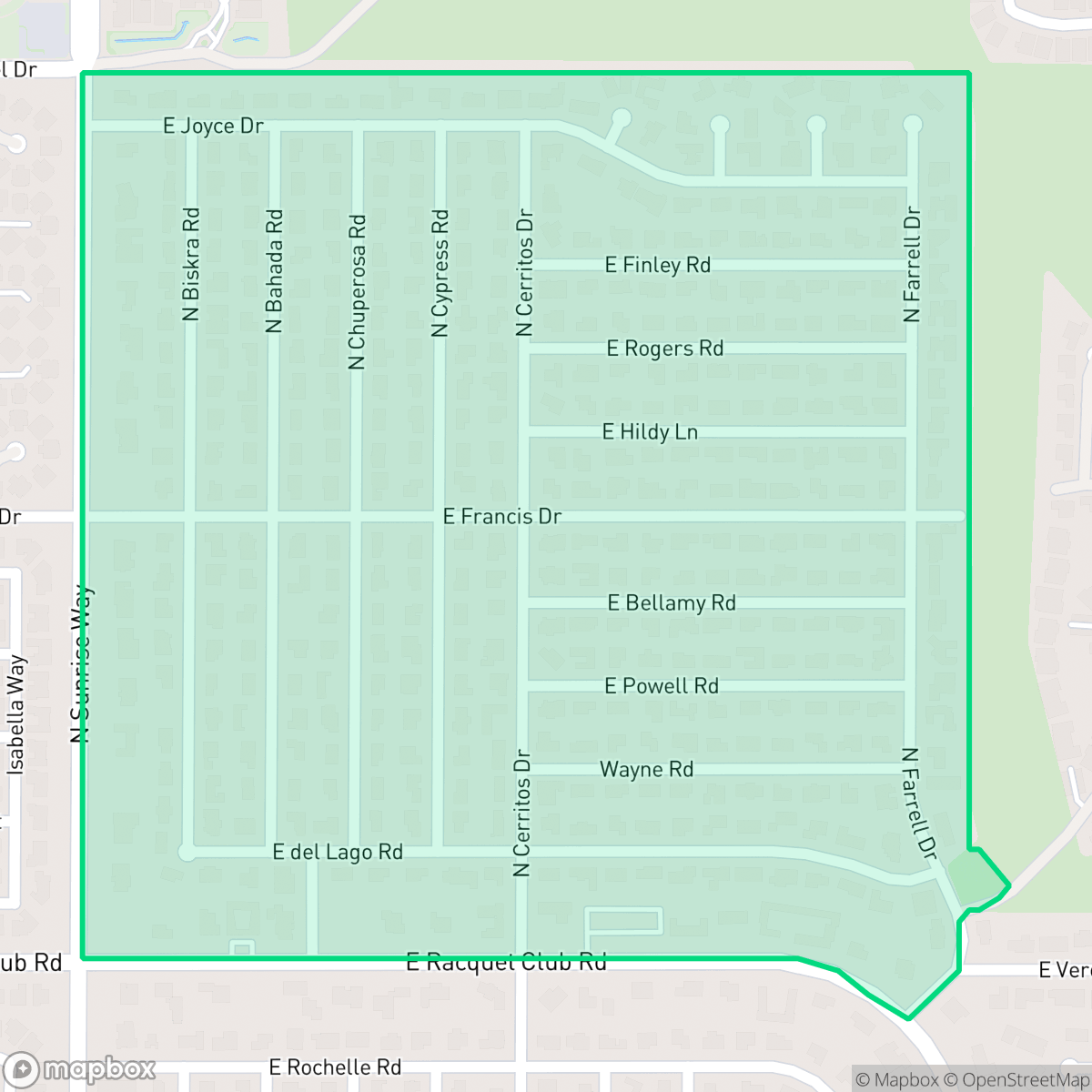
Desert Park Estates is a serene residential enclave in northeast Palm Springs defined by its collection of midcentury modern homes and fee-simple land ownership. The area offers a quiet, suburban atmosphere with walkable streets, though residents should expect moderate noise levels primarily driven by regional road traffic and aviation.
Key Highlights
About Desert Park Estates
Developed in the late 1950s, the Desert Park Estates neighborhood (originally known as Ranch Club Estates) began when developer Noel Clarke transformed 1,000 acres in northeast Palm Springs into the Ranch Club. Clarke commissioned midcentury architect Hugh Kaptur to design low-slung, post-and-beam homes with gently sloped roofs. Built primarily between 1959 and 1965, these residences were highly insulated to withstand the harsh desert winds. The neighborhood evolved into an architecturally eclectic enclave, featuring midcentury modern ranch models by the Alexander Construction Company and rare, open-concept homes by developer Jack Meiselman. A key local landmark is the Albert Frey-designed Monkey Tree Hotel, built in 1960. Unlike many Palm Springs neighborhoods situated on leased tribal land, Desert Park Estates is highly distinct for its fee-simple land ownership.
This neighborhood serves as a peaceful retreat characterized by its open green spaces and low-density residential layout. It maintains a distinct identity through its architectural variety, which includes post-and-beam designs and open-concept floor plans that prioritize indoor-outdoor living. According to iHuus data, the area benefits from high health insurance coverage and excellent air quality, making it a stable environment for long-term residents who value a quiet, suburban pace of life over high-density urban activity. The neighborhood is notably free from industrial encroachment, maintaining a consistent residential character throughout its borders.
Prospective residents should consider that while the area is quite walkable, it lacks a dense concentration of local businesses, requiring travel for daily errands. The acoustic environment is influenced by its proximity to flight paths and local roads, resulting in a moderate noise profile. Those seeking a community with high fire safety standards may find the area challenging, as current data indicates significant risks in this regard. It is best suited for individuals who prioritize architectural heritage and a calm, residential setting over proximity to commercial hubs or nightlife.
Neighborhood Scores Across 15 Qualities
Residential spacing is consistent with the Palm Springs average, offering a mix of separated structures and some denser multi-unit clusters. Most homes provide a moderate buffer between neighbors according to iHuus data.
Continuous sidewalks and low-traffic cul-de-sacs provide a safe environment for pedestrians. This level of accessibility is slightly higher than the Palm Springs average, according to iHuus data.
Large homes featuring private pools and tennis courts contribute to a high level of visual appeal that is slightly above the Palm Springs average. According to iHuus data, the presence of premium amenities and spacious lots creates an intentionally polished landscape.
Central park access and consistent sidewalk verges provide adequate space for walking pets; however, overall amenities for dogs are slightly below the Palm Springs average.
Residential areas feature a medium-density suburban layout with single-family homes and shared amenities. This setting is slightly less open than the typical landscape found across Palm Springs.
Residential life here is peaceful and low-density, featuring a balance of green space and quiet streets. While a few local social hubs are present, the area lacks significant commercial activity and maintains a steady rhythm similar to the rest of Palm Springs.
Steady traffic sounds from a nearby busy street are noticeable, though the acoustic environment remains more tranquil than the average for Palm Springs according to iHuus data.
Air quality remains consistently high with rare instances of elevated readings. This level of air purity is slightly above the Palm Springs average, according to iHuus data.
Industrial activity is entirely absent from this area, providing a strictly residential environment that is even more secluded from warehouses and facilities than the Palm Springs average.
Health insurance access among residents is notably higher than the Palm Springs average, according to iHuus data.
Voting patterns and census indicators show a predominantly liberal community that is slightly more aligned with these values than the Palm Springs average, according to iHuus data.
Older adults represent the majority of the population here, which aligns with the broader age distribution seen across Palm Springs.
Flood safety levels in this area are notably higher than the Palm Springs average, though some residual risk remains due to being within a 500-year floodplain.
Address-Level Insights for Desert Park Estates


iHuus Neighborhood Intelligence Insights
Get address-level neighborhood insights for Desert Park Estates
- Street-level scores — see how individual blocks compare, not just neighborhood averages
- Micro-zone boundaries — identify quiet pockets, flood boundaries, and walkable clusters before you visit
- 15 dimensions in full — walkability, noise, air quality, school quality, insurance coverage, population age profile, urban/rural index, and more
- Boundary risk alerts — know if your address sits near a block boundary where scores drop, the kind of detail no listing will ever mention
- School insights — individual school ratings and insights, not just district-level data
- Compare before you commit — side-by-side data across neighborhoods, down to block precision
No credit card required
Compare with Any Neighborhood
| Dimension | Desert Park Estates | Andreas Hills |
|---|---|---|
| 🚶 Walkabilityavg 8.06 | ||
| 🔊 Acoustic Comfortavg 3.6 | ||
| 🤫 Privacy Indexavg 6 | ||
| 🎨 Visual Appealavg 7.66 | ||
| 🐕 Dog Friendlinessavg 6.14 | ||
| 🗺️ Urban-Rural Indexavg 7.27 | ||
| ✨ Neighborhood Vibeavg 4.76 | ||
| 🏥 Health Insurance Coverageavg 7.38 | ||
| 🌿 Air Qualityavg 8.11 | ||
| 🏭 Industrial Proximityavg 9.12 | ||
| 🌊 Flood Safetyavg 5.92 | ||
| 🗳️ Ideological Leanavg 9.69 | ||
| 👥 Population Age Profileavg 6.29 | ||
| 🔥 Fire Safetyavg 0.39 | ||
| 🏫 School Quality |
Desert Park Estates Rankings
School Districts Serving Desert Park Estates
School Insights for Desert Park Estates
Below average outcomes; significant attendance and academic challenges.
School Insights
See what's really behind every school rating near Desert Park Estates
- Individual school ratings — each school's own score with outcome context, not just a district average
- Enrollment & class size data — student-to-teacher ratio and how it compares to the state average
- Full demographics breakdown — ethnicity and gender composition for every school in the enrollment zone
- Every school in the district — all schools within the enrollment boundary ranked by rating, not just the closest one
- Grade levels & benchmarks — elementary through high school, with below/above state-average flags
No credit card required