Desert Highland/Gateway, Palm Springs
Updated · 1,113 residents
Desert Highland/Gateway is a quiet, semi-rural enclave at the northern edge of Palm Springs known for its distinctive Desert Modernist architecture. The area offers a spacious, residential environment with high air quality, though residents should be prepared for significant noise from nearby transit corridors and a heightened risk of wildfires.
Key Highlights
About Desert Highland/Gateway
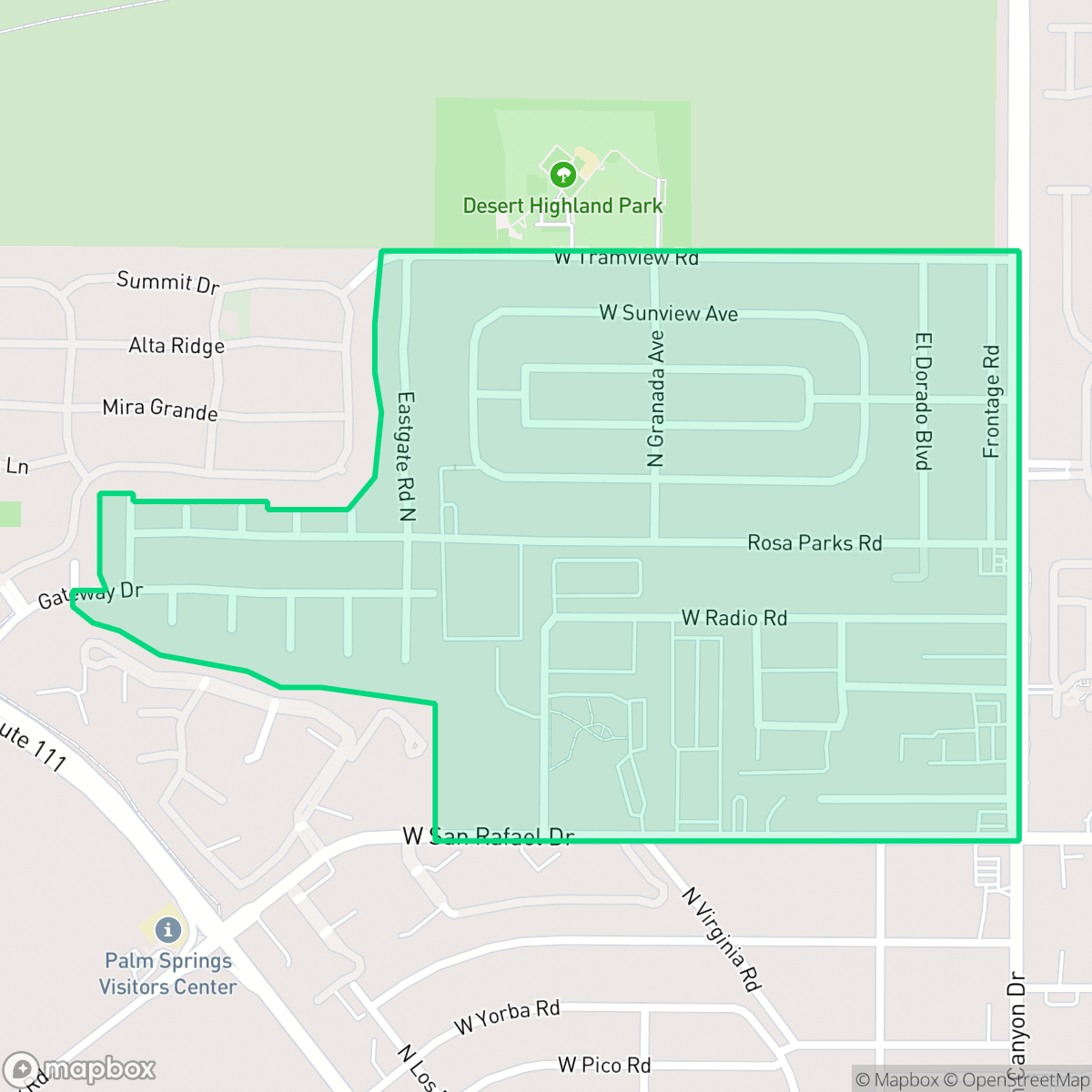
Desert Highland Gateway Estates, located at the northernmost edge of Palm Springs, is a historically significant neighborhood established between 1959 and 1961 by the Southland Development Co. It emerged as a vital community for Black families displaced during the mid-century razing of Section 14, a segregated area on tribal land. The neighborhood features approximately 70 homes characterized by Desert Modernism, including post-and-beam construction, floor-to-ceiling windows, and decorative concrete blocks. It is closely linked to the legacy of Lawrence Crossley, a prominent Black entrepreneur who facilitated homeownership for Black residents in an era of systemic exclusion. The James O. Jessie Desert Highland Unity Center serves as the neighborhood's cultural and social hub, anchoring a community that remains a cornerstone of Palm Springs' Black history and ongoing efforts to preserve cultural heritage through land trusts and community-led initiatives.
The neighborhood maintains a distinct identity through its large residential lots and polished streetscapes that reflect a semi-rural atmosphere. As a purely residential zone, it avoids the intrusion of industrial facilities, offering a peaceful visual character that stands out within the city. The layout encourages a steady, mixed-use rhythm where residents enjoy a sense of space and separation between properties that exceeds the density found in more central parts of Palm Springs.
Living in this area involves specific trade-offs regarding environmental and acoustic factors. While the air quality is consistently high, the proximity to railroad tracks and major highways results in frequent noise levels that are significantly higher than the city average. Furthermore, the area is subject to extreme wildfire risks, necessitating proactive safety measures for homeowners. Prospective residents should also consider that the local school district, while offering specialized career programs, faces challenges with academic consistency across its various campuses.
Neighborhood Scores Across 15 Qualities
Residential spacing is consistent with the Palm Springs average, providing a balanced mix of open areas and proximity to neighbors. According to iHuus data, the neighborhood offers a moderate level of separation between adjacent properties.
Sidewalks are available on one side of the streets and safe crossings are provided for pedestrians. This level of walkability is slightly below the average for Palm Springs.
Large residential lots and frequent upscale amenities contribute to a visual character that is slightly more polished than the Palm Springs average, according to iHuus data.
Access to dedicated public parks and wide green verges is somewhat restricted in this area. According to iHuus data, dog-friendly infrastructure is slightly below the Palm Springs average.
Open land and scattered homes provide a more rural atmosphere than much of Palm Springs. According to iHuus data, this area features more undeveloped space and less density than the city average.
Daily activity levels are consistent with the city average, offering a balance of suburban residential life and scattered local services. Some pockets feature accessible social spots and galleries, while other areas remain quiet and more rural in character.
Frequent noise from nearby railroad tracks and major freeways characterizes this area. Levels of acoustic disturbance are significantly higher than the Palm Springs average, according to iHuus data.
Air quality remains consistently high with rare instances of elevated readings. This level of air purity is consistent with the rest of Palm Springs.
No warehouses, industrial facilities, or hazard sites are detected within the area. This residential environment is consistent with the broader Palm Springs average.
Health insurance access is notably higher here than the Palm Springs average, according to iHuus data. Most residents in the area are covered by a health insurance plan.
Voting patterns and census indicators show a highly liberal political leaning that is consistent with the broader Palm Springs area, according to iHuus data.
Residents experience a varied demographic landscape featuring a blend of young adults, families, and seniors. This age distribution is slightly more varied than the typical profile found across Palm Springs, according to iHuus data.
Flood risk in this area is notably lower than the Palm Springs average, though some residual risk remains due to its location within a 500-year floodplain. According to iHuus data, the area is generally more secure against major flooding events than many other parts of the city.
Wildfire hazards are significantly higher here than the Palm Springs average, requiring residents to maintain rigorous fire prevention and protection measures. According to iHuus data, the area faces extreme vulnerabilities to fire incidents.
Address-Level Insights for Desert Highland/Gateway


iHuus Neighborhood Intelligence Insights
Get address-level neighborhood insights for Desert Highland/Gateway
- Street-level scores — see how individual blocks compare, not just neighborhood averages
- Micro-zone boundaries — identify quiet pockets, flood boundaries, and walkable clusters before you visit
- 15 dimensions in full — walkability, noise, air quality, school quality, insurance coverage, population age profile, urban/rural index, and more
- Boundary risk alerts — know if your address sits near a block boundary where scores drop, the kind of detail no listing will ever mention
- School insights — individual school ratings and insights, not just district-level data
- Compare before you commit — side-by-side data across neighborhoods, down to block precision
No credit card required
Compare with Any Neighborhood
| Dimension | Desert Highland/Gateway | Andreas Hills |
|---|---|---|
| 🚶 Walkabilityavg 8.06 | ||
| 🔊 Acoustic Comfortavg 3.6 | ||
| 🤫 Privacy Indexavg 6 | ||
| 🎨 Visual Appealavg 7.66 | ||
| 🐕 Dog Friendlinessavg 6.14 | ||
| 🗺️ Urban-Rural Indexavg 7.27 | ||
| ✨ Neighborhood Vibeavg 4.76 | ||
| 🏥 Health Insurance Coverageavg 7.38 | ||
| 🌿 Air Qualityavg 8.11 | ||
| 🏭 Industrial Proximityavg 9.12 | ||
| 🌊 Flood Safetyavg 5.92 | ||
| 🗳️ Ideological Leanavg 9.69 | ||
| 👥 Population Age Profileavg 6.29 | ||
| 🔥 Fire Safetyavg 0.39 | ||
| 🏫 School Quality |
Desert Highland/Gateway Rankings
School Districts Serving Desert Highland/Gateway
School Insights for Desert Highland/Gateway
Below average outcomes; significant attendance and academic challenges.
School Insights
See what's really behind every school rating near Desert Highland/Gateway
- Individual school ratings — each school's own score with outcome context, not just a district average
- Enrollment & class size data — student-to-teacher ratio and how it compares to the state average
- Full demographics breakdown — ethnicity and gender composition for every school in the enrollment zone
- Every school in the district — all schools within the enrollment boundary ranked by rating, not just the closest one
- Grade levels & benchmarks — elementary through high school, with below/above state-average flags
No credit card required