Demuth Park, Palm Springs
Updated · 1,942 residents
Demuth Park is a highly walkable residential area defined by its expansive public green space and dense suburban layout. The neighborhood offers a strong community identity, though residents should be aware of localized noise from road traffic and the presence of nearby municipal infrastructure.
Key Highlights
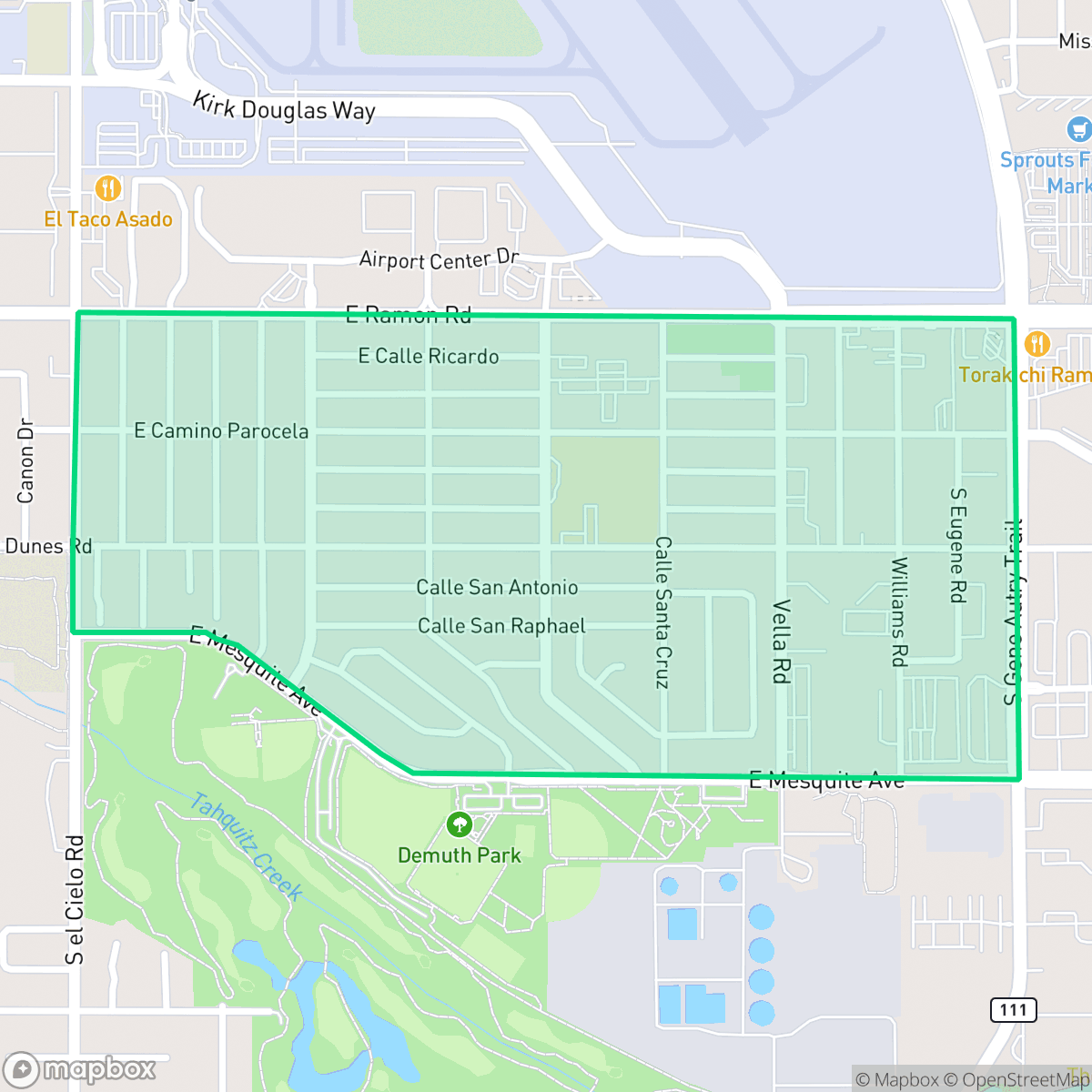
About Demuth Park
Developed immediately after World War II, the Demuth Park neighborhood in south Palm Springs was originally established as the "Veterans Tract". It served as the city's first major postwar housing development, designed to provide affordable midcentury modern and ranch-style homes for returning military personnel. The neighborhood was later renamed to honor Adolf Demuth, a local benefactor whose bequest funded the creation of the adjacent 61-acre Demuth Park—the city's largest public park and community center. Over the decades, the area's affordability and creative spirit have attracted a diverse mix of residents, including midcentury artists and entertainers like actor Robert Dix, composer Paul Sawtell, and big band singer Eadie Adams.
The neighborhood functions as a dense suburban enclave in south Palm Springs, characterized by its high walkability and strong visual appeal. It is anchored by the 61-acre park that serves as a central hub for outdoor recreation and community gatherings. According to iHuus data, the area maintains a consistent aesthetic and remains a popular choice for those who prioritize pedestrian access to local amenities and a cohesive residential environment.
Prospective residents should consider certain livability trade-offs, including moderate noise levels from road traffic and the proximity of a wastewater treatment plant. The area faces specific environmental challenges, such as elevated fire and flood risks, which are important factors for long-term planning. Educational options are provided by the Palm Springs Unified School District and the local Cielo Vista Charter, both of which operate with moderate performance ratings. Overall, the neighborhood is best suited for those seeking a highly connected, community-oriented environment who are comfortable with the realities of living near municipal utility footprints.
Neighborhood Scores Across 15 Qualities
Residential structures feature yards that provide a buffer between neighbors, maintaining a density that is consistent with the Palm Springs average.
Pedestrian safety is a primary feature here due to consistent sidewalks on both sides of residential streets and ample crossings. This level of walkability is significantly higher than the Palm Springs average, according to iHuus data.
Large homes and frequent private backyard pools create a highly manicured landscape that is slightly more visually appealing than the Palm Springs average. According to iHuus data, the presence of spacious driveways and upscale amenities contributes to a premium residential feel.
Private fencing and narrow sidewalk verges restrict accessible green space for pets. According to iHuus data, the availability of walking space for dogs is slightly below the Palm Springs average.
Open land and scattered residential pockets exist alongside industrial warehouses and airport facilities. This area is slightly less developed than the typical Palm Springs urban landscape, according to iHuus data.
Low-density industrial and suburban layouts make most dining and retail options difficult to reach without a vehicle. This area is notably less active than the Palm Springs average, offering a serene environment centered around scattered green spaces and light commercial units.
Frequent noise from nearby transit corridors and flight paths creates a louder environment than the Palm Springs average, according to iHuus data.
Air quality remains consistently good with rare instances of elevated readings, performing very similarly to the Palm Springs average according to iHuus data.
Active commercial zones and light industrial warehouses are integrated with residential streets, making the industrial density significantly higher than the Palm Springs average. Residents should expect proximity to logistics docks, a wastewater treatment facility, and noise from nearby airport runways.
Health insurance coverage among residents is high and stays roughly in line with the average for Palm Springs. According to iHuus data, most inhabitants in this area are covered by a health plan.
Voting patterns and census indicators show a highly liberal political leaning, which is consistent with the broader Palm Springs area.
Residents are predominantly older adults, though a modest younger population is also present. This age profile is largely consistent with the average seen across Palm Springs.
Some residual flood risk exists within this area due to its location in a 500-year floodplain; however, safety levels remain higher than the Palm Springs city average according to iHuus data.
Address-Level Insights for Demuth Park


iHuus Neighborhood Intelligence Insights
Get address-level neighborhood insights for Demuth Park
- Street-level scores — see how individual blocks compare, not just neighborhood averages
- Micro-zone boundaries — identify quiet pockets, flood boundaries, and walkable clusters before you visit
- 15 dimensions in full — walkability, noise, air quality, school quality, insurance coverage, population age profile, urban/rural index, and more
- Boundary risk alerts — know if your address sits near a block boundary where scores drop, the kind of detail no listing will ever mention
- School insights — individual school ratings and insights, not just district-level data
- Compare before you commit — side-by-side data across neighborhoods, down to block precision
No credit card required
Compare with Any Neighborhood
| Dimension | Demuth Park | Andreas Hills |
|---|---|---|
| 🚶 Walkabilityavg 8.06 | ||
| 🔊 Acoustic Comfortavg 3.6 | ||
| 🤫 Privacy Indexavg 6 | ||
| 🎨 Visual Appealavg 7.66 | ||
| 🐕 Dog Friendlinessavg 6.14 | ||
| 🗺️ Urban-Rural Indexavg 7.27 | ||
| ✨ Neighborhood Vibeavg 4.76 | ||
| 🏥 Health Insurance Coverageavg 7.38 | ||
| 🌿 Air Qualityavg 8.11 | ||
| 🏭 Industrial Proximityavg 9.12 | ||
| 🌊 Flood Safetyavg 5.92 | ||
| 🗳️ Ideological Leanavg 9.69 | ||
| 👥 Population Age Profileavg 6.29 | ||
| 🔥 Fire Safetyavg 0.39 | ||
| 🏫 School Quality |
Demuth Park Rankings
School Districts Serving Demuth Park
School Insights for Demuth Park
Below average outcomes; significant attendance and academic challenges.
School Insights
See what's really behind every school rating near Demuth Park
- Individual school ratings — each school's own score with outcome context, not just a district average
- Enrollment & class size data — student-to-teacher ratio and how it compares to the state average
- Full demographics breakdown — ethnicity and gender composition for every school in the enrollment zone
- Every school in the district — all schools within the enrollment boundary ranked by rating, not just the closest one
- Grade levels & benchmarks — elementary through high school, with below/above state-average flags
No credit card required