Canyon Corridor, Palm Springs
Updated · 596 residents
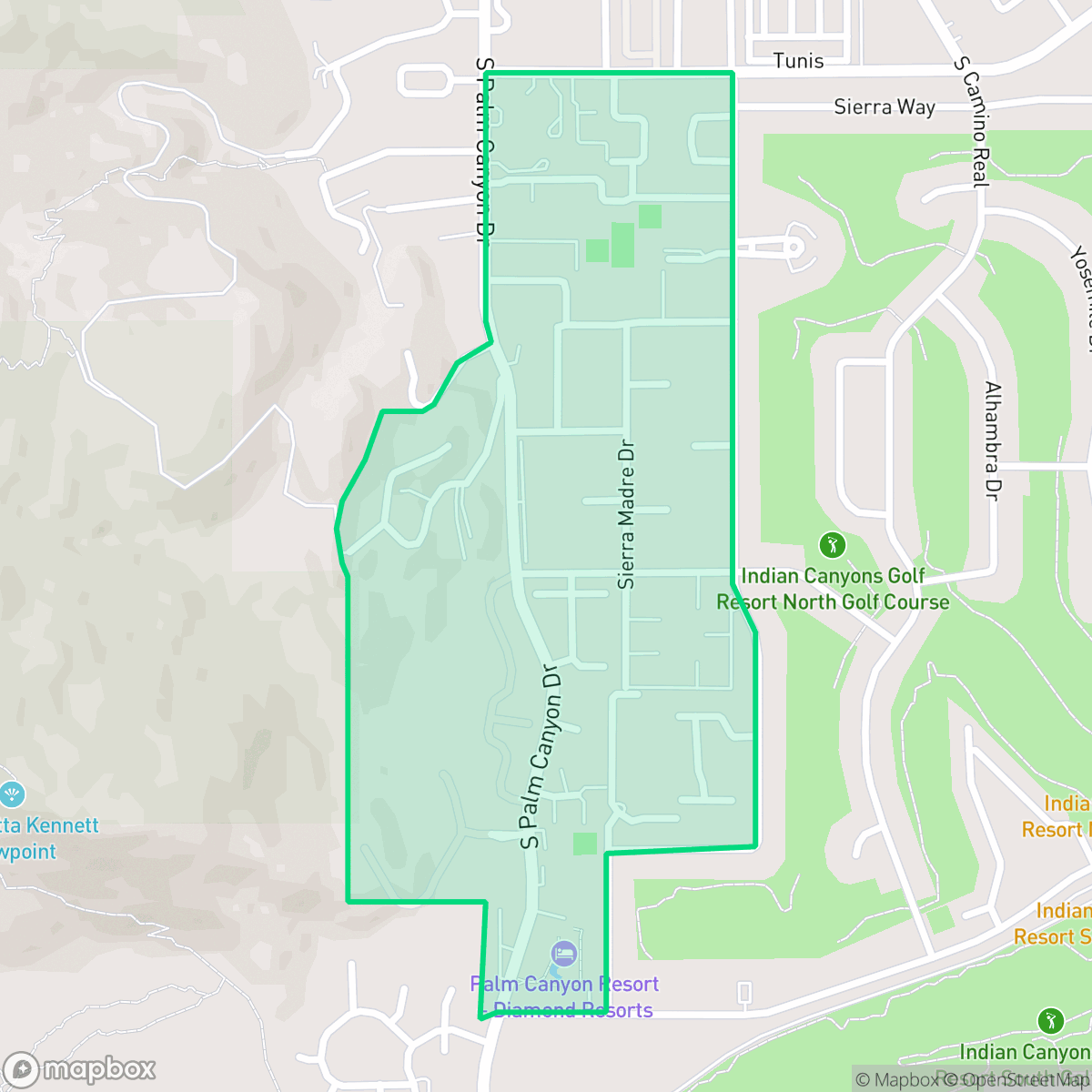
Canyon Corridor is a vibrant south Palm Springs neighborhood characterized by high visual appeal and a lively social atmosphere. While the area offers excellent air quality and high health insurance coverage, residents should anticipate moderate road noise and a car-dependent lifestyle.
Key Highlights
About Canyon Corridor
Once undeveloped open land in the 1950s, the Canyon Corridor neighborhood in south Palm Springs was transformed by visionary developer Roy Fey into a hub of pioneering, resort-style condominium living. Fey's early projects in the area included the 1958 Desert Skies Apartment Hotel, one of the city's first condominium concepts, and the 1964 Villa Roma complex, an architecturally significant, Roman-themed historic district. The neighborhood is celebrated for its rich stock of midcentury modern architecture. Notable landmarks include the iconic Canyon View Estates, designed by William Krisel and Dan Palmer with signature umbrella ceilings and clerestory windows, and the Royal Hawaiian Estates, designed by Donald Wexler and Richard Harrison, which uniquely blends modernist design with Polynesian tiki motifs.
The neighborhood functions as a lively residential hub that balances suburban density with open green spaces. According to iHuus data, the area maintains a high level of visual appeal, benefiting from its proximity to natural landscapes and well-maintained streets. It attracts a mature demographic, which is reflected in its stable population age profile and strong health insurance coverage rates. The community vibe is notably more active than the city average, providing a social environment that complements the distinct architectural character of the surroundings.
Living in this area requires a vehicle, as the neighborhood remains largely car-dependent despite its aesthetic appeal. Residents experience moderate noise levels primarily driven by road traffic, though the absence of industrial activity contributes to a generally quiet residential environment. Prospective residents should be aware of the specific fire safety challenges common to the region, as well as the academic performance variations within the local school district, which currently faces challenges with consistency across its feeder schools.
Neighborhood Scores Across 15 Qualities
Residential spacing offers a balanced amount of buffer between neighbors, which is slightly higher than the Palm Springs average. This density provides a mix of open space and proximity to adjacent properties.
Pedestrian movement is easy due to safe crossings and sidewalks present on one side of the street. This level of accessibility is slightly above the Palm Springs average, according to iHuus data.
Large residential properties and frequent upscale amenities create a highly pleasing environment that is more visually polished than the Palm Springs average, according to iHuus data.
Connected green spaces and wide, traffic-safe paths make this area more accommodating for pet owners than the Palm Springs average, according to iHuus data.
Frequent open land and scattered homes among woodland create a semi-rural atmosphere that is very similar to the Palm Springs city average. Residents can expect a landscape defined by natural spaces and lower density than more urbanized areas.
Residential life here features a mix of quiet, low-density pockets and lively blocks with accessible amenities. According to iHuus data, the area offers slightly more social and leisure activity than the typical Palm Springs neighborhood, though much of the landscape remains serene and car-dependent.
Acoustic levels remain low with only sporadic sounds from distant traffic or infrequent trains. This area is significantly quieter than the typical Palm Springs neighborhood, according to iHuus data.
Air quality is consistently high with rare instances of elevated readings, performing slightly better than the Palm Springs average according to iHuus data.
No warehouses, industrial facilities, or hazard sites are present within this area. According to iHuus data, this neighborhood remains exclusively residential and is notably clearer of industrial proximity than the Palm Springs average.
Health insurance accessibility is strong in this area, with coverage rates notably higher than the Palm Springs average according to iHuus data.
Voting patterns and census indicators show a predominantly liberal political leaning that is slightly more pronounced than the Palm Springs average.
Older adults make up the majority of the population here, representing a significantly more mature demographic than the Palm Springs average. This creates a quieter residential atmosphere with a smaller presence of young children and families.
Residual flood risk exists due to being located within a 500-year floodplain; however, safety levels remain notably higher than the Palm Springs average according to iHuus data.
Wildfire danger is exceptionally high in this area, representing a more severe hazard than the typical Palm Springs neighborhood. Residents should maintain rigorous fire prevention and protection measures according to iHuus data.
Address-Level Insights for Canyon Corridor


iHuus Neighborhood Intelligence Insights
Get address-level neighborhood insights for Canyon Corridor
- Street-level scores — see how individual blocks compare, not just neighborhood averages
- Micro-zone boundaries — identify quiet pockets, flood boundaries, and walkable clusters before you visit
- 15 dimensions in full — walkability, noise, air quality, school quality, insurance coverage, population age profile, urban/rural index, and more
- Boundary risk alerts — know if your address sits near a block boundary where scores drop, the kind of detail no listing will ever mention
- School insights — individual school ratings and insights, not just district-level data
- Compare before you commit — side-by-side data across neighborhoods, down to block precision
No credit card required
Compare with Any Neighborhood
| Dimension | Canyon Corridor | Andreas Hills |
|---|---|---|
| 🚶 Walkabilityavg 8.06 | ||
| 🔊 Acoustic Comfortavg 3.6 | ||
| 🤫 Privacy Indexavg 6 | ||
| 🎨 Visual Appealavg 7.66 | ||
| 🐕 Dog Friendlinessavg 6.14 | ||
| 🗺️ Urban-Rural Indexavg 7.27 | ||
| ✨ Neighborhood Vibeavg 4.76 | ||
| 🏥 Health Insurance Coverageavg 7.38 | ||
| 🌿 Air Qualityavg 8.11 | ||
| 🏭 Industrial Proximityavg 9.12 | ||
| 🌊 Flood Safetyavg 5.92 | ||
| 🗳️ Ideological Leanavg 9.69 | ||
| 👥 Population Age Profileavg 6.29 | ||
| 🔥 Fire Safetyavg 0.39 | ||
| 🏫 School Quality |
Canyon Corridor Rankings
School Districts Serving Canyon Corridor
School Insights for Canyon Corridor
Below average outcomes; significant attendance and academic challenges.
School Insights
See what's really behind every school rating near Canyon Corridor
- Individual school ratings — each school's own score with outcome context, not just a district average
- Enrollment & class size data — student-to-teacher ratio and how it compares to the state average
- Full demographics breakdown — ethnicity and gender composition for every school in the enrollment zone
- Every school in the district — all schools within the enrollment boundary ranked by rating, not just the closest one
- Grade levels & benchmarks — elementary through high school, with below/above state-average flags
No credit card required