Baristo, Palm Springs
Updated · 1,917 residents
Baristo is an exceptionally walkable neighborhood in Palm Springs, defined by its vibrant Arenas District and diverse multi-family housing. While the area offers high urban convenience and local entertainment, residents should expect notable noise levels from road traffic and a high risk of fire.
Key Highlights
About Baristo
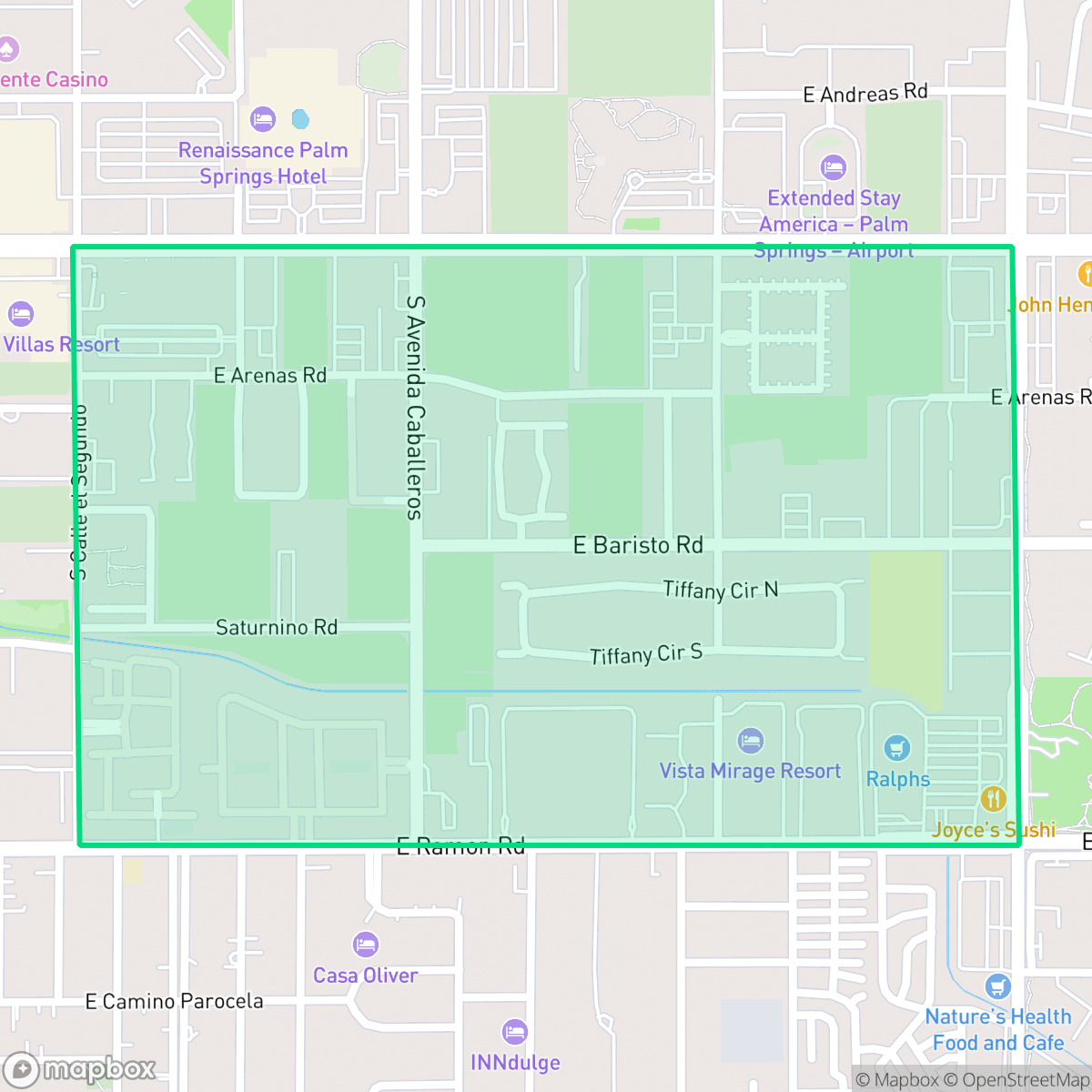
The Baristo neighborhood in Palm Springs, named for Cahuilla Tribal leader Baristo Sol Santiago (1884–1942), is situated on the historic Section 14 reservation land of the Agua Caliente Band of Cahuilla Indians. Unlike other Palm Springs neighborhoods characterized by single-family mid-century modern homes, Baristo consists primarily of multi-family condominium communities, including the Donald Wexler-designed Rose Garden. The neighborhood is home to the Arenas District along Arenas Road, a thriving LGBTQ+ business and entertainment hub. The street itself honors Lee Arenas, whose landmark 1944 U.S. Supreme Court case, *Arenas v. United States*, successfully secured individual land allotment rights for tribal members, dramatically shaping the modern development of both the neighborhood and the city.
This neighborhood functions as a central hub for dining and entertainment, particularly along the Arenas District, which serves as a significant LGBTQ+ destination. Unlike the sprawling mid-century estates found elsewhere in the city, the residential landscape here is dominated by high-density condominium complexes, including notable examples of mid-century architecture. This density contributes to a high level of walkability, allowing residents to access local services and social venues without relying on a vehicle. According to iHuus data, the area maintains a high level of liveliness, making it a focal point for those seeking an active urban environment.
The area is best suited for individuals who prioritize an active lifestyle and proximity to city amenities over quiet seclusion. Prospective residents should note that the neighborhood experiences elevated noise levels from traffic and faces significant environmental challenges, specifically regarding fire safety. While the local school district provides modern facilities and technical programs, it remains subject to academic performance inconsistencies. Overall, the community offers a dense, social environment that balances city activity with the practical realities of urban living.
Neighborhood Scores Across 15 Qualities
Residential spacing is varied, with some areas featuring shared walls in multi-family units and townhomes. This level of density is slightly higher than the Palm Springs average, according to iHuus data.
Wide sidewalks and ample crossings make much of the area easy to traverse on foot, performing above the Palm Springs average. While a grid system supports walking, certain high-traffic arterials and large parking lots can decrease comfort for pedestrians.
Residential views consist primarily of standard suburban housing and apartments featuring shared pools and boxy roof geometries. According to iHuus data, the visual appeal of this area is slightly below the Palm Springs average.
Public park access is scarce in this area, as most greenery consists of private yards or narrow residential verges. According to iHuus data, this makes the neighborhood slightly less dog friendly than the Palm Springs average.
Open land and scattered homes provide a more semi-rural atmosphere than the more densely developed parts of Palm Springs. This area features a low-density mix of apartment complexes, commercial strips, and single-family tracts according to iHuus data.
Frequent activity and a dense concentration of local eateries, galleries, and social destinations make this area significantly more lively than the Palm Springs average. Residents can find a diverse mix of leisure spots ranging from art spaces to cafes integrated within the suburban landscape.
Steady traffic hum from a nearby busy street characterizes the area. This level of acoustic activity is slightly higher than the typical noise levels found throughout Palm Springs.
Air quality is consistently high with very few instances of poor air readings. This level of cleanliness is nearly identical to the average found throughout Palm Springs.
Industrial presence is non-existent in Baristo, consisting entirely of residential and light commercial zones. This area is notably cleaner of warehouses and heavy industrial hazards than the Palm Springs average, according to iHuus data.
Health insurance coverage among residents is lower than the average seen across Palm Springs, according to iHuus data.
Voting patterns and census indicators reflect a predominantly liberal political landscape that is slightly more pronounced than the Palm Springs average.
Older adults make up the majority of the population here, though a modest number of younger residents are also present. This demographic profile is largely consistent with the average age found across Palm Springs.
Residual flood risk exists within this area as it falls within a 500-year floodplain; however, safety levels remain slightly higher than the Palm Springs city average according to iHuus data.
Address-Level Insights for Baristo


iHuus Neighborhood Intelligence Insights
Get address-level neighborhood insights for Baristo
- Street-level scores — see how individual blocks compare, not just neighborhood averages
- Micro-zone boundaries — identify quiet pockets, flood boundaries, and walkable clusters before you visit
- 15 dimensions in full — walkability, noise, air quality, school quality, insurance coverage, population age profile, urban/rural index, and more
- Boundary risk alerts — know if your address sits near a block boundary where scores drop, the kind of detail no listing will ever mention
- School insights — individual school ratings and insights, not just district-level data
- Compare before you commit — side-by-side data across neighborhoods, down to block precision
No credit card required
Compare with Any Neighborhood
| Dimension | Baristo | Andreas Hills |
|---|---|---|
| 🚶 Walkabilityavg 8.06 | ||
| 🔊 Acoustic Comfortavg 3.6 | ||
| 🤫 Privacy Indexavg 6 | ||
| 🎨 Visual Appealavg 7.66 | ||
| 🐕 Dog Friendlinessavg 6.14 | ||
| 🗺️ Urban-Rural Indexavg 7.27 | ||
| ✨ Neighborhood Vibeavg 4.76 | ||
| 🏥 Health Insurance Coverageavg 7.38 | ||
| 🌿 Air Qualityavg 8.11 | ||
| 🏭 Industrial Proximityavg 9.12 | ||
| 🌊 Flood Safetyavg 5.92 | ||
| 🗳️ Ideological Leanavg 9.69 | ||
| 👥 Population Age Profileavg 6.29 | ||
| 🔥 Fire Safetyavg 0.39 | ||
| 🏫 School Quality |
Baristo Rankings
School Districts Serving Baristo
School Insights for Baristo
Below average outcomes; significant attendance and academic challenges.
School Insights
See what's really behind every school rating near Baristo
- Individual school ratings — each school's own score with outcome context, not just a district average
- Enrollment & class size data — student-to-teacher ratio and how it compares to the state average
- Full demographics breakdown — ethnicity and gender composition for every school in the enrollment zone
- Every school in the district — all schools within the enrollment boundary ranked by rating, not just the closest one
- Grade levels & benchmarks — elementary through high school, with below/above state-average flags
No credit card required