Araby Cove, Palm Springs
Updated · 230 residents
Araby Cove offers exceptional privacy and visual appeal, defined by its rugged desert landscape and proximity to expansive natural trails. According to iHuus data, this quiet enclave functions as a rural retreat with minimal commercial activity, making it ideal for those seeking solitude over urban convenience.
Key Highlights
About Araby Cove
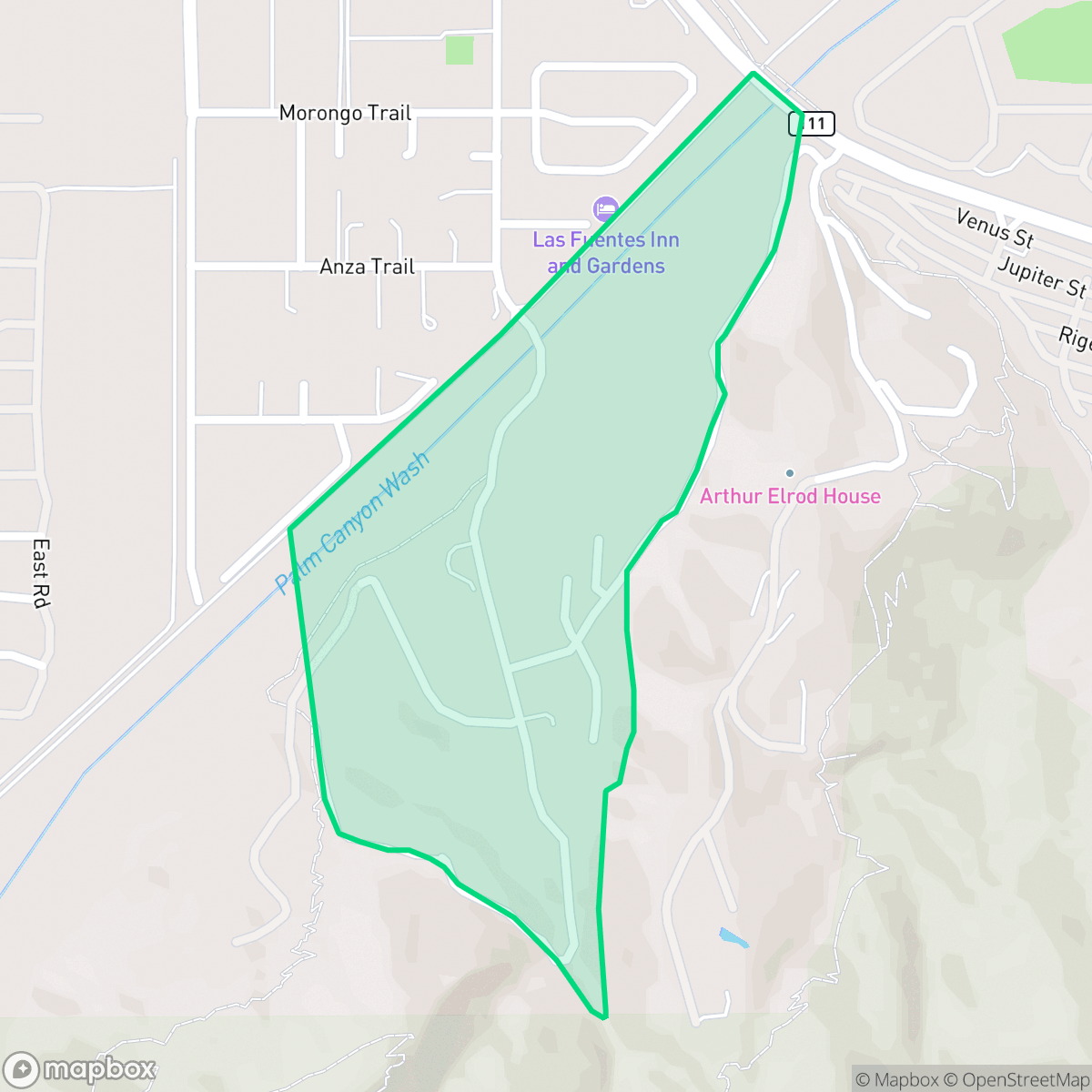
Tucked against the mountains of South Palm Springs, Araby Cove is a secluded, bohemian enclave that originated in the early 1920s when adventurous homesteaders built rustic cabins in the remote desert wash. The neighborhood is celebrated for its eclectic architecture, most notably R. Lee Miller’s 1920s "Rock Houses". Handcrafted from native stone with Hopi and Navajo design influences, these historic structures inspired local folklore falsely claiming they were built for filming The Wizard of Oz. Today, the close-knit community of around 80 homes fiercely preserves its rugged, low-density character. The popular Araby Trail begins at the edge of the cove, winding upward to offer hikers panoramic views of the valley and a close look at the iconic, flying-saucer-shaped Bob Hope House designed by John Lautner on the ridge above.
The neighborhood is a secluded residential area with significant open space, offering high air quality and a peaceful atmosphere. It maintains a distinct rural character, characterized by low density and a lack of local business development. Residents benefit from an environment that prioritizes quietude and natural beauty, with iHuus data confirming it as one of the most private and visually striking areas in Palm Springs.
While the area excels in privacy and dog friendliness, it lacks the walkability and commercial infrastructure found in more central parts of the city. Prospective residents should note that while the neighborhood provides a serene living experience, it is located within a moderate fire risk zone. The local school district remains in a period of academic transition, and the area is best suited for individuals who prioritize a quiet, nature-oriented lifestyle over immediate access to urban amenities.
Neighborhood Scores Across 15 Qualities
Large lot sizes and significant separation between properties provide a sense of seclusion that is slightly higher than the Palm Springs average. According to iHuus data, the spacing of homes in Araby Cove offers more privacy than many other areas in the city.
Sidewalks are available on one side of the street with safe crossings present, though the level of walkability is slightly below the Palm Springs average. Most local movement is manageable on foot, according to iHuus data.
Large residential properties and premium amenities provide a highly manicured landscape that is more visually polished than the Palm Springs average. According to iHuus data, the presence of expansive driveways and upscale features defines the area's aesthetic.
Access to connected green spaces and wide, traffic-safe paths makes this area more dog friendly than the Palm Springs average, according to iHuus data.
Open land and scattered homes predominate this area, providing a slightly more rural feel than most parts of Palm Springs according to iHuus data.
Low levels of commercial activity and a sparse, rural landscape create a much more tranquil atmosphere than the typical Palm Springs area. According to iHuus data, the neighborhood lacks a central social hub, consisting primarily of quiet residential streets and vast open spaces.
Steady hums from nearby busy streets characterize the area, though acoustic levels remain notably more tranquil than the Palm Springs average according to iHuus data.
Air quality remains consistently high and is on par with the rest of Palm Springs. Residents can expect mostly clean air with only rare instances of elevated readings.
Industrial facilities and warehouses are entirely absent from this area, offering a more residential environment than the Palm Springs average. According to iHuus data, the landscape consists solely of residential streets and open green spaces.
Health insurance coverage is relatively high in this area, though it sits slightly below the Palm Springs city average according to iHuus data.
Voting patterns and census indicators show a predominantly liberal political leaning that is slightly more pronounced than the Palm Springs average.
Residents live alongside a balanced demographic of young adults, families, and older individuals. This age distribution is roughly in line with the Palm Springs average according to iHuus data.
Flood risk in this area is slightly above the Palm Springs average, though a lack of detailed FEMA studies means the exact level of risk remains undetermined. Residents should remain aware of potential seasonal water fluctuations according to iHuus data.
High wildfire vulnerability characterizes this area, matching the severe fire hazard levels found across Palm Springs. Residents must prioritize maximum protection measures and strict fire safety protocols due to the extreme nature of the risk.
Address-Level Insights for Araby Cove


iHuus Neighborhood Intelligence Insights
Get address-level neighborhood insights for Araby Cove
- Street-level scores — see how individual blocks compare, not just neighborhood averages
- Micro-zone boundaries — identify quiet pockets, flood boundaries, and walkable clusters before you visit
- 15 dimensions in full — walkability, noise, air quality, school quality, insurance coverage, population age profile, urban/rural index, and more
- Boundary risk alerts — know if your address sits near a block boundary where scores drop, the kind of detail no listing will ever mention
- School insights — individual school ratings and insights, not just district-level data
- Compare before you commit — side-by-side data across neighborhoods, down to block precision
No credit card required
Compare with Any Neighborhood
| Dimension | Araby Cove | Andreas Hills |
|---|---|---|
| 🚶 Walkabilityavg 8.06 | ||
| 🔊 Acoustic Comfortavg 3.6 | ||
| 🤫 Privacy Indexavg 6 | ||
| 🎨 Visual Appealavg 7.66 | ||
| 🐕 Dog Friendlinessavg 6.14 | ||
| 🗺️ Urban-Rural Indexavg 7.27 | ||
| ✨ Neighborhood Vibeavg 4.76 | ||
| 🏥 Health Insurance Coverageavg 7.38 | ||
| 🌿 Air Qualityavg 8.11 | ||
| 🏭 Industrial Proximityavg 9.12 | ||
| 🌊 Flood Safetyavg 5.92 | ||
| 🗳️ Ideological Leanavg 9.69 | ||
| 👥 Population Age Profileavg 6.29 | ||
| 🔥 Fire Safetyavg 0.39 | ||
| 🏫 School Quality |
Araby Cove Rankings
School Districts Serving Araby Cove
School Insights for Araby Cove
Below average outcomes; significant attendance and academic challenges.
School Insights
See what's really behind every school rating near Araby Cove
- Individual school ratings — each school's own score with outcome context, not just a district average
- Enrollment & class size data — student-to-teacher ratio and how it compares to the state average
- Full demographics breakdown — ethnicity and gender composition for every school in the enrollment zone
- Every school in the district — all schools within the enrollment boundary ranked by rating, not just the closest one
- Grade levels & benchmarks — elementary through high school, with below/above state-average flags
No credit card required