Araby Commons, Palm Springs
Updated · 834 residents
Araby Commons is a quiet, residential enclave in South Palm Springs characterized by its mix of historic estates and mid-century garden apartments. Residents benefit from high air quality and a peaceful atmosphere, with local dining options and green spaces easily accessible within the neighborhood.
Key Highlights
About Araby Commons
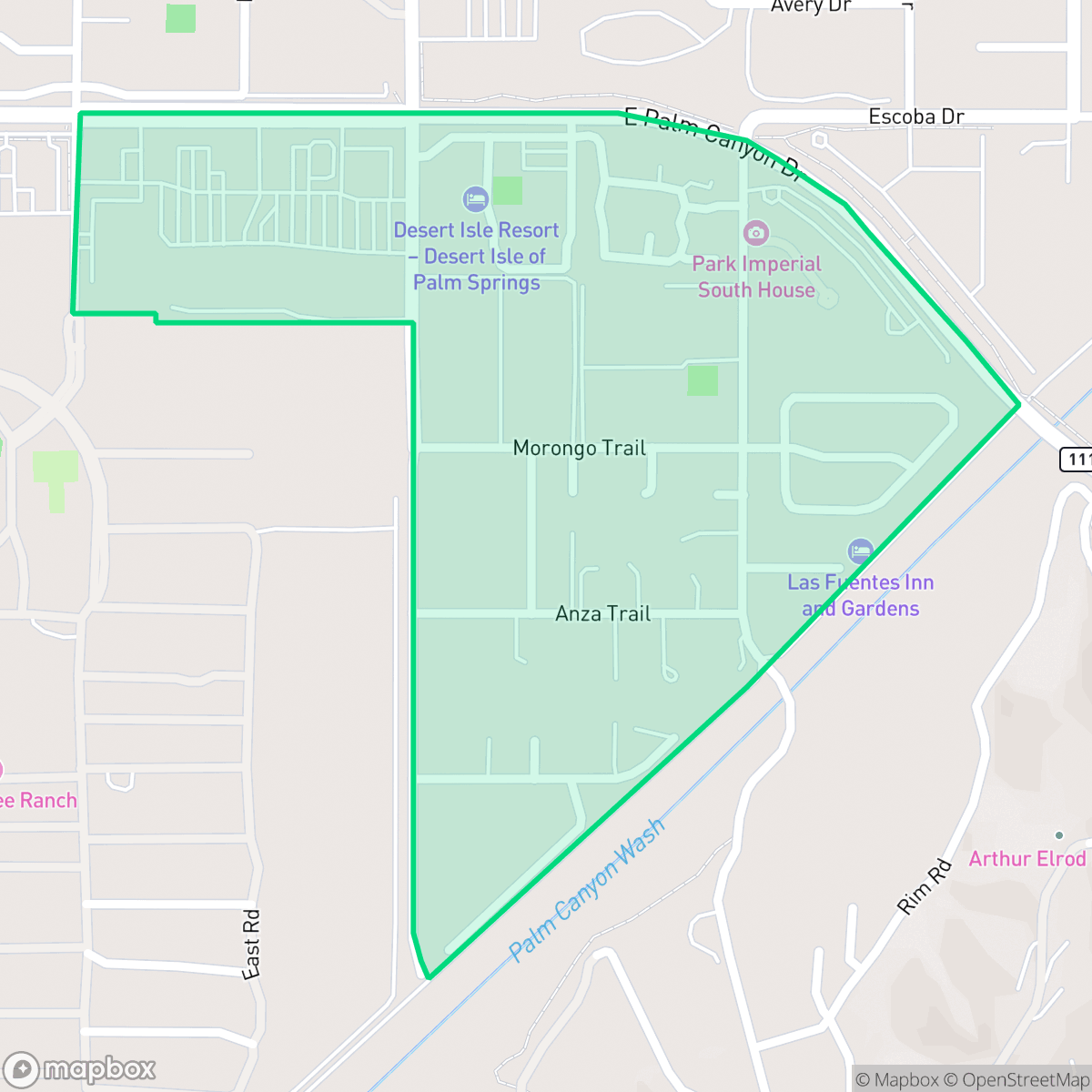
Araby Commons is an upscale residential neighborhood in South Palm Springs, California, bordered by Highway 111 and the Araby Wash. The neighborhood is highly regarded for its distinctive blend of historic Spanish Revival homes on large, former equestrian lots alongside a concentrated collection of mid-century modern garden-apartment condominium communities. Notable among these is Sandcliff, designed by architect Sherwin L. Barton between 1960 and 1964, which became the first multi-family development in Palm Springs listed on the National Register of Historic Places. Another architectural highlight is CoCo Cabana, designed by Charles W. Doty in 1955 as a garden apartment hotel. Positioned directly below the cliffs of Southridge, Araby Commons also offers iconic views of Bob Hope’s landmark mountainside estate.
The neighborhood maintains a serene rhythm, offering a level of acoustic comfort that significantly exceeds the city average. It is primarily residential, featuring quiet streets and open green spaces that foster a calm living environment. Local amenities, such as Manhattan In The Desert and community-focused spots like Passion Church At Palm Springs, provide convenient services for those living in the area. According to data, the community also benefits from high health insurance coverage, contributing to its appeal for long-term residents. For those considering a move, the area presents a balance of historic character and modern convenience. While the neighborhood boasts a strong flood safety profile, prospective residents should note the regional fire safety risks common to the desert environment. Families may also want to consider that the local school district, while providing modern facility upgrades and career technical education, experiences academic inconsistencies across its various campuses. The area is best suited for individuals or families who prioritize a quiet, stable environment and appreciate the unique architectural heritage of South Palm Springs.
Neighborhood Scores Across 15 Qualities
Large lots with significant separation between properties provide a sense of seclusion that is slightly higher than the Palm Springs average.
Pedestrians can utilize sidewalks on one side of the street and navigate safe crossings, though connectivity is slightly lower than the Palm Springs average.
Large homes and frequent upscale amenities provide an aesthetic that is more visually appealing than the Palm Springs average, according to iHuus data.
Connected green spaces and wide, traffic-safe paths make this area more dog friendly than much of Palm Springs. According to iHuus data, the neighborhood offers accessible routes for pet owners.
Open land and scattered homes provide a more semi-rural atmosphere compared to the more developed urban density found elsewhere in Palm Springs.
Lively pockets of dining and amenities exist alongside quiet, low-density residential streets. According to iHuus data, the area offers a slightly more active atmosphere than the Palm Springs average, blending accessible local eateries with serene, open landscapes.
Steady traffic hum from nearby thoroughfares is present, though the acoustic environment remains notably quieter than the Palm Springs average according to iHuus data.
Air quality remains consistently high with rare instances of elevated readings, matching the typical levels found throughout Palm Springs according to iHuus data.
Industrial activity and nearby warehouses are entirely absent from this area. Residents can expect a quiet environment with no detectable industrial hazards, a quality that is notably higher than the Palm Springs average.
Health insurance accessibility is very high among residents, significantly exceeding the Palm Springs average according to iHuus data.
Voting patterns and census indicators show a deeply liberal political leaning that is slightly more pronounced than the Palm Springs average.
Older adults represent the majority of the population, though a modest presence of younger residents remains. According to iHuus data, the age profile here trends slightly higher than the Palm Springs average.
Residual flood risks exist within this area because it is located within a 500-year floodplain. However, safety levels remain notably higher than the Palm Springs city average according to iHuus data.
Wildfire hazards in this area are severe, representing a level of risk that is slightly higher than the typical Palm Springs average. Residents should remain vigilant regarding extreme fire safety protocols according to iHuus data.
Address-Level Insights for Araby Commons


iHuus Neighborhood Intelligence Insights
Get address-level neighborhood insights for Araby Commons
- Street-level scores — see how individual blocks compare, not just neighborhood averages
- Micro-zone boundaries — identify quiet pockets, flood boundaries, and walkable clusters before you visit
- 15 dimensions in full — walkability, noise, air quality, school quality, insurance coverage, population age profile, urban/rural index, and more
- Boundary risk alerts — know if your address sits near a block boundary where scores drop, the kind of detail no listing will ever mention
- School insights — individual school ratings and insights, not just district-level data
- Compare before you commit — side-by-side data across neighborhoods, down to block precision
No credit card required
Compare with Any Neighborhood
| Dimension | Araby Commons | Andreas Hills |
|---|---|---|
| 🚶 Walkabilityavg 8.06 | ||
| 🔊 Acoustic Comfortavg 3.6 | ||
| 🤫 Privacy Indexavg 6 | ||
| 🎨 Visual Appealavg 7.66 | ||
| 🐕 Dog Friendlinessavg 6.14 | ||
| 🗺️ Urban-Rural Indexavg 7.27 | ||
| ✨ Neighborhood Vibeavg 4.76 | ||
| 🏥 Health Insurance Coverageavg 7.38 | ||
| 🌿 Air Qualityavg 8.11 | ||
| 🏭 Industrial Proximityavg 9.12 | ||
| 🌊 Flood Safetyavg 5.92 | ||
| 🗳️ Ideological Leanavg 9.69 | ||
| 👥 Population Age Profileavg 6.29 | ||
| 🔥 Fire Safetyavg 0.39 | ||
| 🏫 School Quality |
Araby Commons Rankings
School Districts Serving Araby Commons
School Insights for Araby Commons
Below average outcomes; significant attendance and academic challenges.
School Insights
See what's really behind every school rating near Araby Commons
- Individual school ratings — each school's own score with outcome context, not just a district average
- Enrollment & class size data — student-to-teacher ratio and how it compares to the state average
- Full demographics breakdown — ethnicity and gender composition for every school in the enrollment zone
- Every school in the district — all schools within the enrollment boundary ranked by rating, not just the closest one
- Grade levels & benchmarks — elementary through high school, with below/above state-average flags
No credit card required