Fourth Addition, Pacific Grove
Updated · 310 residents
The Fourth Addition is a highly walkable, grid-based neighborhood in eastern Pacific Grove known for its accessible local dining and vibrant community atmosphere. Residents benefit from consistent sidewalk connectivity and immediate proximity to essential services, though the area features closely spaced homes with limited private outdoor space.
Key Highlights
About Fourth Addition
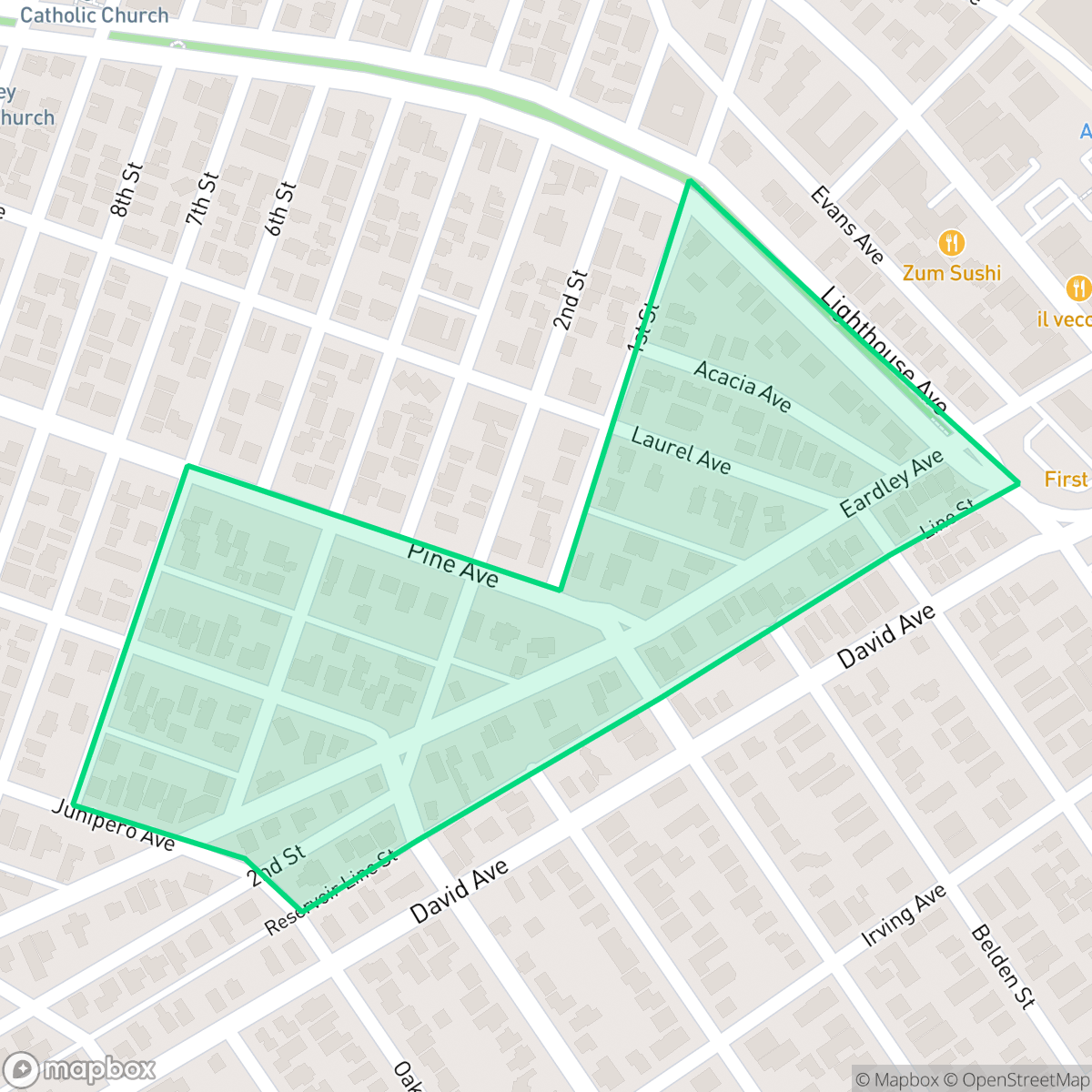
Subdivided in 1905 by the Pacific Improvement Company (PIC), the Fourth Addition is a historic neighborhood at the eastern end of Pacific Grove, California. It is defined as a wedge-shaped area bounded by Lighthouse Avenue to the north, Junipero Avenue to the south, and the Monterey city border to the east, with its western boundary running along 1st and 6th streets. Developed shortly before the adjacent University Park, the Fourth Addition was heavily promoted in local city directories during 1905 and 1906 to attract new residents to the expanding coastal town. Over the decades, the neighborhood's residential character evolved to feature a mix of classic early 20th-century architectural styles, including Craftsman-style homes and bungalows, which remain characteristic of this historic gateway to Pacific Grove.
This neighborhood functions as a dense, pedestrian-friendly gateway to Pacific Grove, characterized by a well-maintained grid system that ensures high connectivity throughout the area. According to iHuus data, the locale maintains a lively atmosphere, supported by a variety of local dining options such as Petra Restaurant and nearby community centers. The area is defined by its residential density, where homes are typically situated on small lots with minimal side yards, creating a tight-knit environment that prioritizes street-level interaction over expansive private landscapes. It is a suitable choice for those who value a walkable lifestyle and immediate access to local amenities over large private grounds.
Living in the area involves certain trade-offs, particularly regarding acoustic comfort, as road traffic contributes to a consistent baseline noise level of 56 decibels. While the neighborhood offers excellent walkability and a lack of industrial disturbances, prospective residents should be aware of the high fire risk profile inherent to the region. Families are well-positioned to access the Pacific Grove Unified School District, which serves as a premier educational anchor for the area, though the neighborhood remains a distinct, light-commercial and residential zone that balances its historic charm with the practical realities of modern suburban living.
Neighborhood Scores Across 15 Qualities
Houses are positioned with some buffer between neighbors, though closely spaced side yards are common. This level of privacy is slightly higher than the Pacific Grove average according to iHuus data.
Extensive sidewalk networks and a highly connected grid system make navigating the area on foot very easy. According to iHuus data, the pedestrian infrastructure here is superior to the average found throughout Pacific Grove.
Residential streetscapes consist primarily of uniform housing with modest yards and limited luxury amenities. This level of visual variety is slightly below the average found throughout Pacific Grove, according to iHuus data.
Sidewalks and access to an athletic field provide opportunities for exercise, though overall accessibility to pet-friendly spaces is lower than the Pacific Grove average according to iHuus data.
Residential streets feature small lots and a dense suburban layout, making the area slightly more urban than the typical Pacific Grove landscape. According to iHuus data, this neighborhood lacks the frequent open fields and woodland found elsewhere in the city.
Diverse dining options and local amenities create a much more active atmosphere than the typical Pacific Grove neighborhood. Residents have easy access to a variety of coastal eateries, cafes, and community spaces, according to iHuus data.
Steady sounds from local traffic on nearby busy streets are common here, though levels remain more tranquil than the average for Pacific Grove according to iHuus data.
Industrial activity is non-existent in this area, matching the low level of industrial presence found across Pacific Grove. Residents can expect a landscape comprised of residential streets and open green spaces without any nearby warehouses or heavy manufacturing facilities.
Health insurance access is very high among residents, sitting well above the Pacific Grove average according to iHuus data.
Voting patterns and census indicators show a very high concentration of liberal leanings, which is slightly more pronounced than the average seen across Pacific Grove. According to iHuus data, the area exhibits a highly consistent ideological profile.
A balanced mix of young adults, families, and older residents defines the local demographic. According to iHuus data, this age distribution is slightly more varied than the average seen across Pacific Grove.
Residual flood risk exists within this area due to its location in a 500-year floodplain, though safety levels remain higher than the Pacific Grove average according to iHuus data.
Address-Level Insights for Fourth Addition


iHuus Neighborhood Intelligence Insights
Get address-level neighborhood insights for Fourth Addition
- Street-level scores — see how individual blocks compare, not just neighborhood averages
- Micro-zone boundaries — identify quiet pockets, flood boundaries, and walkable clusters before you visit
- 15 dimensions in full — walkability, noise, air quality, school quality, insurance coverage, population age profile, urban/rural index, and more
- Boundary risk alerts — know if your address sits near a block boundary where scores drop, the kind of detail no listing will ever mention
- School insights — individual school ratings and insights, not just district-level data
- Compare before you commit — side-by-side data across neighborhoods, down to block precision
No credit card required
Compare with Any Neighborhood
| Dimension | Fourth Addition | Asilomar Dunes |
|---|---|---|
| 🚶 Walkabilityavg 8.68 | ||
| 🔊 Acoustic Comfortavg 4.49 | ||
| 🤫 Privacy Indexavg 5.57 | ||
| 🎨 Visual Appealavg 7.37 | ||
| 🐕 Dog Friendlinessavg 8.15 | ||
| 🗺️ Urban-Rural Indexavg 7.2 | ||
| ✨ Neighborhood Vibeavg 5.27 | ||
| 🏥 Health Insurance Coverageavg 8.4 | ||
| 🌿 Air Quality | ||
| 🏭 Industrial Proximityavg 10 | ||
| 🌊 Flood Safetyavg 7.03 | ||
| 🗳️ Ideological Leanavg 9.43 | ||
| 👥 Population Age Profileavg 5.6 | ||
| 🔥 Fire Safetyavg 1.51 | ||
| 🏫 School Quality |
Fourth Addition Rankings
School Districts Serving Fourth Addition
School Insights for Fourth Addition
Below average outcomes; significant attendance and academic challenges.
School Insights
See what's really behind every school rating near Fourth Addition
- Individual school ratings — each school's own score with outcome context, not just a district average
- Enrollment & class size data — student-to-teacher ratio and how it compares to the state average
- Full demographics breakdown — ethnicity and gender composition for every school in the enrollment zone
- Every school in the district — all schools within the enrollment boundary ranked by rating, not just the closest one
- Grade levels & benchmarks — elementary through high school, with below/above state-average flags
No credit card required