First Addition, Pacific Grove
Updated · 586 residents
The First Addition is an exceptionally walkable residential enclave in Pacific Grove, defined by a dense, historic grid layout. Residents enjoy proximity to local dining and the Pacific Grove Museum of Natural History, though the area features closely spaced homes with limited private yard space.
Key Highlights
About First Addition
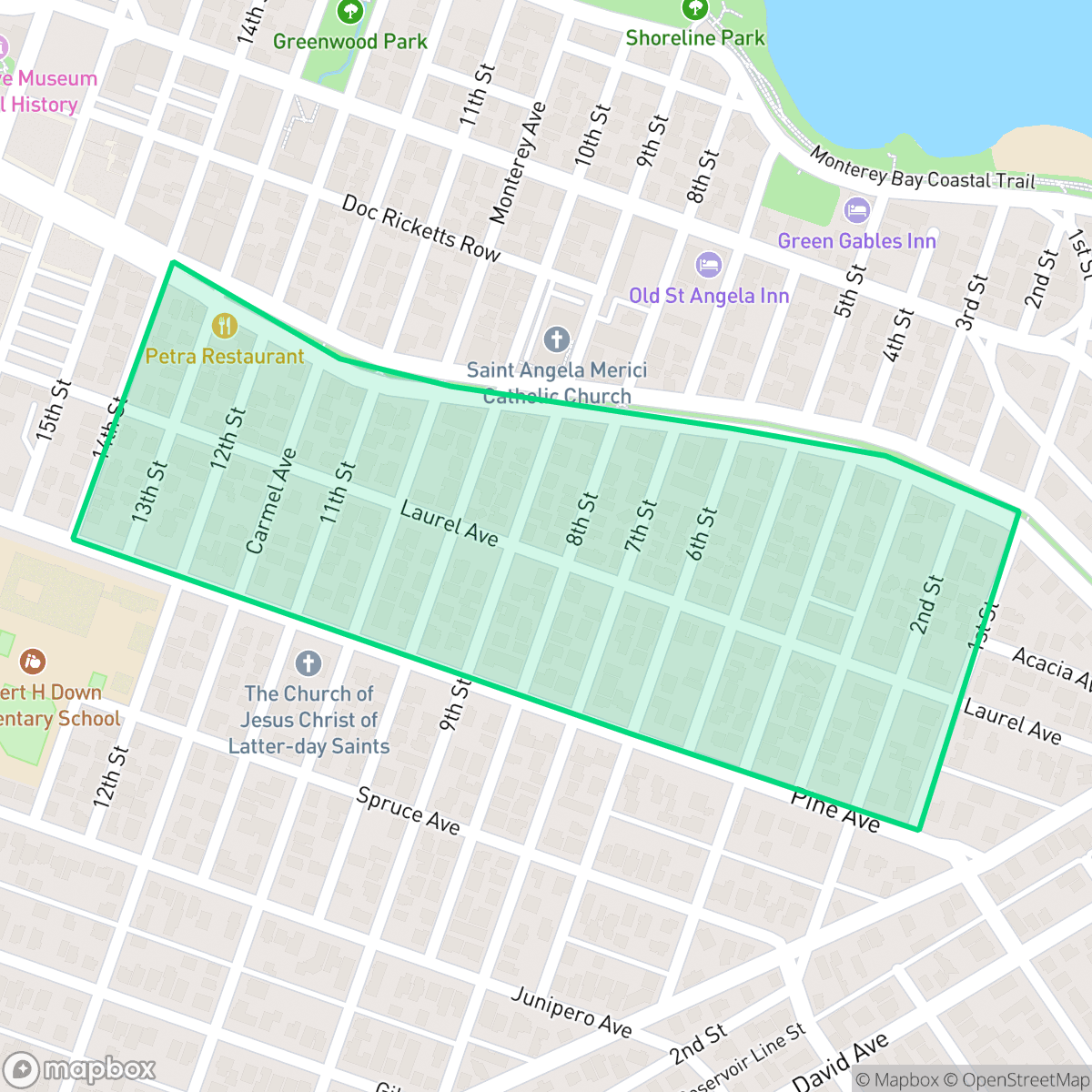
The First Addition in Pacific Grove, California, originated on May 7, 1887, when the Pacific Improvement Company filed survey maps establishing the area as the first major extension of the original 1875 Methodist Retreat. Bordered by 1st Street to the east, 16th Street to the west, Pine Avenue to the south, and Lighthouse Avenue to the north, the neighborhood expanded the town's residential grid. Characterized by a dense layout of historic homes, including Victorian-era residences and early 20th-century bungalows, the neighborhood retains its historic scale. Its distinct character has been preserved through local voter initiatives that established strict R-2 zoning and building site requirements. Today, the First Addition remains a highly walkable, quiet residential enclave situated just blocks from Monterey Bay and the Pacific Grove Museum of Natural History.
The area maintains a vibrant, community-focused atmosphere where suburban streets intersect with a modest commercial core. It benefits from the high-performing Pacific Grove Unified School District, which serves as a primary educational anchor for families in the region. The neighborhood is characterized by high connectivity and consistent sidewalk access, making it a functional choice for those who prioritize pedestrian access to daily amenities over expansive private grounds.
Prospective residents should note that the neighborhood features tightly packed housing with minimal space between structures, which impacts overall privacy. While the area is free from industrial activity, road traffic contributes to a moderate level of ambient noise. Given the density and environmental factors, the area is best suited for individuals or families who value a walkable, established community and proximity to the Monterey Bay coastline over secluded, large-lot living.
Neighborhood Scores Across 15 Qualities
Residential spacing provides a moderate amount of separation between homes, which is slightly higher than the average for Pacific Grove. Houses in some parts of the neighborhood are closely situated with small side yards, according to iHuus data.
Extremely easy to navigate on foot due to a well-connected grid system and dedicated sidewalks on both sides of most streets. This level of pedestrian accessibility is notably higher than the average for Pacific Grove.
Standard tract housing and uniform rooflines characterize this area. The visual landscape is less lush than the average for Pacific Grove, as yards are generally small and lack significant luxury amenities.
Sidewalks and nearby public athletic fields provide some walking opportunities, though overall amenities are below the Pacific Grove average according to iHuus data.
Residential streets feature small lots and easy access to the local commercial core, offering a more densely populated environment than the more semi-rural areas typically found across Pacific Grove.
Local dining and community landmarks create a lively atmosphere that is notably more energetic than the typical Pacific Grove district. Residents have access to a diverse range of social destinations and amenities within the immediate area.
Steady traffic sounds from a nearby busy street are present, though levels remain more tranquil than the average for Pacific Grove according to iHuus data.
Purely residential and light commercial zones define this area, with no warehouses or heavy industrial facilities detected near the neighborhood. This lack of industrial activity is consistent with the rest of Pacific Grove.
Health insurance access is exceptionally high among residents, sitting well above the Pacific Grove average according to iHuus data.
Voting patterns and census indicators reflect a very liberal political landscape, which is even more pronounced here than in the rest of Pacific Grove according to iHuus data.
A balanced variety of age groups resides here, showing a slightly more diverse age distribution than the Pacific Grove average according to iHuus data.
Residual flood risk exists within this area due to its location in the 500-year floodplain. According to iHuus data, this level of safety is slightly higher than the average for Pacific Grove.
Address-Level Insights for First Addition


iHuus Neighborhood Intelligence Insights
Get address-level neighborhood insights for First Addition
- Street-level scores — see how individual blocks compare, not just neighborhood averages
- Micro-zone boundaries — identify quiet pockets, flood boundaries, and walkable clusters before you visit
- 15 dimensions in full — walkability, noise, air quality, school quality, insurance coverage, population age profile, urban/rural index, and more
- Boundary risk alerts — know if your address sits near a block boundary where scores drop, the kind of detail no listing will ever mention
- School insights — individual school ratings and insights, not just district-level data
- Compare before you commit — side-by-side data across neighborhoods, down to block precision
No credit card required
Compare with Any Neighborhood
| Dimension | First Addition | Asilomar Dunes |
|---|---|---|
| 🚶 Walkabilityavg 8.68 | ||
| 🔊 Acoustic Comfortavg 4.49 | ||
| 🤫 Privacy Indexavg 5.57 | ||
| 🎨 Visual Appealavg 7.37 | ||
| 🐕 Dog Friendlinessavg 8.15 | ||
| 🗺️ Urban-Rural Indexavg 7.2 | ||
| ✨ Neighborhood Vibeavg 5.27 | ||
| 🏥 Health Insurance Coverageavg 8.4 | ||
| 🌿 Air Quality | ||
| 🏭 Industrial Proximityavg 10 | ||
| 🌊 Flood Safetyavg 7.03 | ||
| 🗳️ Ideological Leanavg 9.43 | ||
| 👥 Population Age Profileavg 5.6 | ||
| 🔥 Fire Safetyavg 1.51 | ||
| 🏫 School Quality |
First Addition Rankings
School Districts Serving First Addition
School Insights for First Addition
Below average outcomes; significant attendance and academic challenges.
School Insights
See what's really behind every school rating near First Addition
- Individual school ratings — each school's own score with outcome context, not just a district average
- Enrollment & class size data — student-to-teacher ratio and how it compares to the state average
- Full demographics breakdown — ethnicity and gender composition for every school in the enrollment zone
- Every school in the district — all schools within the enrollment boundary ranked by rating, not just the closest one
- Grade levels & benchmarks — elementary through high school, with below/above state-average flags
No credit card required