South Winds, Oxnard
Updated · 5,673 residents
South Winds is a dense, highly walkable neighborhood in Oxnard featuring a mix of mid-century apartments and suburban homes. Residents benefit from excellent air quality and a central park, though they contend with noticeable road traffic noise and limited privacy due to the closely packed housing.
Key Highlights
About South Winds
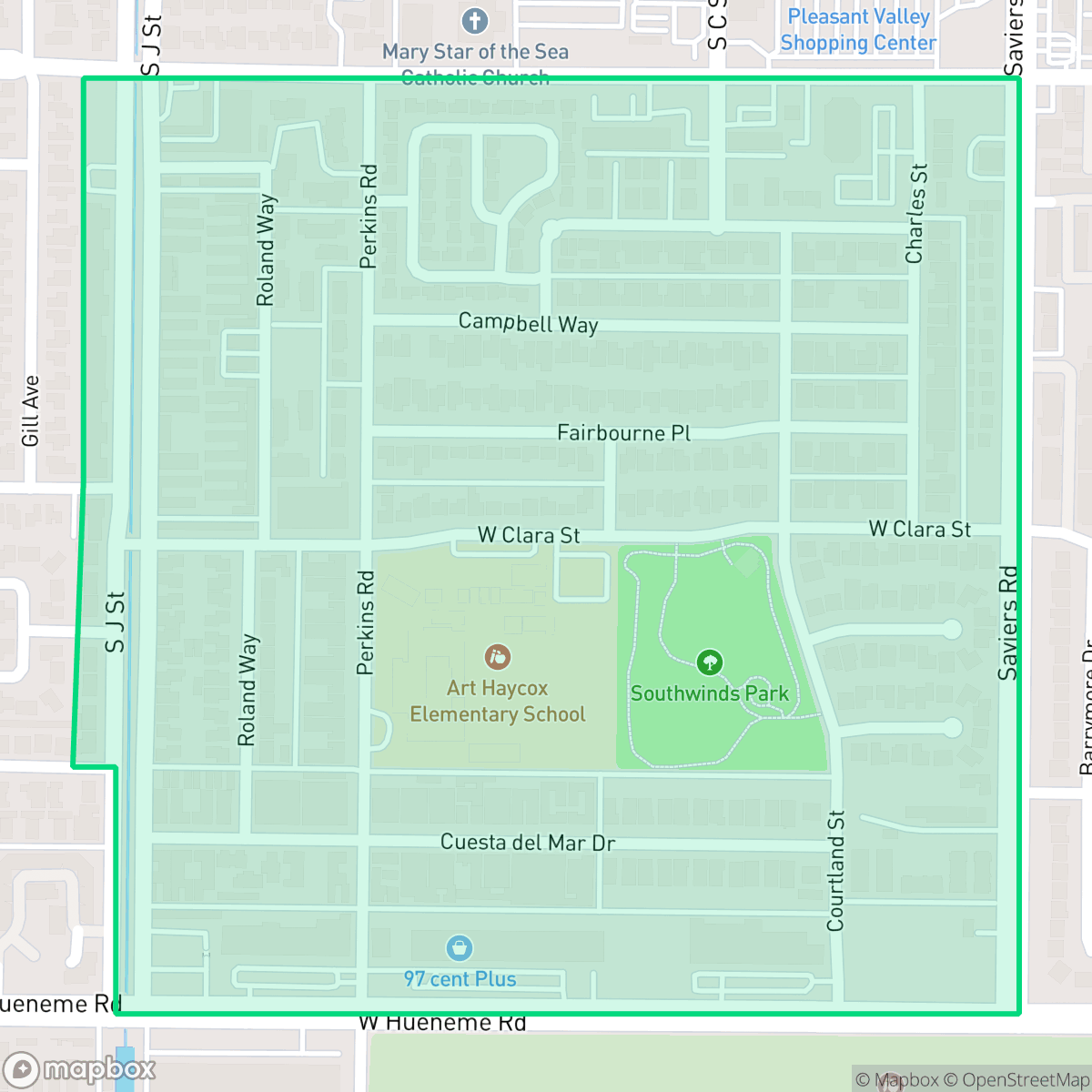
The South Winds neighborhood in south Oxnard, California—bounded by Pleasant Valley Road, Saviers Road, Hueneme Road, and the Ventura County Flood Control Channel—developed primarily during a post-World War II construction boom. Originally a middle-class suburb, it transitioned by the 1970s into a densely populated, renter-dominated enclave characterized by 1960s-era stucco apartment complexes. To address urban blight and crime, the city designated South Winds a redevelopment zone in 1985. In 1988, officials famously renamed the notorious Aleric Street to Cuesta del Mar Drive to help reshape the area's identity. Today, the neighborhood centers around Southwinds Park and its 1990s-era recreation center. It is defined by a strong working-class, predominantly Mexican-American cultural identity, with a significant portion of residents employed in local agriculture.
The area is defined by its compact residential grid and high level of pedestrian accessibility, allowing for easy movement throughout the community. Southwinds Park serves as the primary green space, providing essential recreation areas for families and pet owners. Local dining options along the main thoroughfares offer a variety of quick-service and casual eateries, contributing to a lively suburban atmosphere during the day according to iHuus data.
Prospective residents should note the trade-offs inherent in this high-density environment, including elevated noise levels from surrounding road traffic and a lack of significant private outdoor space. While the neighborhood offers strong connectivity, it is situated near industrial zones and faces challenges regarding flood and fire safety. It is best suited for those who prioritize walkability and proximity to community amenities over quiet, expansive living.
Neighborhood Scores Across 15 Qualities
Residential spacing is typical for the area, featuring a mix of detached homes and high-density complexes where structures are often positioned close to one another. According to iHuus data, neighbor proximity is roughly in line with the Oxnard average.
Extensive sidewalk networks and frequent crosswalks make navigating the residential and commercial grid easy on foot. According to iHuus data, this level of pedestrian connectivity is notably higher than the Oxnard average.
Uniform tract housing and multi-unit complexes define the landscape, which is typical for the area and closely matches the city average. Residents will find closely spaced homes and tidy but small yards throughout the neighborhood.
Access to central public parks and school fields provides ample green space for pets. According to iHuus data, these accessible areas offer better opportunities for dog walking than the Oxnard average.
Residential pockets of single-family homes and apartment complexes sit alongside large undeveloped parcels and industrial zones. This landscape is slightly more developed than the typical Oxnard area, according to iHuus data.
Suburban streets and light industrial zones create a tranquil atmosphere with limited commercial activity. This level of activity is lower than the Oxnard average, as many essential services are not within walking distance.
Frequent disturbances from nearby railroad lines and heavy freeway traffic characterize the area. According to iHuus data, acoustic comfort in South Winds is lower than the Oxnard city average.
Air quality remains consistently high with minimal health concerns, matching the typical standards found throughout Oxnard.
Proximity to heavy industrial zones, freight corridors, and an EPA Superfund site creates more industrial presence than the Oxnard average. Residents may encounter active commercial traffic and large-scale operational facilities in the immediate area.
Health insurance enrollment levels in South Winds are lower than the average seen across Oxnard. According to iHuus data, a minority of residents in this area have access to employer or private health coverage.
Voting patterns and census indicators show a predominantly liberal leaning, which is consistent with the broader Oxnard area according to iHuus data.
Residents live alongside a balanced mix of young adults, families, and seniors. This age distribution is slightly lower than the Oxnard city average, according to iHuus data.
Located in a coastal high-hazard zone, this area is subject to wave action and significantly higher flood risk than the Oxnard average. Residents should prepare for potentially elevated or prohibitive flood insurance costs according to iHuus data.
Fire risk in South Winds is exceptionally high, representing a more severe hazard than the typical Oxnard neighborhood. Residents should be prepared for significant wildfire threats and the necessity of maximum protection measures.
Address-Level Insights for South Winds


iHuus Neighborhood Intelligence Insights
Get address-level neighborhood insights for South Winds
- Street-level scores — see how individual blocks compare, not just neighborhood averages
- Micro-zone boundaries — identify quiet pockets, flood boundaries, and walkable clusters before you visit
- 15 dimensions in full — walkability, noise, air quality, school quality, insurance coverage, population age profile, urban/rural index, and more
- Boundary risk alerts — know if your address sits near a block boundary where scores drop, the kind of detail no listing will ever mention
- School insights — individual school ratings and insights, not just district-level data
- Compare before you commit — side-by-side data across neighborhoods, down to block precision
No credit card required
Compare with Any Neighborhood
| Dimension | South Winds | Bartolo Square North |
|---|---|---|
| 🚶 Walkabilityavg 9.13 | ||
| 🔊 Acoustic Comfortavg 2.93 | ||
| 🤫 Privacy Indexavg 4.06 | ||
| 🎨 Visual Appealavg 6.08 | ||
| 🐕 Dog Friendlinessavg 6.46 | ||
| 🗺️ Urban-Rural Indexavg 6.67 | ||
| ✨ Neighborhood Vibeavg 4.7 | ||
| 🏥 Health Insurance Coverageavg 4.66 | ||
| 🌿 Air Qualityavg 9.99 | ||
| 🏭 Industrial Proximityavg 7.45 | ||
| 🌊 Flood Safetyavg 3.91 | ||
| 🗳️ Ideological Leanavg 9.3 | ||
| 👥 Population Age Profileavg 4.59 | ||
| 🔥 Fire Safetyavg 0.04 | ||
| 🏫 School Quality |
South Winds Rankings
School Districts Serving South Winds
School Insights for South Winds
Below average outcomes; significant attendance and academic challenges.
School Insights
See what's really behind every school rating near South Winds
- Individual school ratings — each school's own score with outcome context, not just a district average
- Enrollment & class size data — student-to-teacher ratio and how it compares to the state average
- Full demographics breakdown — ethnicity and gender composition for every school in the enrollment zone
- Every school in the district — all schools within the enrollment boundary ranked by rating, not just the closest one
- Grade levels & benchmarks — elementary through high school, with below/above state-average flags
No credit card required