Cypress, Oxnard
Updated · 3,696 residents
Cypress is a dense, highly walkable neighborhood in Oxnard characterized by its standard tract housing and proximity to both agricultural fields and industrial zones. While the area offers excellent pedestrian accessibility and clean air, residents should be aware of persistent road traffic noise and limited privacy due to the close proximity of homes.
Key Highlights
About Cypress
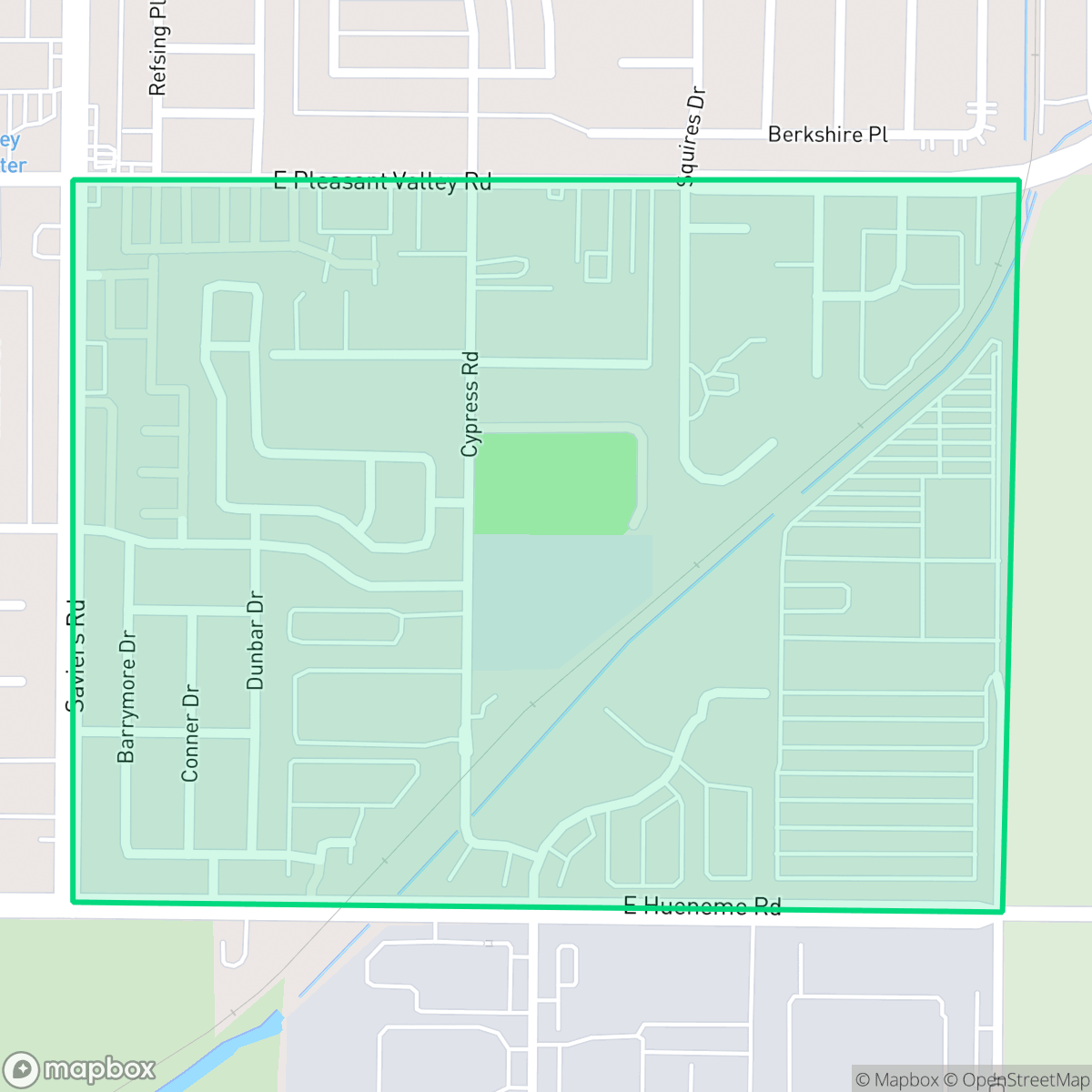
Cypress serves as a quiet, mixed-use residential enclave that balances suburban living with nearby industrial and agricultural activity. The neighborhood features a consistent grid layout that makes it one of the most walkable areas in Oxnard, allowing residents to navigate easily between local homes and nearby commercial spots. While the visual aesthetic consists primarily of standard tract housing and multi-family complexes, the area maintains high air quality despite its location near logistics and freight-heavy zones.
Prospective residents should note that the neighborhood experiences significant road traffic noise, which impacts the overall acoustic environment. The high density of the residential layout means homes are situated close together, resulting in limited personal space. Additionally, the area faces specific environmental risks, including low scores for flood and fire safety, and is situated near an EPA Superfund site. It is best suited for individuals who prioritize walkability and proximity to essential services over a quiet, secluded living environment.
Neighborhood Scores Across 15 Qualities
Residential spacing is slightly above the Oxnard average, though certain sectors feature high-density layouts with very little buffer between neighbors. According to iHuus data, some areas particularly within the mobile home community offer minimal separation between adjacent homes.
Consistent sidewalk networks and a predictable grid system make most errands manageable on foot. This area offers a level of pedestrian accessibility that is nearly comparable to the rest of Oxnard.
Residential views consist of standard tract housing and apartment complexes with repetitive rooflines. This level of visual variety is roughly in line with the average for Oxnard.
Access to public parks and school fields offers more space for pets than the Oxnard average. While residential streets lack wide parkways, connected green spaces provide reliable areas for exercise.
Residential pockets of dense housing and industrial zones transition directly into large agricultural fields and undeveloped land. This landscape sits very close to the Oxnard average for semi-rural development according to iHuus data.
Low density and a lack of walkable retail options make this area feel more remote and subdued than much of Oxnard. According to iHuus data, the neighborhood is primarily characterized by quiet residential pockets and light industrial zones with limited social activity.
Frequent noise from nearby railroad tracks and freeway traffic characterizes this area. According to iHuus data, acoustic comfort in Cypress is notably lower than the Oxnard average.
Air quality remains consistently high with minimal health concerns. According to iHuus data, these levels are on par with the rest of Oxnard.
Light industrial and commercial units are interspersed with residential areas, though the neighborhood features significantly less industrial density than the Oxnard average. Proximity to an EPA Superfund site and some heavy freight traffic are notable characteristics of certain zones within the area.
Health insurance access is significantly lower in Cypress compared to the Oxnard city average, according to iHuus data.
Voting patterns and census indicators show a predominantly liberal leaning, which is slightly more pronounced than the average seen across Oxnard.
Residents live alongside a varied mix of young adults, families, and seniors. This age distribution is slightly lower than the Oxnard average, according to iHuus data.
Extreme fire hazards are present in this area, which represents a higher risk level than the Oxnard average according to iHuus data.
Address-Level Insights for Cypress


iHuus Neighborhood Intelligence Insights
Get address-level neighborhood insights for Cypress
- Street-level scores — see how individual blocks compare, not just neighborhood averages
- Micro-zone boundaries — identify quiet pockets, flood boundaries, and walkable clusters before you visit
- 15 dimensions in full — walkability, noise, air quality, school quality, insurance coverage, population age profile, urban/rural index, and more
- Boundary risk alerts — know if your address sits near a block boundary where scores drop, the kind of detail no listing will ever mention
- School insights — individual school ratings and insights, not just district-level data
- Compare before you commit — side-by-side data across neighborhoods, down to block precision
No credit card required
Compare with Any Neighborhood
| Dimension | Cypress | Bartolo Square North |
|---|---|---|
| 🚶 Walkabilityavg 9.13 | ||
| 🔊 Acoustic Comfortavg 2.93 | ||
| 🤫 Privacy Indexavg 4.06 | ||
| 🎨 Visual Appealavg 6.08 | ||
| 🐕 Dog Friendlinessavg 6.46 | ||
| 🗺️ Urban-Rural Indexavg 6.67 | ||
| ✨ Neighborhood Vibeavg 4.7 | ||
| 🏥 Health Insurance Coverageavg 4.66 | ||
| 🌿 Air Qualityavg 9.99 | ||
| 🏭 Industrial Proximityavg 7.45 | ||
| 🌊 Flood Safetyavg 3.91 | ||
| 🗳️ Ideological Leanavg 9.3 | ||
| 👥 Population Age Profileavg 4.59 | ||
| 🔥 Fire Safetyavg 0.04 | ||
| 🏫 School Quality |
Cypress Rankings
School Districts Serving Cypress
School Insights for Cypress
Below average outcomes; significant attendance and academic challenges.
School Insights
See what's really behind every school rating near Cypress
- Individual school ratings — each school's own score with outcome context, not just a district average
- Enrollment & class size data — student-to-teacher ratio and how it compares to the state average
- Full demographics breakdown — ethnicity and gender composition for every school in the enrollment zone
- Every school in the district — all schools within the enrollment boundary ranked by rating, not just the closest one
- Grade levels & benchmarks — elementary through high school, with below/above state-average flags
No credit card required