Bartolo Square South, Oxnard
Updated · 2,965 residents
Bartolo Square South is a dense, suburban neighborhood in Oxnard known for its exceptional walkability and grid-based layout. The area features uniform tract housing and provides convenient access to local parks, making it a functional choice for those prioritizing pedestrian-friendly streets.
Key Highlights
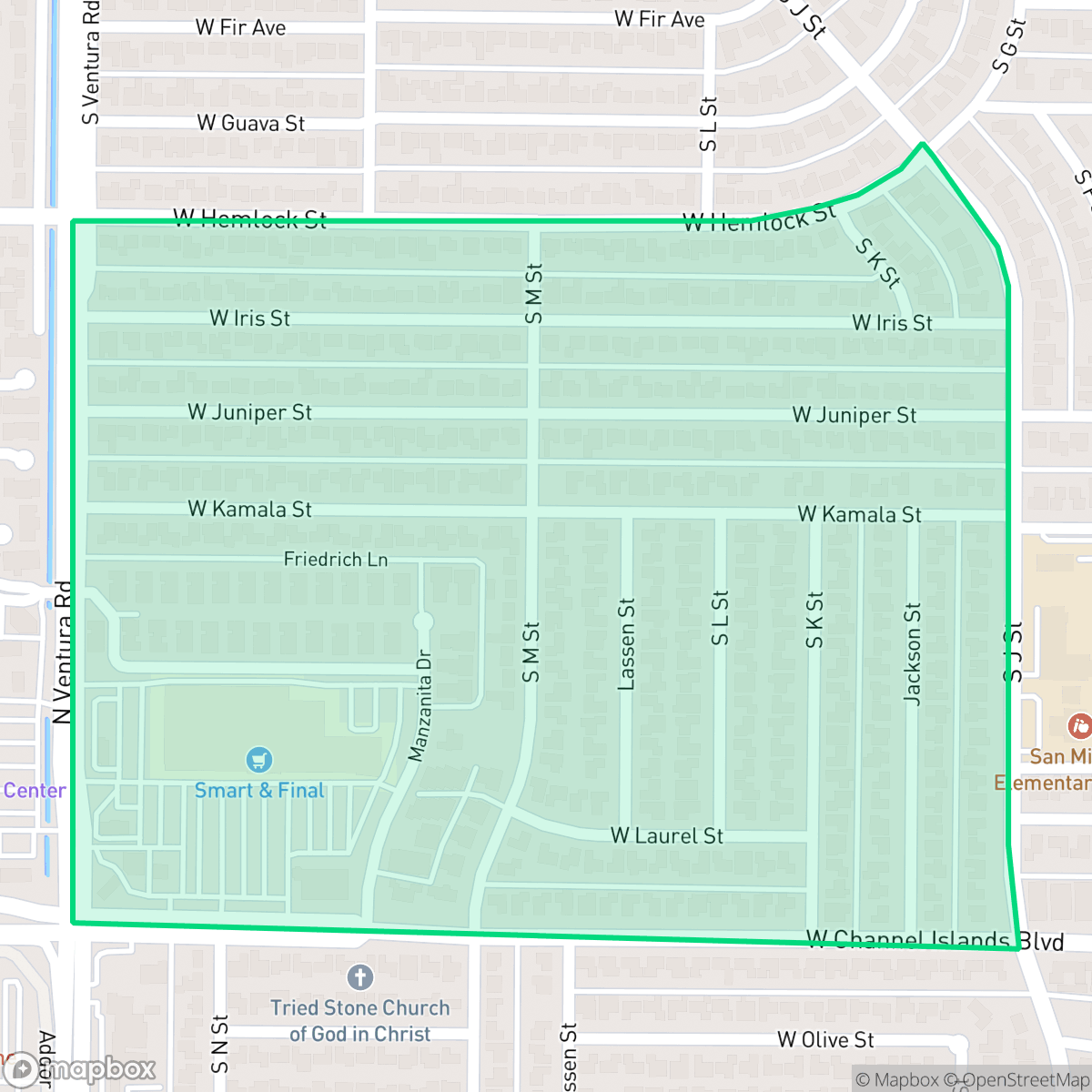
About Bartolo Square South
Bartolo Square South is characterized by its structured, high-density residential grid and consistent architectural style. The neighborhood offers a quiet, suburban atmosphere with a strong emphasis on walkability, as residents benefit from well-maintained sidewalks and clear pedestrian infrastructure throughout the area. It maintains a balanced environment that integrates residential living with accessible green spaces, providing a stable setting for those who value a predictable, low-rise suburban lifestyle free from industrial hazards. According to recent data, the area is notably free from industrial proximity, contributing to a clean and purely residential environment.
While the neighborhood offers excellent pedestrian access, residents should be aware of the trade-offs regarding privacy and noise. The houses are positioned in close proximity to one another, which limits personal outdoor space, and the area experiences a moderate level of ambient noise primarily driven by local road traffic. Prospective residents will find a community that prioritizes accessibility and connectivity over expansive private grounds. The neighborhood is best suited for individuals or families who value a walkable, established community and are comfortable with a compact, suburban living arrangement.
Neighborhood Scores Across 15 Qualities
Residential spacing varies between shared walls in dense complexes and narrow lots with close property lines. This level of privacy is roughly in line with the Oxnard average, according to iHuus data.
Continuous sidewalks and clearly marked crosswalks define the street network here, offering superior pedestrian accessibility compared to the Oxnard average.
Standard tract housing and apartment blocks define the area, featuring uniform roof geometries and small yards. This residential landscape is largely consistent with the typical visual character found throughout Oxnard.
Access to public green space is somewhat limited due to narrow sidewalk verges and primarily private backyards. While local parks and school fields are available, pet walking options are below the Oxnard average according to iHuus data.
Residential grids and multi-story apartment complexes define this area. According to iHuus data, the landscape is slightly more developed than the typical Oxnard surroundings, featuring a mix of dense housing and established street patterns.
Local amenities and dining options provide more activity than the Oxnard average, featuring a mix of quiet residential streets and accessible social hubs. While some leisure businesses are within walking distance, other commercial units remain primarily car-dependent according to iHuus data.
Frequent noise from nearby railroad tracks and major freeway traffic characterizes this area. According to iHuus data, acoustic levels are notably higher than the Oxnard average.
Air quality remains consistently high with minimal health concerns. This level of air purity is on par with the rest of Oxnard.
Residential and light commercial uses predominate here, with significantly fewer warehouses or heavy industrial facilities than the Oxnard average. According to iHuus data, the area is largely free of visible industrial hazards or large-scale utility yards.
Health insurance accessibility is significantly lower here than the Oxnard average, according to iHuus data. Residents may face greater challenges accessing employer-sponsored or private medical coverage within this area.
Voting patterns and census indicators show a strong liberal lean that is slightly more pronounced than the Oxnard average, according to iHuus data.
A diverse mix of young adults, families, and seniors resides here, representing a slightly more concentrated age distribution than the Oxnard average according to iHuus data.
Flood risk in this area is slightly higher than the Oxnard average, though a lack of detailed FEMA studies means the precise level of danger remains undetermined. Residents should remain aware of potential vulnerabilities during heavy rain events.
Address-Level Insights for Bartolo Square South


iHuus Neighborhood Intelligence Insights
Get address-level neighborhood insights for Bartolo Square South
- Street-level scores — see how individual blocks compare, not just neighborhood averages
- Micro-zone boundaries — identify quiet pockets, flood boundaries, and walkable clusters before you visit
- 15 dimensions in full — walkability, noise, air quality, school quality, insurance coverage, population age profile, urban/rural index, and more
- Boundary risk alerts — know if your address sits near a block boundary where scores drop, the kind of detail no listing will ever mention
- School insights — individual school ratings and insights, not just district-level data
- Compare before you commit — side-by-side data across neighborhoods, down to block precision
No credit card required
Compare with Any Neighborhood
| Dimension | Bartolo Square South | Bartolo Square North |
|---|---|---|
| 🚶 Walkabilityavg 9.13 | ||
| 🔊 Acoustic Comfortavg 2.93 | ||
| 🤫 Privacy Indexavg 4.06 | ||
| 🎨 Visual Appealavg 6.08 | ||
| 🐕 Dog Friendlinessavg 6.46 | ||
| 🗺️ Urban-Rural Indexavg 6.67 | ||
| ✨ Neighborhood Vibeavg 4.7 | ||
| 🏥 Health Insurance Coverageavg 4.66 | ||
| 🌿 Air Qualityavg 9.99 | ||
| 🏭 Industrial Proximityavg 7.45 | ||
| 🌊 Flood Safetyavg 3.91 | ||
| 🗳️ Ideological Leanavg 9.3 | ||
| 👥 Population Age Profileavg 4.59 | ||
| 🔥 Fire Safetyavg 0.04 | ||
| 🏫 School Quality |
Bartolo Square South Rankings
School Districts Serving Bartolo Square South
School Insights for Bartolo Square South
Below average outcomes; significant attendance and academic challenges.
School Insights
See what's really behind every school rating near Bartolo Square South
- Individual school ratings — each school's own score with outcome context, not just a district average
- Enrollment & class size data — student-to-teacher ratio and how it compares to the state average
- Full demographics breakdown — ethnicity and gender composition for every school in the enrollment zone
- Every school in the district — all schools within the enrollment boundary ranked by rating, not just the closest one
- Grade levels & benchmarks — elementary through high school, with below/above state-average flags
No credit card required