Woodminster, Oakland
Updated · 1,149 residents
Woodminster is a quiet, low-density enclave in the Oakland Hills defined by its immediate proximity to expansive green spaces and high dog-friendliness. While the area offers significant visual appeal and a rural feel, residents should be aware of persistent road traffic noise and notable fire safety risks.
Key Highlights
About Woodminster
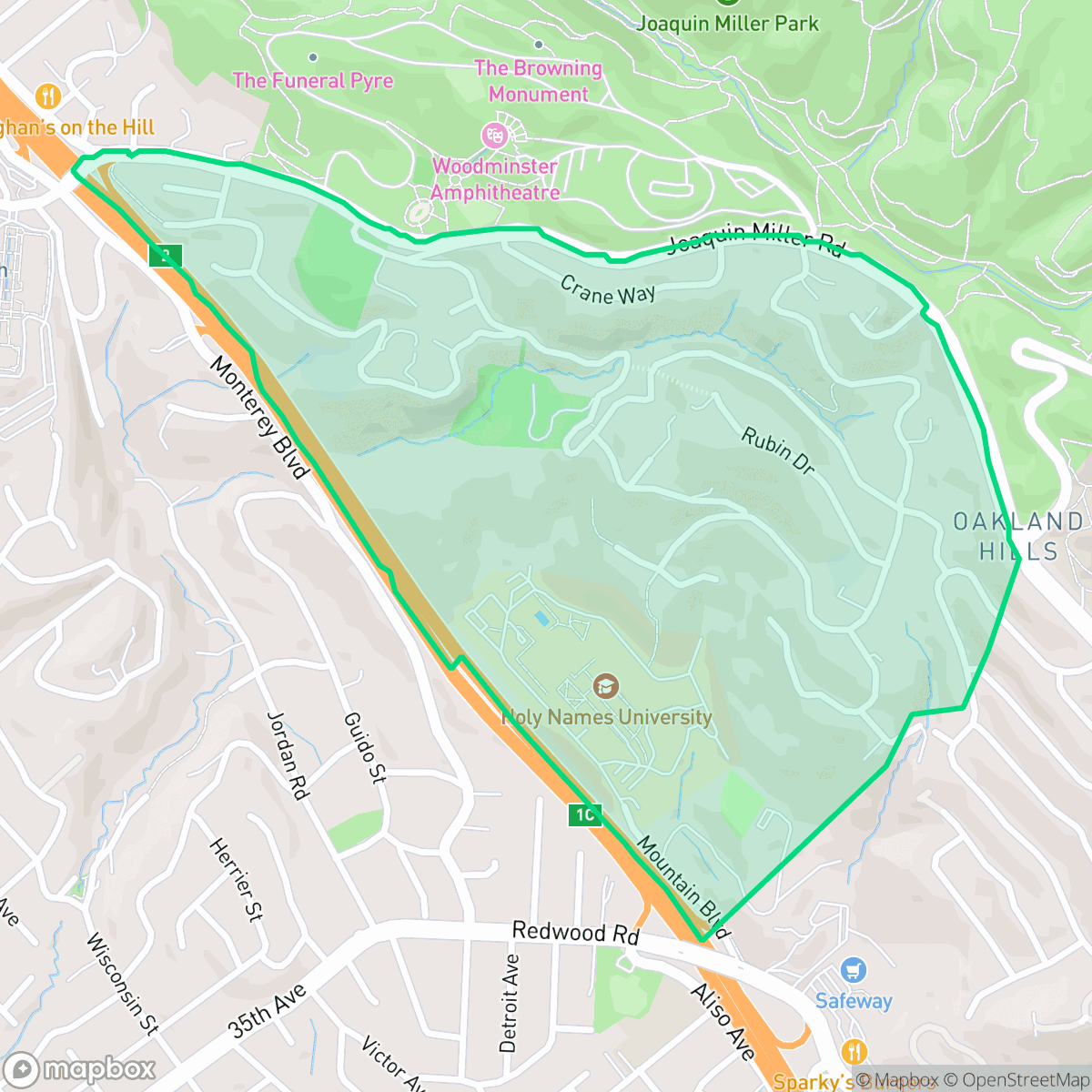
Nestled in the scenic Oakland Hills, the Woodminster neighborhood is deeply intertwined with the historic Joaquin Miller Park, formerly the estate of the eccentric "Poet of the Sierras," Joaquin Miller. The neighborhood’s defining landmark is the Woodminster Amphitheater and Cascades, an Art Deco open-air venue constructed by the Works Progress Administration (WPA) between 1939 and 1940. Designed by Edward T. Foulkes and William Penn Mott Jr., it was dedicated in 1941 as a memorial to California writers, flanked by the Writers Memorial Grove. Since 1967, the amphitheater has hosted the Woodminster Summer Musicals, Oakland’s longest continually running live theater. Woodminster features a quiet residential character and a small, charming shopping district along Woodminster Lane, home to local fixtures like Monaghan's on the Hill and the historic Montclair Village Hardware.
The neighborhood maintains a distinct low-density character that prioritizes natural surroundings over urban convenience. With high scores for visual appeal and an urban-rural balance, it serves as a secluded retreat from the busier parts of Oakland. According to iHuus data, the area is exceptionally dog-friendly, making it a preferred location for pet owners who value access to nearby trails and open spaces.
Prospective residents should weigh these aesthetic benefits against several practical challenges. The area experiences high levels of ambient noise from nearby highway traffic and faces significant fire safety concerns common to the Oakland Hills. Furthermore, the local school district currently faces financial and administrative instability, which may impact families. The area is best suited for those who prioritize a quiet, nature-oriented lifestyle and are comfortable navigating the trade-offs of living in a high-risk fire zone with limited walkability.
Neighborhood Scores Across 15 Qualities
Residential spacing provides a reasonable buffer between neighbors, offering significantly more privacy than the Oakland average. According to iHuus data, the neighborhood features a mix of building densities that prevent a crowded atmosphere.
Sidewalks are available on one side of the streets and safe crossings are present, though the area is less walkable than the Oakland average. Most local travel requires more reliance on vehicles compared to more densely connected parts of the city.
Large residential properties and upscale amenities define the area's landscape. According to iHuus data, the visual character of this neighborhood is notably more manicured than the Oakland average.
Extensive trails and large open spaces provide significantly more pet-friendly amenities than the Oakland average. Residents have easy access to numerous parks and nature preserves for outdoor exercise.
Frequent open land and scattered homes among woodland areas create a landscape significantly more rural than the Oakland average, according to iHuus data.
Residential life here is characterized by a serene, low-density environment with sparse commercial activity. This area offers a much more tranquil and remote atmosphere than the Oakland average, featuring scattered dining options and significant open space.
Frequent aircraft noise from the nearby airport runway is a constant presence. This level of acoustic disturbance is significantly higher than the Oakland average, according to iHuus data.
Air quality remains consistently high with rare instances of elevated readings. This level of air cleanliness is roughly comparable to the Oakland city average, according to iHuus data.
No warehouses, industrial facilities, or hazard sites are present within the neighborhood. This area is more strictly residential than the Oakland average, consisting primarily of quiet streets and open green spaces according to iHuus data.
Health insurance access is widespread among residents, significantly surpassing the Oakland city average according to iHuus data.
Voting patterns and census indicators show a predominantly liberal community, consistent with the broader political landscape of Oakland.
A diverse range of age groups resides here, including young professionals, families, and seniors. According to iHuus data, this demographic spread is more balanced than the average found throughout Oakland.
Flood risk in this area is significantly lower than the Oakland average, though some residual risk remains within the 500 year floodplain according to iHuus data.
Fire hazard levels are significantly higher than the Oakland average; residents should prioritize enhanced wildfire mitigation and preparedness measures. According to iHuus data, the area requires more rigorous safety precautions than most parts of the city.
Address-Level Insights for Woodminster


iHuus Neighborhood Intelligence Insights
Get address-level neighborhood insights for Woodminster
- Street-level scores — see how individual blocks compare, not just neighborhood averages
- Micro-zone boundaries — identify quiet pockets, flood boundaries, and walkable clusters before you visit
- 15 dimensions in full — walkability, noise, air quality, school quality, insurance coverage, population age profile, urban/rural index, and more
- Boundary risk alerts — know if your address sits near a block boundary where scores drop, the kind of detail no listing will ever mention
- School insights — individual school ratings and insights, not just district-level data
- Compare before you commit — side-by-side data across neighborhoods, down to block precision
No credit card required
Compare with Any Neighborhood
| Dimension | Woodminster | Acorn |
|---|---|---|
| 🚶 Walkabilityavg 8.99 | ||
| 🔊 Acoustic Comfortavg 3.24 | ||
| 🤫 Privacy Indexavg 3.74 | ||
| 🎨 Visual Appealavg 6.28 | ||
| 🐕 Dog Friendlinessavg 5.74 | ||
| 🗺️ Urban-Rural Indexavg 6.02 | ||
| ✨ Neighborhood Vibeavg 5.22 | ||
| 🏥 Health Insurance Coverageavg 7.4 | ||
| 🌿 Air Qualityavg 8.06 | ||
| 🏭 Industrial Proximityavg 8.37 | ||
| 🌊 Flood Safetyavg 2.61 | ||
| 🗳️ Ideological Leanavg 9.95 | ||
| 👥 Population Age Profileavg 4.92 | ||
| 🔥 Fire Safetyavg 0.17 | ||
| 🏫 School Quality |
Woodminster Rankings
School Districts Serving Woodminster
School Insights for Woodminster
Below average outcomes; significant attendance and academic challenges.
School Insights
See what's really behind every school rating near Woodminster
- Individual school ratings — each school's own score with outcome context, not just a district average
- Enrollment & class size data — student-to-teacher ratio and how it compares to the state average
- Full demographics breakdown — ethnicity and gender composition for every school in the enrollment zone
- Every school in the district — all schools within the enrollment boundary ranked by rating, not just the closest one
- Grade levels & benchmarks — elementary through high school, with below/above state-average flags
No credit card required