Webster, Oakland
Updated · 5,566 residents
Webster is a residential enclave in East Oakland defined by its dense grid of mid-century bungalows and a highly walkable street network. While the area offers a quiet, community-focused atmosphere, residents experience limited privacy due to closely spaced homes and a lack of expansive green space.
Key Highlights
About Webster
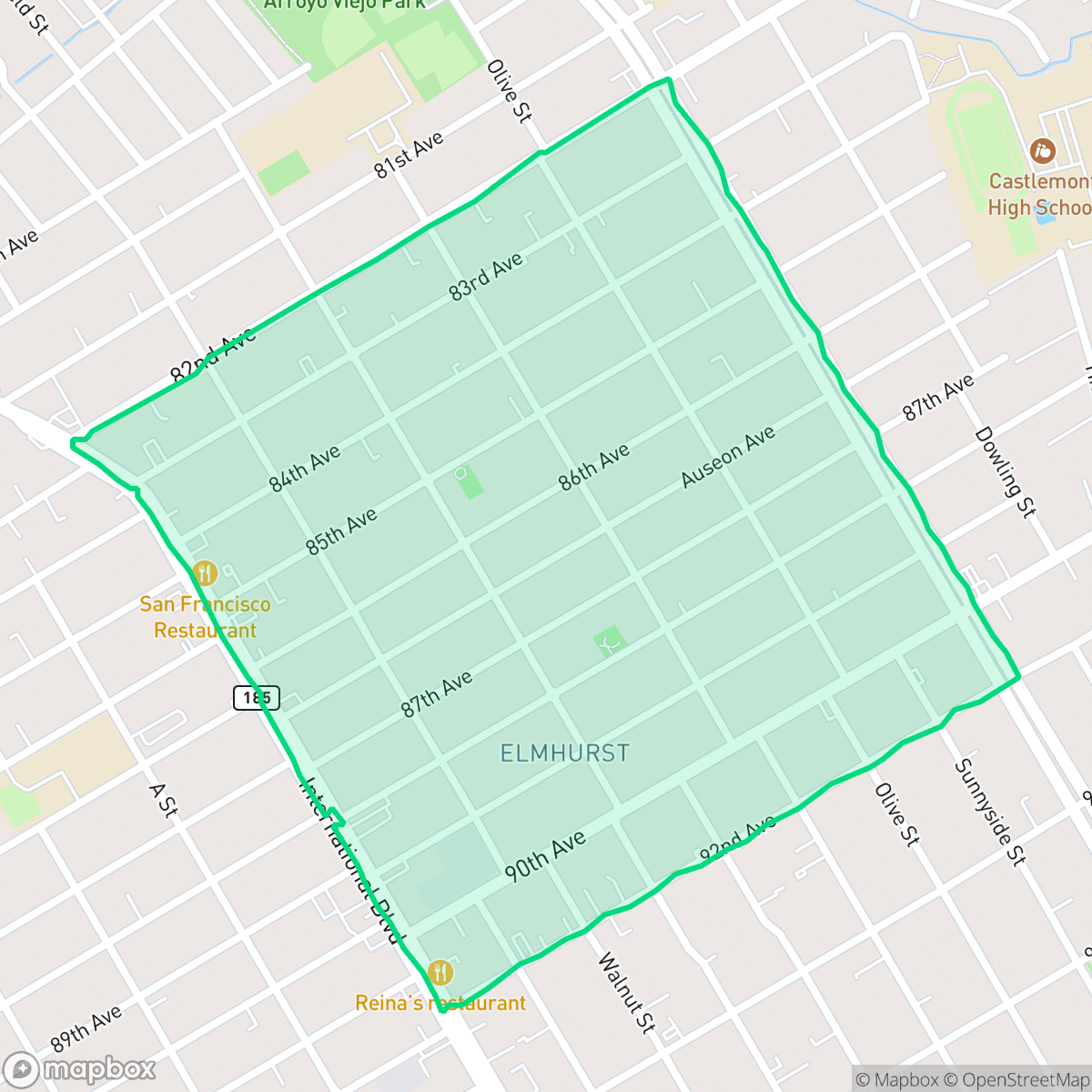
Located in East Oakland, the Webster neighborhood is a flat, grid-patterned residential community spanning between International Boulevard and Bancroft Avenue, roughly from 79th to 92nd Avenue. Developing from around 1908, the neighborhood is characterized by its neat rows of 1920s to 1940s bungalows sitting behind slim front lawns. A central historical landmark is the Daniel Webster School (now hosting East Oakland Pride Elementary), which opened in 1922 on the former Webster Academy site. The neighborhood’s primary public green space is the Eula M. Brinson Mini-Park. Culturally, Webster is defined by a diverse, close-knit community with strong Mexican and Jamaican heritage, where local life is anchored by neighborhood block gatherings, informal sidewalk stands, and nearby community institutions like the Allen Temple Baptist Church.
The neighborhood functions as a stable, low-rise residential grid that prioritizes pedestrian access with a complete sidewalk system. Residents benefit from an environment free of heavy industrial activity, contributing to a relatively calm acoustic profile despite the proximity to major transit arteries. The local housing stock consists primarily of modest, uniform structures on small lots, reflecting the development history of the area as a dense residential community.
Livability in the area is shaped by a reliance on the broader Oakland Unified School District, which currently faces significant fiscal and administrative challenges. While the neighborhood offers high levels of health insurance coverage and a strong sense of community, those seeking significant private outdoor space or diverse commercial amenities within walking distance may find the options limited. It is best suited for those who value a predictable, pedestrian-friendly environment and established community ties over proximity to luxury retail or large-scale parklands.
Neighborhood Scores Across 15 Qualities
Residential structures are closely packed with minimal separation between buildings, resulting in a lower privacy index than the Oakland average according to iHuus data.
Continuous sidewalks and clear crosswalks exist on both sides of nearly every street throughout the area. This highly regular grid offers superior pedestrian accessibility compared to the Oakland average, according to iHuus data.
Residential lots feature simple, uniform rooflines and small yards with limited private greenery. This level of visual variety is slightly below the Oakland average according to iHuus data.
Limited public green verges and narrow sidewalks make much of the area challenging for long walks. While a central public park provides some access to open space, the overall availability of dog-friendly areas is below the Oakland average.
Building density and grey surfaces are high throughout the area, resulting in a more urban feel than the typical Oakland neighborhood. According to iHuus data, the landscape consists of a dense low-rise grid with minimal open space compared to the city average.
A blend of lively urban blocks and quieter, suburban-style streets characterizes the area. According to iHuus data, the local energy and variety of amenities are slightly above the Oakland average.
Frequent sound from nearby transit corridors and rail lines defines the acoustic environment. This level of noise is slightly higher than the Oakland average, according to iHuus data.
Air quality levels in Webster fluctuate between acceptable and unhealthy, notably lower than the Oakland average. Residents with respiratory sensitivities may experience occasional concern during certain periods, according to iHuus data.
Residential and institutional uses dominate the area without any detectable warehouses or heavy industrial facilities. This neighborhood maintains a higher level of separation from industrial activity than the Oakland average, according to iHuus data.
Health insurance access is lower in Webster than the Oakland average, according to iHuus data. A portion of the local population remains uninsured.
Voting patterns and census indicators show a predominantly liberal political leaning, which is consistent with the broader Oakland area according to iHuus data.
Residents live alongside a broad mix of young adults, families, and older individuals. This demographic spread is slightly more concentrated toward younger and middle-aged populations than the Oakland average, according to iHuus data.
Flood vulnerability is significantly higher here than the Oakland average, presenting a notable risk during heavy rain events. According to iHuus data, the area lacks the natural or structural defenses found in more stable parts of the city.
Address-Level Insights for Webster


iHuus Neighborhood Intelligence Insights
Get address-level neighborhood insights for Webster
- Street-level scores — see how individual blocks compare, not just neighborhood averages
- Micro-zone boundaries — identify quiet pockets, flood boundaries, and walkable clusters before you visit
- 15 dimensions in full — walkability, noise, air quality, school quality, insurance coverage, population age profile, urban/rural index, and more
- Boundary risk alerts — know if your address sits near a block boundary where scores drop, the kind of detail no listing will ever mention
- School insights — individual school ratings and insights, not just district-level data
- Compare before you commit — side-by-side data across neighborhoods, down to block precision
No credit card required
Compare with Any Neighborhood
| Dimension | Webster | Acorn |
|---|---|---|
| 🚶 Walkabilityavg 8.99 | ||
| 🔊 Acoustic Comfortavg 3.24 | ||
| 🤫 Privacy Indexavg 3.74 | ||
| 🎨 Visual Appealavg 6.28 | ||
| 🐕 Dog Friendlinessavg 5.74 | ||
| 🗺️ Urban-Rural Indexavg 6.02 | ||
| ✨ Neighborhood Vibeavg 5.22 | ||
| 🏥 Health Insurance Coverageavg 7.4 | ||
| 🌿 Air Qualityavg 8.06 | ||
| 🏭 Industrial Proximityavg 8.37 | ||
| 🌊 Flood Safetyavg 2.61 | ||
| 🗳️ Ideological Leanavg 9.95 | ||
| 👥 Population Age Profileavg 4.92 | ||
| 🔥 Fire Safetyavg 0.17 | ||
| 🏫 School Quality |
Webster Rankings
School Districts Serving Webster
School Insights for Webster
Below average outcomes; significant attendance and academic challenges.
School Insights
See what's really behind every school rating near Webster
- Individual school ratings — each school's own score with outcome context, not just a district average
- Enrollment & class size data — student-to-teacher ratio and how it compares to the state average
- Full demographics breakdown — ethnicity and gender composition for every school in the enrollment zone
- Every school in the district — all schools within the enrollment boundary ranked by rating, not just the closest one
- Grade levels & benchmarks — elementary through high school, with below/above state-average flags
No credit card required