Upper Dimond, Oakland
Updated · 6,063 residents
Upper Dimond is an exceptionally walkable neighborhood characterized by a dense, interconnected grid and a vibrant, active atmosphere. While residents benefit from excellent air quality and a lack of industrial hazards, the area experiences high noise levels due to its proximity to major traffic corridors and features tightly packed residential lots.
Key Highlights
About Upper Dimond
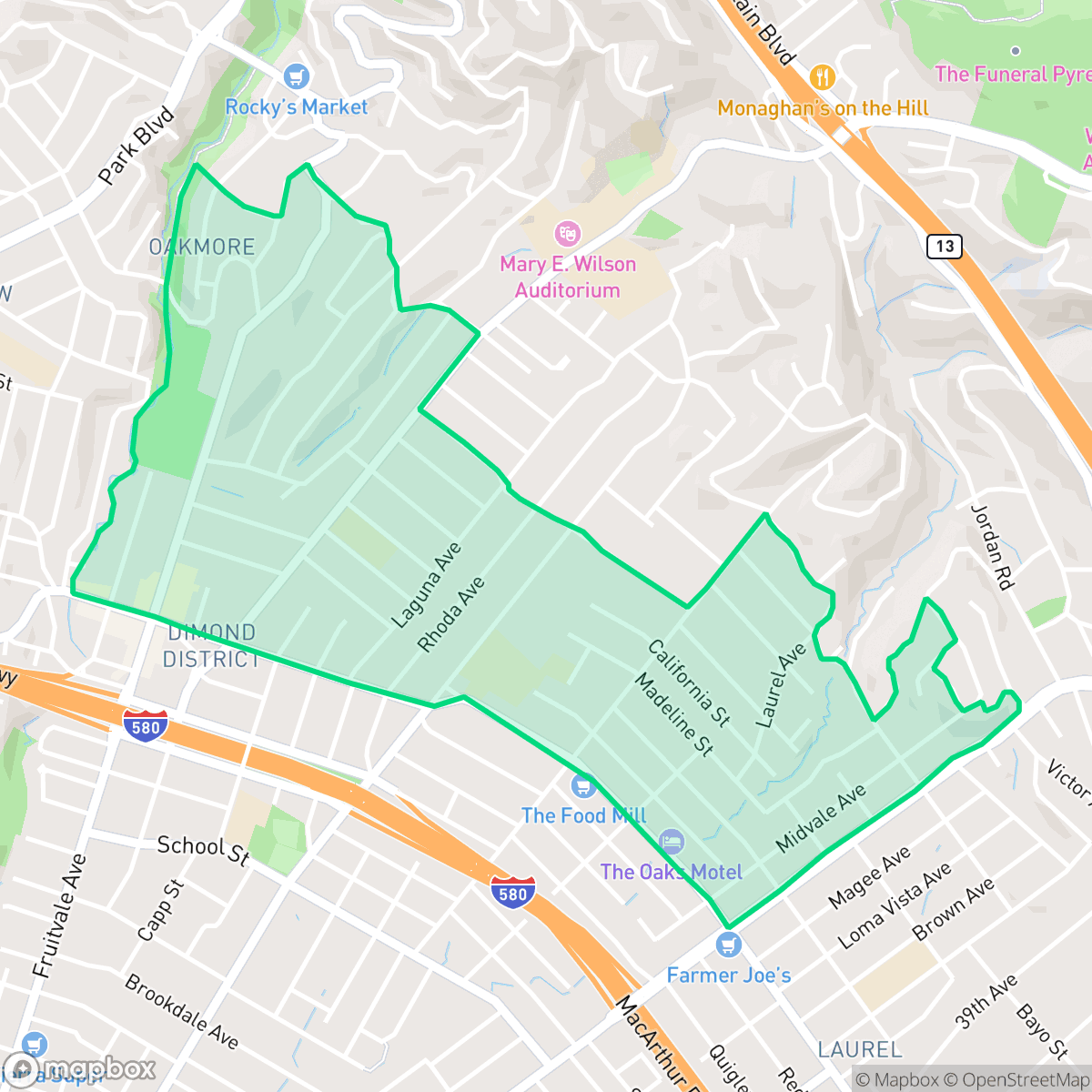
Nestled at the foot of the Oakland hills, the Upper Dimond neighborhood is named after Hugh Dimond, who purchased the land in 1867. The neighborhood boasts a rich architectural heritage, with over half of its residential housing stock built before 1939. In 1907, "Borax King" Francis Marion Smith acquired the upper canyon as part of the F.M. Smith Reserve. A portion of this reserve became Camp Dimond (originally Camp Sheaoak) in 1919, a prominent 28-acre Boy Scout camp that operated until 1948. Today, the neighborhood is defined by natural landmarks like the Upper Dimond Canyon Trail along Sausal Creek and is home to the historic flagship location of Loard’s Ice Cream, a local institution operating on MacArthur Boulevard since 1950.
The neighborhood is defined by its dense urban layout and immediate access to natural amenities like the Upper Dimond Canyon Trail. It offers a lively environment with diverse local dining options and community spaces, creating a distinct suburban-urban hybrid feel. The housing stock is varied, ranging from standard urban residences to larger, well-maintained homes, all situated within a highly accessible grid that prioritizes pedestrian movement and connectivity.
Prospective residents should consider the trade-offs associated with the area, particularly regarding acoustic comfort, as road traffic noise is a significant factor. While the neighborhood provides a high degree of health insurance coverage and clean air, the local school district faces systemic challenges, including budget deficits and performance issues. The area is best suited for those who prioritize walkability and access to local amenities over absolute quiet or top-tier public school performance.
Neighborhood Scores Across 15 Qualities
Residential structures feature a moderate level of separation with some houses benefiting from mature tree buffers. According to iHuus data, this degree of spacing provides slightly more privacy from neighbors than the Oakland average.
A well-defined grid with consistent sidewalks and frequent crosswalks makes navigating the area easy on foot. The neighborhood's pedestrian infrastructure is on par with the Oakland average, offering safe movement through residential streets and low-traffic areas.
Manicured grounds, large homes, and private pools contribute to a visual profile that is more polished than the Oakland average. According to iHuus data, the presence of complex architecture and well-maintained properties creates a more premium streetscape than much of the surrounding city.
Access to large reservoir parks, wooded slopes, and connected green spaces makes this area more dog friendly than the Oakland average. Wide paths and tree-lined streets provide reliable walking routes, though some denser residential pockets have limited yard space.
Significant tree canopy and pockets of open land provide a more semi-rural feel than much of Oakland. Residents will find a landscape of single-family homes integrated with mature greenery, according to iHuus data.
Local dining, parks, and community landmarks create a more active atmosphere than the Oakland average. While some residential blocks remain quiet and suburban, there is a notable concentration of social hubs and eateries throughout the area according to iHuus data.
Frequent noise from nearby freeway corridors and railroad tracks makes this area noisier than the Oakland average. Residents may experience consistent auditory disturbances from heavy transit patterns, according to iHuus data.
Air quality in this area is consistently high and presents little to no health concern. According to iHuus data, the air quality here is notably better than the Oakland average.
Industrial activity and heavy warehouses are entirely absent from this area. Residents benefit from a purely residential and light commercial environment that is significantly cleaner of industrial hazards than the Oakland average, according to iHuus data.
Health insurance access is very high among residents, significantly outpacing the Oakland average according to iHuus data.
Voting patterns and census indicators reflect a highly liberal political leaning that is slightly more pronounced than the Oakland average.
Residents live alongside a varied mix of young professionals, families, and seniors. This demographic spread is slightly more balanced than the average found across Oakland, according to iHuus data.
Flood risk levels in this area remain undetermined because FEMA has not yet completed a detailed study. However, according to iHuus data, the potential for flooding is higher than the Oakland city average.
Address-Level Insights for Upper Dimond


iHuus Neighborhood Intelligence Insights
Get address-level neighborhood insights for Upper Dimond
- Street-level scores — see how individual blocks compare, not just neighborhood averages
- Micro-zone boundaries — identify quiet pockets, flood boundaries, and walkable clusters before you visit
- 15 dimensions in full — walkability, noise, air quality, school quality, insurance coverage, population age profile, urban/rural index, and more
- Boundary risk alerts — know if your address sits near a block boundary where scores drop, the kind of detail no listing will ever mention
- School insights — individual school ratings and insights, not just district-level data
- Compare before you commit — side-by-side data across neighborhoods, down to block precision
No credit card required
Compare with Any Neighborhood
| Dimension | Upper Dimond | Acorn |
|---|---|---|
| 🚶 Walkabilityavg 8.99 | ||
| 🔊 Acoustic Comfortavg 3.24 | ||
| 🤫 Privacy Indexavg 3.74 | ||
| 🎨 Visual Appealavg 6.28 | ||
| 🐕 Dog Friendlinessavg 5.74 | ||
| 🗺️ Urban-Rural Indexavg 6.02 | ||
| ✨ Neighborhood Vibeavg 5.22 | ||
| 🏥 Health Insurance Coverageavg 7.4 | ||
| 🌿 Air Qualityavg 8.06 | ||
| 🏭 Industrial Proximityavg 8.37 | ||
| 🌊 Flood Safetyavg 2.61 | ||
| 🗳️ Ideological Leanavg 9.95 | ||
| 👥 Population Age Profileavg 4.92 | ||
| 🔥 Fire Safetyavg 0.17 | ||
| 🏫 School Quality |
Upper Dimond Rankings
School Districts Serving Upper Dimond
School Insights for Upper Dimond
Below average outcomes; significant attendance and academic challenges.
School Insights
See what's really behind every school rating near Upper Dimond
- Individual school ratings — each school's own score with outcome context, not just a district average
- Enrollment & class size data — student-to-teacher ratio and how it compares to the state average
- Full demographics breakdown — ethnicity and gender composition for every school in the enrollment zone
- Every school in the district — all schools within the enrollment boundary ranked by rating, not just the closest one
- Grade levels & benchmarks — elementary through high school, with below/above state-average flags
No credit card required