Trestle Glen, Oakland
Updated · 3,690 residents
Trestle Glen is a visually striking neighborhood defined by its winding streets and historic period revival architecture. While the area offers high aesthetic appeal and a strong sense of community, residents face significant noise levels from nearby highway traffic and should be aware of high fire safety risks.
Key Highlights
About Trestle Glen
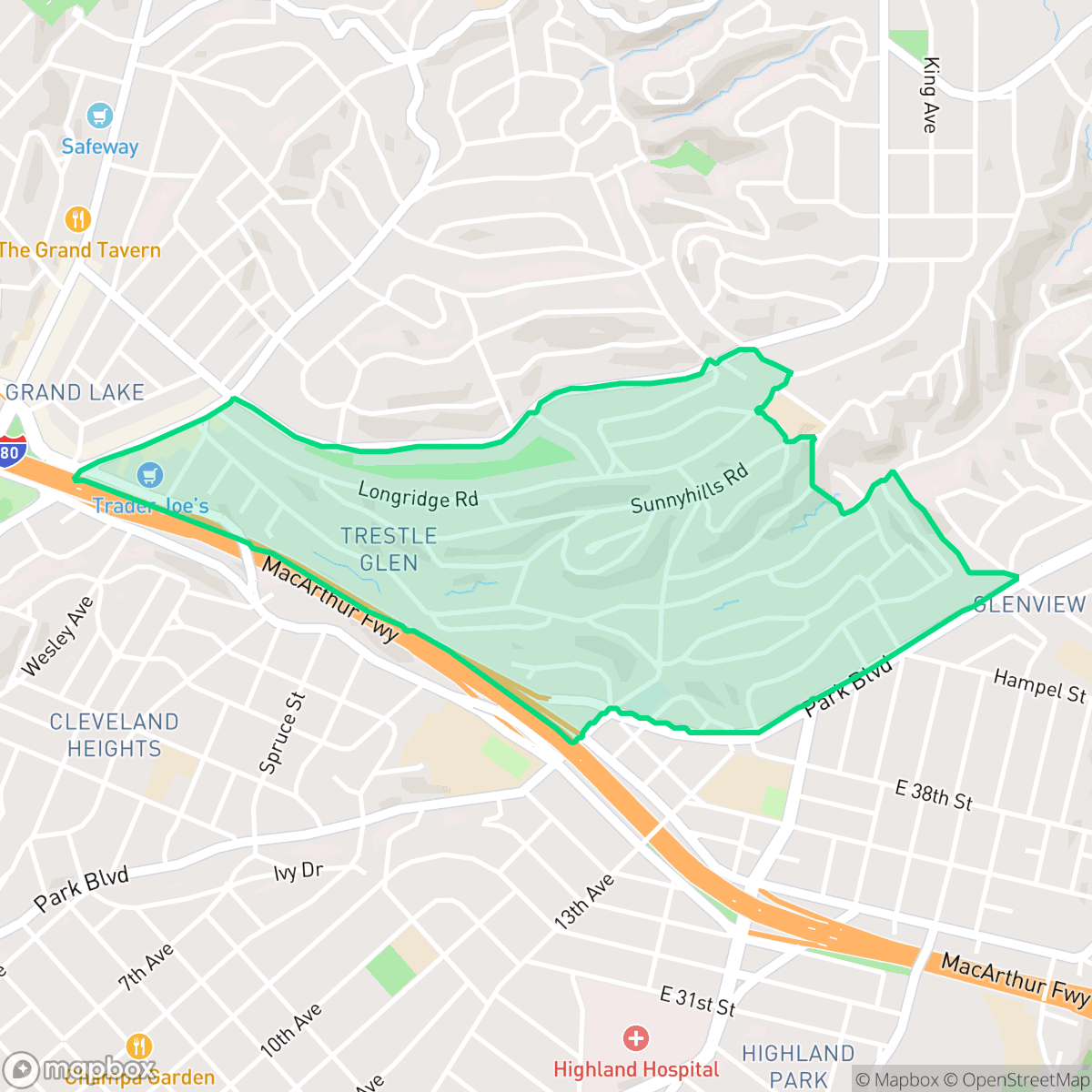
Originally home to a Huchiun (Ohlone) village along Indian Gulch (now Trestle Glen Creek), the Oakland neighborhood of Trestle Glen is named for an 1893 wooden railway trestle built to carry picnickers to Sather Park. In 1915, the Olmsted Brothers designed a master plan for the area, marketed as "Lakeshore Highlands". Developed primarily in the 1920s by Frank C. Havens and Walter Leimert, the neighborhood is characterized by the winding, curvilinear streets of the early 20th-century garden suburb movement. Its hilly terrain features a rich stock of period revival homes—including Tudor, Spanish, and Craftsman styles—designed by prominent architects such as Julia Morgan and Bernard Maybeck. Trestle Glen is governed by the Lakeshore Homes Association; established in 1917, it is the second-oldest homeowners association west of the Mississippi River.
The neighborhood serves as a prime example of early 20th-century urban planning, featuring a dense canopy of mature trees and well-maintained residential architecture. It provides a quiet, leafy aesthetic despite being located near major transportation arteries. The area is exclusively residential, free from industrial activity, and maintains a high standard of health insurance coverage for its residents, according to local data.
Neighborhood Scores Across 15 Qualities
Residential spacing is notably more open than the Oakland average, featuring a mix of detached homes and greenery that provides visual buffering between neighbors. While some areas have closer building proximities, many properties maintain significant distance and yard space between structures.
Tree-lined streets and wide sidewalks offer pleasant pedestrian routes, though the presence of a major high-traffic freeway corridor makes the area slightly less walkable than the Oakland average. Most residential roads feature continuous sidewalk networks and safe crossings for residents.
Large homes with complex architecture and well-maintained landscapes characterize this area. According to iHuus data, the prevalence of private amenities like pools and tennis courts makes the visual environment significantly more polished than the Oakland average.
Wide green verges, mature tree canopies, and proximity to large wooded parklands provide ample space for pets. According to iHuus data, the area offers more accessible walking paths and greenery than the Oakland average.
Residential streets feature a consistent mix of single-family homes and mature tree canopies, matching the city average for urban-rural balance. According to iHuus data, the area provides a stable blend of built environments and greenery.
Local social hubs and diverse dining options provide more activity than the typical Oakland neighborhood, though many destinations require a car to reach. According to iHuus data, the area features a balanced mix of green space and community spots like cafes and bakeries.
Frequent auditory disturbances from nearby railroad tracks and freeway traffic are common in this area. According to iHuus data, acoustic comfort in Trestle Glen is lower than the Oakland average.
Air quality is consistently good with rare instances of elevated readings. This level of air cleanliness is nearly identical to the Oakland average, according to iHuus data.
Industrial activity is entirely absent from this area, offering a purely residential and light commercial environment that is significantly cleaner of heavy industry than the Oakland average.
Health insurance access is nearly universal among residents, representing a significantly higher rate of coverage than the Oakland average according to iHuus data.
Voting patterns and census indicators show a deeply liberal political leaning that is consistent with the broader Oakland area.
Residents live alongside a balanced mix of young adults, families, and older populations. This demographic spread is slightly more varied than the average found across Oakland, according to iHuus data.
Flood risk in this area is notably higher than the Oakland average, though detailed federal studies for this specific location are currently incomplete. Residents should remain aware of potential drainage considerations during heavy rain events.
Address-Level Insights for Trestle Glen


iHuus Neighborhood Intelligence Insights
Get address-level neighborhood insights for Trestle Glen
- Street-level scores — see how individual blocks compare, not just neighborhood averages
- Micro-zone boundaries — identify quiet pockets, flood boundaries, and walkable clusters before you visit
- 15 dimensions in full — walkability, noise, air quality, school quality, insurance coverage, population age profile, urban/rural index, and more
- Boundary risk alerts — know if your address sits near a block boundary where scores drop, the kind of detail no listing will ever mention
- School insights — individual school ratings and insights, not just district-level data
- Compare before you commit — side-by-side data across neighborhoods, down to block precision
No credit card required
Compare with Any Neighborhood
| Dimension | Trestle Glen | Acorn |
|---|---|---|
| 🚶 Walkabilityavg 8.99 | ||
| 🔊 Acoustic Comfortavg 3.24 | ||
| 🤫 Privacy Indexavg 3.74 | ||
| 🎨 Visual Appealavg 6.28 | ||
| 🐕 Dog Friendlinessavg 5.74 | ||
| 🗺️ Urban-Rural Indexavg 6.02 | ||
| ✨ Neighborhood Vibeavg 5.22 | ||
| 🏥 Health Insurance Coverageavg 7.4 | ||
| 🌿 Air Qualityavg 8.06 | ||
| 🏭 Industrial Proximityavg 8.37 | ||
| 🌊 Flood Safetyavg 2.61 | ||
| 🗳️ Ideological Leanavg 9.95 | ||
| 👥 Population Age Profileavg 4.92 | ||
| 🔥 Fire Safetyavg 0.17 | ||
| 🏫 School Quality |
Trestle Glen Rankings
School Districts Serving Trestle Glen
School Insights for Trestle Glen
Below average outcomes; significant attendance and academic challenges.
School Insights
See what's really behind every school rating near Trestle Glen
- Individual school ratings — each school's own score with outcome context, not just a district average
- Enrollment & class size data — student-to-teacher ratio and how it compares to the state average
- Full demographics breakdown — ethnicity and gender composition for every school in the enrollment zone
- Every school in the district — all schools within the enrollment boundary ranked by rating, not just the closest one
- Grade levels & benchmarks — elementary through high school, with below/above state-average flags
No credit card required