Toler Heights, Oakland
Updated · 2,148 residents
Toler Heights is a quiet, residential neighborhood in East Oakland characterized by its exceptional walkability and high level of dog friendliness. The area offers a blend of suburban streets and open green spaces, providing a peaceful environment that stands apart from the density of central Oakland.
Key Highlights
About Toler Heights
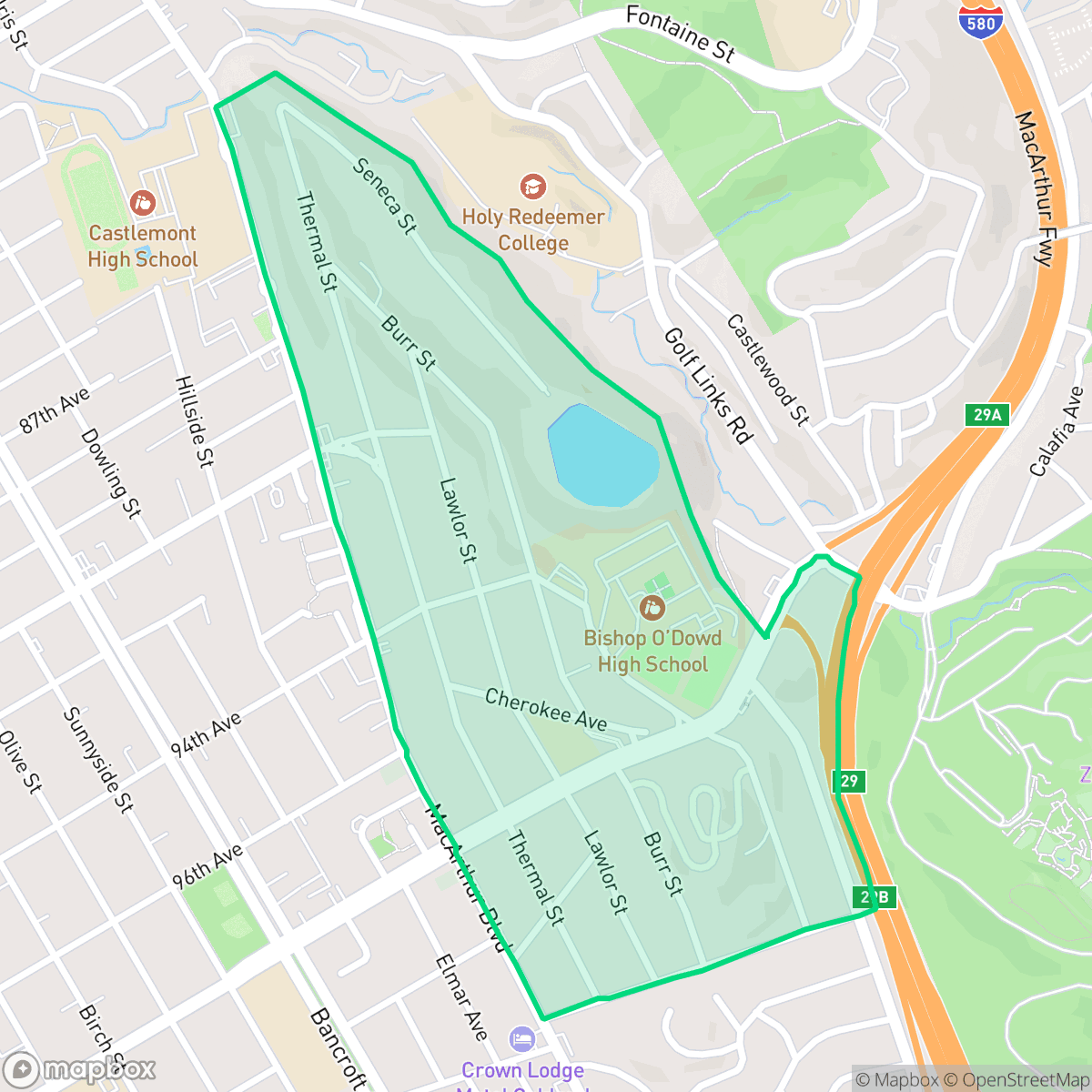
Located in East Oakland, California, the Toler Heights neighborhood originated from the 330-acre Toler Ranch, owned by William Pinkney Toler and Maria Antonia Peralta, daughter of the prominent Californio landowner Ignacio Peralta. Following William's death, the ranch was sold to the Realty Syndicate and subdivided, with residential sales launching in 1907. Marketed as "The Piedmont of East Oakland" due to its elevated, panoramic views of the San Francisco Bay, the tract underwent major improvements under the Henderson & Tapscotts Company in 1910. The neighborhood’s early growth was catalyzed by the 1911 completion of the Oakland Traction Company’s Toler Heights streetcar extension along 90th Avenue, which connected the scenic foothill community to downtown Oakland.
Toler Heights is a predominantly residential enclave in East Oakland known for its hilly terrain and tranquil atmosphere. The community features numerous green spaces and high walkability, making it a practical choice for those who value pedestrian access to local services. The neighborhood maintains a distinct suburban feel, benefiting from low industrial proximity and a relatively quiet acoustic environment compared to the broader city average. Residents enjoy a high level of health insurance coverage and a stable, community-focused environment.
Prospective residents should note that the area faces significant challenges regarding fire and flood safety, which are important factors to consider when evaluating property. While the neighborhood offers a peaceful setting, families with school-age children should be aware that the local public schools within the Oakland Unified School District currently face systemic instability. However, the nearby Francophone Charter School of Oakland provides a higher-rated alternative for local students. The area is best suited for individuals seeking a quiet, dog-friendly environment who are prepared to navigate the complexities of the local school system and regional safety considerations.
Neighborhood Scores Across 15 Qualities
Residential structures feature mixed spacing with some buffer between neighbors, offering more separation than the typical density found across Oakland. According to iHuus data, houses are often closely situated with small side yards.
Pedestrian movement is easy due to a consistent grid with sidewalks on both sides of nearly every street. According to iHuus data, the availability of clear crosswalks and dedicated sidewalks makes this area more walkable than the Oakland average.
Uniform residential tract housing characterizes the area, featuring consistent rooflines and small yards. This visual landscape is slightly below the Oakland average for architectural variety.
Continuous sidewalks and accessible public parks provide reliable walking routes for pets. According to iHuus data, the area offers more integrated green space for animals than the Oakland average.
A mix of dense residential grids and low-density housing characterizes the area, offering more open space and greenery than the Oakland average according to iHuus data.
Local activity levels are below the Oakland average, characterized by a subdued atmosphere of suburban streets and scattered greenery. Residents will find a low-density setting where services are sparse and some areas require a car for most errands.
Local traffic from nearby busy streets creates a consistent level of sound, though this is notably quieter than the typical noise levels found across Oakland. According to iHuus data, the area maintains a moderate level of acoustic activity.
Air quality levels fluctuate between acceptable and unhealthy, remaining notably lower than the Oakland average according to iHuus data. Residents in sensitive groups may experience occasional concern during certain periods.
Industrial activity is virtually nonexistent here, as the area consists entirely of residential, commercial, and educational zones. According to iHuus data, this lack of heavy industry and large warehouses makes the neighborhood notably cleaner of industrial hazards than the Oakland average.
Health insurance coverage among residents is lower than the Oakland average. According to iHuus data, fewer than half of the local population is covered by a health plan.
Voting patterns and census indicators show a predominantly liberal community, which is slightly more pronounced than the average across Oakland. According to iHuus data, residents in this area share highly aligned political and social values.
Residents live alongside a varied mix of young professionals, families, and seniors. According to iHuus data, this age distribution is slightly more centered around middle-aged groups than the broader Oakland average.
Extreme flood vulnerability and potential wave action characterize this area, placing it at a significantly higher risk level than the Oakland average. Residents should anticipate elevated or potentially prohibitive flood insurance costs according to iHuus data.
Address-Level Insights for Toler Heights


iHuus Neighborhood Intelligence Insights
Get address-level neighborhood insights for Toler Heights
- Street-level scores — see how individual blocks compare, not just neighborhood averages
- Micro-zone boundaries — identify quiet pockets, flood boundaries, and walkable clusters before you visit
- 15 dimensions in full — walkability, noise, air quality, school quality, insurance coverage, population age profile, urban/rural index, and more
- Boundary risk alerts — know if your address sits near a block boundary where scores drop, the kind of detail no listing will ever mention
- School insights — individual school ratings and insights, not just district-level data
- Compare before you commit — side-by-side data across neighborhoods, down to block precision
No credit card required
Compare with Any Neighborhood
| Dimension | Toler Heights | Acorn |
|---|---|---|
| 🚶 Walkabilityavg 8.99 | ||
| 🔊 Acoustic Comfortavg 3.24 | ||
| 🤫 Privacy Indexavg 3.74 | ||
| 🎨 Visual Appealavg 6.28 | ||
| 🐕 Dog Friendlinessavg 5.74 | ||
| 🗺️ Urban-Rural Indexavg 6.02 | ||
| ✨ Neighborhood Vibeavg 5.22 | ||
| 🏥 Health Insurance Coverageavg 7.4 | ||
| 🌿 Air Qualityavg 8.06 | ||
| 🏭 Industrial Proximityavg 8.37 | ||
| 🌊 Flood Safetyavg 2.61 | ||
| 🗳️ Ideological Leanavg 9.95 | ||
| 👥 Population Age Profileavg 4.92 | ||
| 🔥 Fire Safetyavg 0.17 | ||
| 🏫 School Quality |
Toler Heights Rankings
School Districts Serving Toler Heights
School Insights for Toler Heights
Below average outcomes; significant attendance and academic challenges.
School Insights
See what's really behind every school rating near Toler Heights
- Individual school ratings — each school's own score with outcome context, not just a district average
- Enrollment & class size data — student-to-teacher ratio and how it compares to the state average
- Full demographics breakdown — ethnicity and gender composition for every school in the enrollment zone
- Every school in the district — all schools within the enrollment boundary ranked by rating, not just the closest one
- Grade levels & benchmarks — elementary through high school, with below/above state-average flags
No credit card required