Temescal, Oakland
Updated · 4,776 residents
Temescal is an exceptionally walkable urban neighborhood defined by its dense grid of 1920s Craftsman bungalows and a bustling culinary corridor along Telegraph Avenue. While the area offers excellent air quality and high health insurance coverage, residents experience limited privacy due to high density and elevated noise levels from local road traffic.
Key Highlights
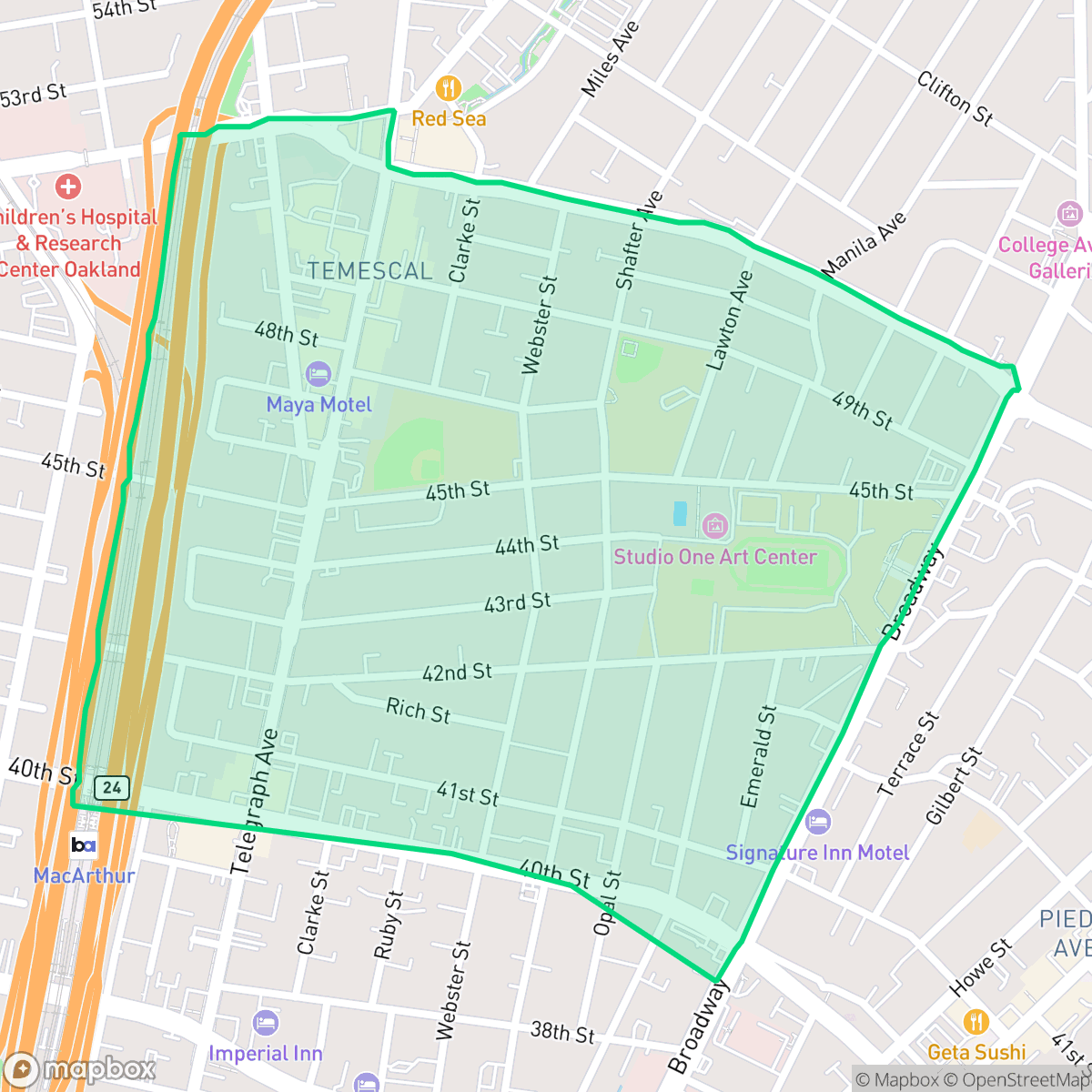
About Temescal
One of Oakland's oldest neighborhoods, Temescal grew as an unincorporated village around Vicente Peralta's 1836 estate along Temescal Creek. Named after the Nahuatl word for indigenous sweat lodges, the area evolved into a bustling transit hub with a horsecar line established in the 1870s. Annexed by Oakland in 1897, Temescal became a prominent working-class Italian-American enclave, earning the nickname "Little Italy" and hosting the historic Colombo Club. Architecturally, the neighborhood is celebrated for its well-preserved 1920s Craftsman bungalows. While the construction of Highway 24 divided the community in the mid-20th century, Temescal has experienced a major revitalization. Today, centered on Telegraph Avenue, it is a vibrant cultural and culinary hub, featuring landmarks like Oakland Technical High School and a diverse array of global eateries.
The area serves as a primary cultural and transit corridor in North Oakland, characterized by a dense, pedestrian-friendly layout that encourages foot traffic. Residents benefit from a robust selection of global eateries and proximity to major transit arteries, which contribute to the neighborhood's lively atmosphere. According to iHuus data, the community maintains a high level of air quality and a lack of heavy industrial presence, making it a clean urban environment despite its compact footprint.
Prospective residents should consider the trade-offs of this high-density setting, which includes limited acoustic comfort due to road traffic and closely spaced housing that offers little privacy. While the neighborhood provides a strong sense of community and accessibility, the local school district faces significant challenges with budget deficits and facility maintenance. It is best suited for those who prioritize walkability and urban convenience over quiet, secluded living.
Neighborhood Scores Across 15 Qualities
Residential structures are closely packed with very little separation between homes. According to iHuus data, this level of density is notably higher than the Oakland average, with many properties featuring narrow lots or shared property lines.
Pedestrian travel is seamless due to a dense grid of streets featuring continuous sidewalks and frequent crosswalks. This level of connectivity and infrastructure is superior to the Oakland average.
Housing consists primarily of modest, single-family and multi-unit homes with small yards and simple rooflines. This visual profile is slightly below the Oakland average for visual variety and luxury amenities.
Walking routes for pets are supported by tree-lined streets and nearby school fields, though the availability of public green space is slightly below the Oakland average. According to iHuus data, some denser parts of the neighborhood feature narrower sidewalks and more limited access to public parks.
Dense residential blocks of multi-story apartments and single-family homes create a suburban feel that is consistent with the Oakland average. The area features a high degree of pavement coverage with limited natural open space, according to iHuus data.
Diverse dining options and local destinations create a much more energetic atmosphere than the Oakland average. According to iHuus data, residents have access to a wide variety of culinary spots ranging from cafes to international cuisine within the area.
Frequent disturbances from nearby railroad tracks and heavy freeway traffic are common in this area. Acoustic comfort is notably lower than the Oakland average according to iHuus data.
Air quality remains consistently high with minimal health concerns. According to iHuus data, these levels are notably better than the Oakland average.
Residential and light commercial uses dominate the landscape, with no heavy warehouses or industrial hazards detected. This area offers a significantly cleaner environment regarding industrial proximity compared to the Oakland average, according to iHuus data.
Health insurance enrollment among residents is notably higher than the Oakland average, according to iHuus data.
Voting patterns and census indicators show a deeply liberal political leaning that is slightly more pronounced than the Oakland average, according to iHuus data.
Residents of all ages reside here, ranging from young professionals to established families and seniors. This demographic distribution is consistent with the broader Oakland area according to iHuus data.
Flood risk in this area is notably higher than the Oakland average. According to iHuus data, the precise level of danger remains undetermined because detailed federal flood studies have not yet been completed for this specific zone.
Address-Level Insights for Temescal


iHuus Neighborhood Intelligence Insights
Get address-level neighborhood insights for Temescal
- Street-level scores — see how individual blocks compare, not just neighborhood averages
- Micro-zone boundaries — identify quiet pockets, flood boundaries, and walkable clusters before you visit
- 15 dimensions in full — walkability, noise, air quality, school quality, insurance coverage, population age profile, urban/rural index, and more
- Boundary risk alerts — know if your address sits near a block boundary where scores drop, the kind of detail no listing will ever mention
- School insights — individual school ratings and insights, not just district-level data
- Compare before you commit — side-by-side data across neighborhoods, down to block precision
No credit card required
Compare with Any Neighborhood
| Dimension | Temescal | Acorn |
|---|---|---|
| 🚶 Walkabilityavg 8.99 | ||
| 🔊 Acoustic Comfortavg 3.24 | ||
| 🤫 Privacy Indexavg 3.74 | ||
| 🎨 Visual Appealavg 6.28 | ||
| 🐕 Dog Friendlinessavg 5.74 | ||
| 🗺️ Urban-Rural Indexavg 6.02 | ||
| ✨ Neighborhood Vibeavg 5.22 | ||
| 🏥 Health Insurance Coverageavg 7.4 | ||
| 🌿 Air Qualityavg 8.06 | ||
| 🏭 Industrial Proximityavg 8.37 | ||
| 🌊 Flood Safetyavg 2.61 | ||
| 🗳️ Ideological Leanavg 9.95 | ||
| 👥 Population Age Profileavg 4.92 | ||
| 🔥 Fire Safetyavg 0.17 | ||
| 🏫 School Quality |
Temescal Rankings
School Districts Serving Temescal
School Insights for Temescal
Below average outcomes; significant attendance and academic challenges.
School Insights
See what's really behind every school rating near Temescal
- Individual school ratings — each school's own score with outcome context, not just a district average
- Enrollment & class size data — student-to-teacher ratio and how it compares to the state average
- Full demographics breakdown — ethnicity and gender composition for every school in the enrollment zone
- Every school in the district — all schools within the enrollment boundary ranked by rating, not just the closest one
- Grade levels & benchmarks — elementary through high school, with below/above state-average flags
No credit card required