South Stonehurst, Oakland
Updated · 1,434 residents
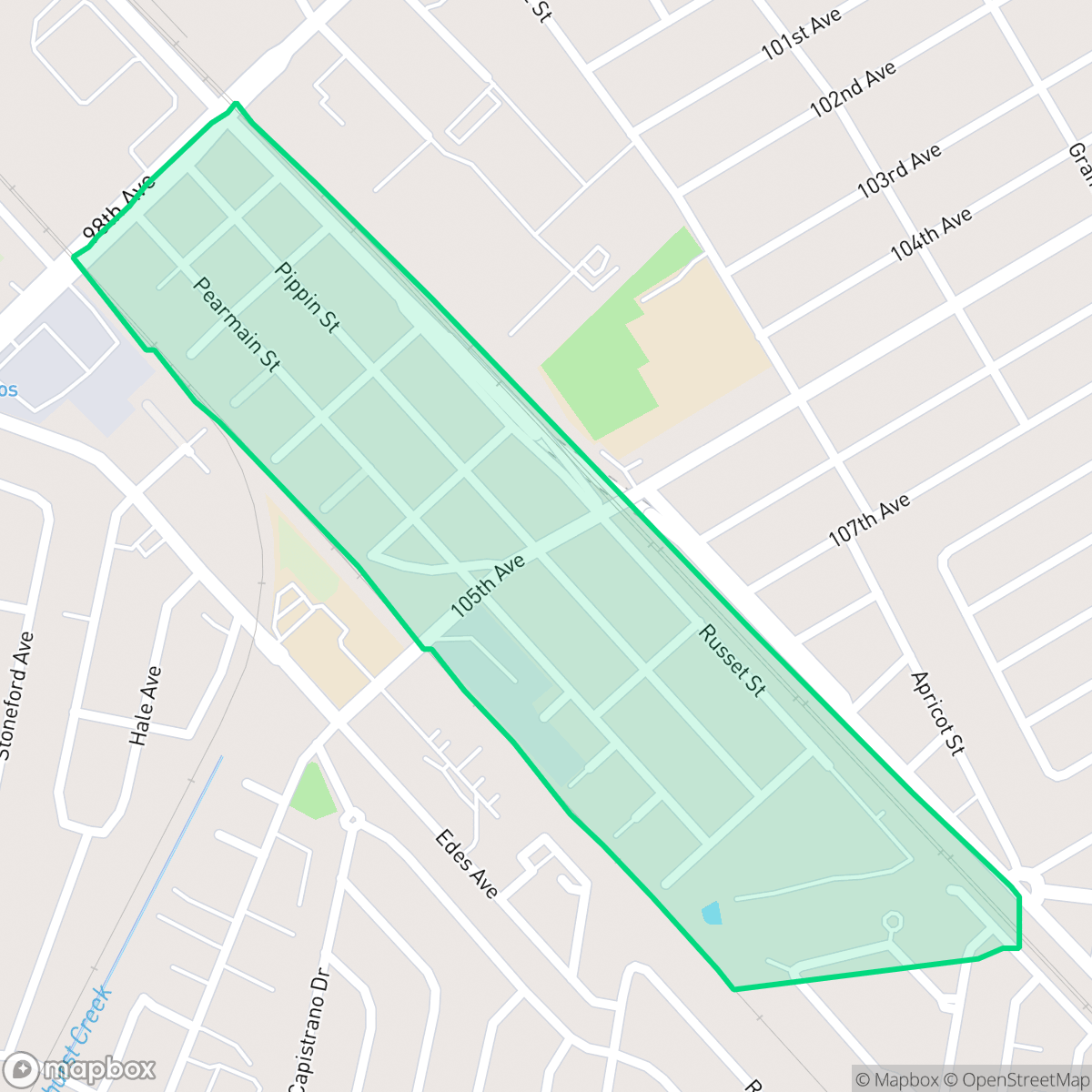
South Stonehurst is a compact East Oakland neighborhood defined by its dense, mid-century tract housing and industrial legacy. While residents benefit from a consistent sidewalk network, the area experiences moderate noise levels from nearby rail corridors and industrial activity.
Key Highlights
About South Stonehurst
South Stonehurst in East Oakland traces its origins to the 1860s when fruit farmer Lysander Stone settled on 256 acres in the area. The neighborhood grew following the arrival of the Southern Pacific Railroad’s Stonehurst branch in 1877, remnants of which still run down 105th Avenue. In 1915, working-class residents successfully petitioned for the establishment of Stonehurst Elementary School to serve local children. Most notably, civil rights icon Fred Korematsu and his brothers grew up on Edes Avenue in the neighborhood and attended Stonehurst Elementary. In 2006, the school was renamed the Fred T. Korematsu Discovery Academy in his honor. Today, South Stonehurst retains its historic working-class character, defined by a mix of mid-century single-family homes, industrial history, and deep community roots.
The area maintains a quiet, urban atmosphere characterized by uniform residential architecture and proximity to local light industrial zones. According to iHuus data, the neighborhood offers a functional, grid-based layout that supports pedestrian movement, though the presence of large rail corridors and warehouses creates physical barriers and contributes to a steady ambient noise level. The streetscape is primarily composed of boxy, mid-century homes with narrow side-yard setbacks, reflecting the high-density nature of the local residential environment.
Prospective residents should note that the neighborhood features limited private yard space and minimal public green areas. While it provides a stable, working-class residential environment, the combination of industrial proximity and moderate air quality considerations makes it a practical choice for those prioritizing central location and community history over expansive outdoor amenities. The area is best suited for individuals who value a dense, urban setting and proximity to transit corridors over suburban-style open space.
Neighborhood Scores Across 15 Qualities
Homes are closely packed with narrow side-yard setbacks and minimal separation between structures. This density is slightly higher than the Oakland average, according to iHuus data.
Pedestrian access is reliable throughout much of the area due to consistent sidewalk networks and marked crosswalks. While the neighborhood is slightly less walkable than the Oakland average, most residential streets feature dedicated pathways for safe travel.
Standard tract housing with small, uniform lots and boxy rooflines characterizes the area. This residential aesthetic is less varied than the Oakland average, featuring modest yards and minimal private luxury amenities according to iHuus data.
Public green space is restricted to a single small central park, as the area is dominated by private fenced yards and narrow sidewalks. According to iHuus data, this lack of accessible parkland and wide verges makes the neighborhood less dog friendly than the Oakland average.
Residential streets and green spaces are distributed in roughly equal measure. This balance of built environments and vegetation is nearly identical to the Oakland city average, according to iHuus data.
Low levels of commercial activity and light industrial presence create a more subdued environment than the Oakland average. Most areas feature a calm, suburban rhythm with limited access to dense retail hubs.
A steady hum of traffic from nearby busy streets is present, though the acoustic environment is slightly calmer than the Oakland average according to iHuus data.
Occasional periods of unhealthy air may occur, which is notably lower than the Oakland average according to iHuus data. Sensitive groups should monitor local conditions during days when air quality is less than optimal.
Large warehouses and active freight rail lines are concentrated along the southern edge of the area. This creates significantly more industrial activity and truck traffic than is typical for the rest of Oakland.
Health insurance enrollment among residents is relatively high, though it falls slightly below the Oakland average according to iHuus data.
Voting patterns and census indicators reflect a predominantly liberal political leaning that is consistent with the city average.
Residents live alongside a varied demographic of young adults, families, and seniors. According to iHuus data, this age distribution is slightly more concentrated in certain age brackets compared to the Oakland average.
Properties in this area are located within a designated floodplain, meaning residents may face higher flood risks and a likely requirement for flood insurance. According to iHuus data, the vulnerability to flooding in South Stonehurst is slightly higher than the Oakland city average.
Address-Level Insights for South Stonehurst


iHuus Neighborhood Intelligence Insights
Get address-level neighborhood insights for South Stonehurst
- Street-level scores — see how individual blocks compare, not just neighborhood averages
- Micro-zone boundaries — identify quiet pockets, flood boundaries, and walkable clusters before you visit
- 15 dimensions in full — walkability, noise, air quality, school quality, insurance coverage, population age profile, urban/rural index, and more
- Boundary risk alerts — know if your address sits near a block boundary where scores drop, the kind of detail no listing will ever mention
- School insights — individual school ratings and insights, not just district-level data
- Compare before you commit — side-by-side data across neighborhoods, down to block precision
No credit card required
Compare with Any Neighborhood
| Dimension | South Stonehurst | Acorn |
|---|---|---|
| 🚶 Walkabilityavg 8.99 | ||
| 🔊 Acoustic Comfortavg 3.24 | ||
| 🤫 Privacy Indexavg 3.74 | ||
| 🎨 Visual Appealavg 6.28 | ||
| 🐕 Dog Friendlinessavg 5.74 | ||
| 🗺️ Urban-Rural Indexavg 6.02 | ||
| ✨ Neighborhood Vibeavg 5.22 | ||
| 🏥 Health Insurance Coverageavg 7.4 | ||
| 🌿 Air Qualityavg 8.06 | ||
| 🏭 Industrial Proximityavg 8.37 | ||
| 🌊 Flood Safetyavg 2.61 | ||
| 🗳️ Ideological Leanavg 9.95 | ||
| 👥 Population Age Profileavg 4.92 | ||
| 🔥 Fire Safetyavg 0.17 | ||
| 🏫 School Quality |
South Stonehurst Rankings
School Districts Serving South Stonehurst
School Insights for South Stonehurst
Below average outcomes; significant attendance and academic challenges.
School Insights
See what's really behind every school rating near South Stonehurst
- Individual school ratings — each school's own score with outcome context, not just a district average
- Enrollment & class size data — student-to-teacher ratio and how it compares to the state average
- Full demographics breakdown — ethnicity and gender composition for every school in the enrollment zone
- Every school in the district — all schools within the enrollment boundary ranked by rating, not just the closest one
- Grade levels & benchmarks — elementary through high school, with below/above state-average flags
No credit card required