South Prescott, Oakland
Updated · 1,192 residents
South Prescott is a compact West Oakland neighborhood defined by its industrial landscape and proximity to major transportation corridors. Residents experience a dense urban environment characterized by limited privacy, significant road noise, and a lack of public green space.
Key Highlights
About South Prescott
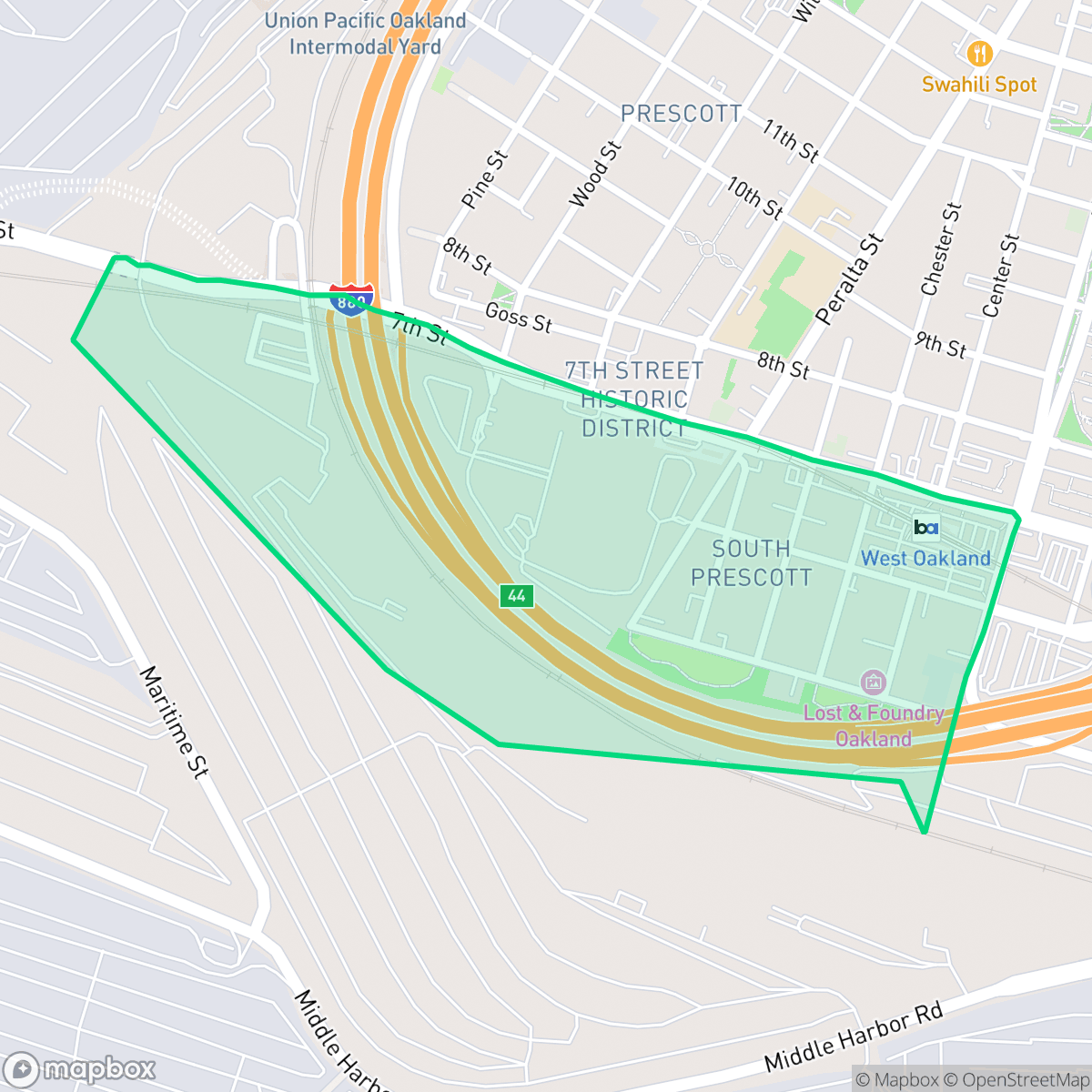
South Prescott is a small, historic neighborhood in West Oakland, California, situated south of 7th Street and the elevated BART tracks. Originally part of Oakland Point, the area developed after 1869 around the transcontinental railroad and the Southern Pacific Yard. It became a vibrant, multicultural hub; before World War II, many Mexican and Puerto Rican railroad workers settled here alongside a prominent African American community. Notably, the first West Coast headquarters of the Brotherhood of Sleeping Car Porters was established in the neighborhood at 517 Wood Street. During the 1950s and 1960s, urban renewal projects—specifically the construction of the Oakland Main Post Office and the West Oakland BART line—led to the demolition of many of South Prescott's historic Victorian homes, displacing numerous resident families.
The neighborhood functions primarily as a logistics and industrial hub, with residential zones heavily influenced by the surrounding infrastructure. The physical environment is marked by high-density housing layouts where homes often share property lines, resulting in minimal privacy for residents. While the location provides proximity to key regional transit routes, the area faces significant challenges regarding acoustic comfort due to constant road traffic. The landscape is dominated by industrial operations, which creates a distinct, utilitarian atmosphere that contrasts with more residential-focused parts of the city.
Prospective residents should note the limited recreational amenities and the prevalence of heavy industrial operations nearby. The area is best suited for those who prioritize transit access over quiet, suburban-style living. Families should also be aware that the local school district is currently experiencing significant financial and administrative instability, which may impact long-term educational resources for the community.
Neighborhood Scores Across 15 Qualities
Residential properties feature minimal setback distances and close quarters, resulting in a much lower level of privacy than the Oakland average. According to iHuus data, many homes are positioned with very little separation between property lines.
Quiet streets allow for some pedestrian movement, but the lack of widespread sidewalks and the presence of nearby heavy rail and highways make the area significantly less walkable than the Oakland average. According to iHuus data, these infrastructure barriers can make navigating the neighborhood on foot more difficult than in other parts of the city.
Housing consists of dense, standard tract homes with modest yards and irregular rooflines. This visual landscape is notably less varied than the Oakland average due to the presence of heavy industry and minimal greenery, according to iHuus data.
Public green space and sidewalk verges are notably sparse, making off-leash exercise difficult. According to iHuus data, most available greenery is restricted to private fenced yards, which is below the Oakland average.
Heavy industrial infrastructure and rail yards create a more paved, urban landscape compared to the city average. Residential blocks sit in close proximity to dense logistics hubs and shipping facilities, according to iHuus data.
Dominated by warehouses, railways, and heavy industrial landscapes, this area offers much less social activity than the Oakland average. Residents will find a calm but car-dependent environment where local services are limited to a few essential spots and small eateries.
Frequent noise from nearby transit infrastructure and heavy rail corridors makes the area significantly louder than the Oakland average. According to iHuus data, residents may experience consistent acoustic disruptions due to the proximity of major transportation routes.
Air quality remains mostly clean with rare instances of elevated readings. Levels are roughly comparable to the Oakland average, according to iHuus data.
Heavy industrial zones and a nearby EPA Superfund site create significant environmental concerns; according to iHuus data, this level of industrial proximity is much higher than the Oakland average.
Health insurance access among residents is below the Oakland average, according to iHuus data. This indicates a higher proportion of uninsured individuals compared to most other parts of the city.
Voting patterns and census indicators reflect a highly liberal political landscape, which is consistent with the broader Oakland area according to iHuus data.
A varied demographic of young professionals, families, and seniors resides here; this age distribution is slightly more concentrated in certain age groups compared to the Oakland average, according to iHuus data.
Address-Level Insights for South Prescott


iHuus Neighborhood Intelligence Insights
Get address-level neighborhood insights for South Prescott
- Street-level scores — see how individual blocks compare, not just neighborhood averages
- Micro-zone boundaries — identify quiet pockets, flood boundaries, and walkable clusters before you visit
- 15 dimensions in full — walkability, noise, air quality, school quality, insurance coverage, population age profile, urban/rural index, and more
- Boundary risk alerts — know if your address sits near a block boundary where scores drop, the kind of detail no listing will ever mention
- School insights — individual school ratings and insights, not just district-level data
- Compare before you commit — side-by-side data across neighborhoods, down to block precision
No credit card required
Compare with Any Neighborhood
| Dimension | South Prescott | Acorn |
|---|---|---|
| 🚶 Walkabilityavg 8.99 | ||
| 🔊 Acoustic Comfortavg 3.24 | ||
| 🤫 Privacy Indexavg 3.74 | ||
| 🎨 Visual Appealavg 6.28 | ||
| 🐕 Dog Friendlinessavg 5.74 | ||
| 🗺️ Urban-Rural Indexavg 6.02 | ||
| ✨ Neighborhood Vibeavg 5.22 | ||
| 🏥 Health Insurance Coverageavg 7.4 | ||
| 🌿 Air Qualityavg 8.06 | ||
| 🏭 Industrial Proximityavg 8.37 | ||
| 🌊 Flood Safetyavg 2.61 | ||
| 🗳️ Ideological Leanavg 9.95 | ||
| 👥 Population Age Profileavg 4.92 | ||
| 🔥 Fire Safetyavg 0.17 | ||
| 🏫 School Quality |
South Prescott Rankings
School Districts Serving South Prescott
School Insights for South Prescott
Below average outcomes; significant attendance and academic challenges.
School Insights
See what's really behind every school rating near South Prescott
- Individual school ratings — each school's own score with outcome context, not just a district average
- Enrollment & class size data — student-to-teacher ratio and how it compares to the state average
- Full demographics breakdown — ethnicity and gender composition for every school in the enrollment zone
- Every school in the district — all schools within the enrollment boundary ranked by rating, not just the closest one
- Grade levels & benchmarks — elementary through high school, with below/above state-average flags
No credit card required