Skyline - Hillcrest Estates, Oakland
Updated · 861 residents
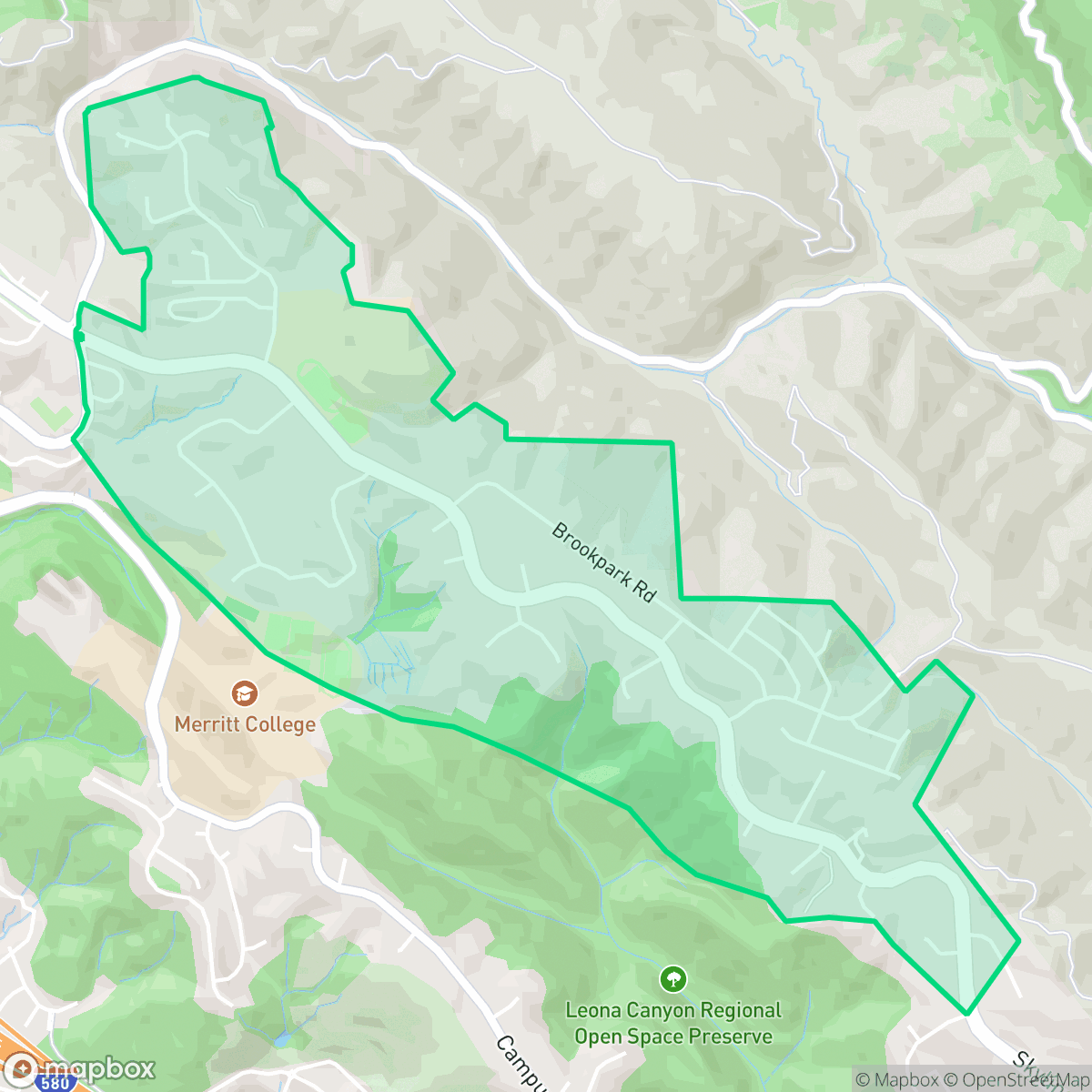
Skyline-Hillcrest Estates is a quiet, rural-feeling enclave in the Oakland Hills known for its stunning bay views and immediate access to extensive redwood trails. While the area offers exceptional privacy and an ideal environment for dog owners, residents rely on vehicles for daily errands due to limited walkability and a lack of local commercial services. According to iHuus data, this neighborhood serves as a serene retreat for those prioritizing natural beauty over urban convenience.
Key Highlights
About Skyline - Hillcrest Estates
Situated along the scenic ridgeline of the Oakland Hills, the Skyline-Hillcrest Estates neighborhood began selling residential lots in 1947, with development expanding rapidly in the early to mid-1950s. The neighborhood is defined by its unique dual exposure, offering panoramic views of the San Francisco Bay to the west and direct access to the second-growth redwood forests of Redwood Regional Park to the east. Its highly varied housing stock reflects decades of custom, owner-builder decisions, featuring mid-century Ranch-style homes alongside modern architectural designs, Mediterranean, and Spanish Colonial estates. At the community's heart lies Skyline High School, established in 1961, while the historic Woodminster Amphitheater in adjacent Joaquin Miller Park serves as a nearby cultural landmark.
The neighborhood is defined by its remote, low-density atmosphere and high visual appeal, characterized by a mix of custom mid-century and modern residential architecture. It functions as a peaceful residential buffer between the dense urban core of Oakland and the expansive green belts of the East Bay. With a high urban-rural index, the area maintains a quiet, tranquil environment that is largely free from industrial proximity, making it a distinct departure from the city's more active districts. Residents enjoy high air quality and a peaceful acoustic environment, contributing to a sense of seclusion that is rare within the city limits.
Prospective residents should be aware of the trade-offs inherent in this secluded setting, including a low score for local nightlife and commercial activity. The area faces significant fire safety challenges common to the Oakland Hills, which is a critical consideration for homeowners. It is best suited for individuals or families who value privacy, outdoor recreation, and a quiet lifestyle, provided they are comfortable with a car-dependent routine for accessing essential services and amenities.
Neighborhood Scores Across 15 Qualities
Large lot sizes and significant distance between homes provide much greater seclusion than the Oakland average. According to iHuus data, the separation between properties remains substantial throughout the area.
Pedestrian movement is possible via safe crossings and partial sidewalks, though walking for daily errands is significantly less convenient than the Oakland average.
Custom architecture and significant privacy buffers create a highly manicured landscape. This area offers much greater visual interest and greenery than the Oakland average, according to iHuus data.
Extensive trail networks and large open spaces provide significantly more-than-average opportunities for pet exercise. According to iHuus data, the abundance of nearby parks makes this area a premier choice for residents with large dogs.
Expansive forests and agricultural land dominate the landscape, providing a much higher degree of natural isolation than the Oakland average. According to iHuus data, residential structures are sparse and largely surrounded by undeveloped greenery.
Sparse residential development and vast open spaces create a serene, low-density environment with significantly less activity than the Oakland average. Local amenities are limited to a few essential services and social spots, as much of the area retains a rural character.
Acoustic levels are notably lower than the Oakland average, characterized by only infrequent distant traffic or train sounds. According to iHuus data, the area maintains a tranquil environment suitable for those sensitive to noise.
Air quality remains generally healthy with infrequent periods of elevated readings, though it sits slightly below the Oakland average according to iHuus data.
Industrial activity is entirely absent from this area, providing a landscape of quiet streets and open green spaces that is significantly lower in industrial density than the Oakland average.
Nearly all residents in this area are covered by health insurance, which is significantly higher than the Oakland average according to iHuus data.
Voting patterns and census indicators reflect a highly liberal community, though this leans slightly less progressive than the Oakland average according to iHuus data.
A varied mix of young adults, families, and older residents characterizes the area, representing a more balanced age distribution than the Oakland average according to iHuus data.
Flood risk in this area is significantly lower than the Oakland average, though some residual risk remains due to its location within the 500-year floodplain. According to iHuus data, the neighborhood is situated in a zone with much higher safety levels compared to most parts of the city.
Wildfire hazards in this area are significantly higher than the Oakland average. According to iHuus data, residents must prioritize maximum fire protection and emergency preparedness measures.
Address-Level Insights for Skyline - Hillcrest Estates


iHuus Neighborhood Intelligence Insights
Get address-level neighborhood insights for Skyline - Hillcrest Estates
- Street-level scores — see how individual blocks compare, not just neighborhood averages
- Micro-zone boundaries — identify quiet pockets, flood boundaries, and walkable clusters before you visit
- 15 dimensions in full — walkability, noise, air quality, school quality, insurance coverage, population age profile, urban/rural index, and more
- Boundary risk alerts — know if your address sits near a block boundary where scores drop, the kind of detail no listing will ever mention
- School insights — individual school ratings and insights, not just district-level data
- Compare before you commit — side-by-side data across neighborhoods, down to block precision
No credit card required
Compare with Any Neighborhood
| Dimension | Skyline - Hillcrest Estates | Acorn |
|---|---|---|
| 🚶 Walkabilityavg 8.99 | ||
| 🔊 Acoustic Comfortavg 3.24 | ||
| 🤫 Privacy Indexavg 3.74 | ||
| 🎨 Visual Appealavg 6.28 | ||
| 🐕 Dog Friendlinessavg 5.74 | ||
| 🗺️ Urban-Rural Indexavg 6.02 | ||
| ✨ Neighborhood Vibeavg 5.22 | ||
| 🏥 Health Insurance Coverageavg 7.4 | ||
| 🌿 Air Qualityavg 8.06 | ||
| 🏭 Industrial Proximityavg 8.37 | ||
| 🌊 Flood Safetyavg 2.61 | ||
| 🗳️ Ideological Leanavg 9.95 | ||
| 👥 Population Age Profileavg 4.92 | ||
| 🔥 Fire Safetyavg 0.17 | ||
| 🏫 School Quality |
Skyline - Hillcrest Estates Rankings
School Districts Serving Skyline - Hillcrest Estates
School Insights for Skyline - Hillcrest Estates
Below average outcomes; significant attendance and academic challenges.
School Insights
See what's really behind every school rating near Skyline - Hillcrest Estates
- Individual school ratings — each school's own score with outcome context, not just a district average
- Enrollment & class size data — student-to-teacher ratio and how it compares to the state average
- Full demographics breakdown — ethnicity and gender composition for every school in the enrollment zone
- Every school in the district — all schools within the enrollment boundary ranked by rating, not just the closest one
- Grade levels & benchmarks — elementary through high school, with below/above state-average flags
No credit card required