Sheffield Village, Oakland
Updated · 647 residents
Sheffield Village is a highly walkable residential enclave in Oakland known for its cohesive mid-century architecture and strong community identity. While the area offers convenient access to local dining and cafes, residents should note that ambient noise levels from nearby road traffic are significant.
Key Highlights
About Sheffield Village
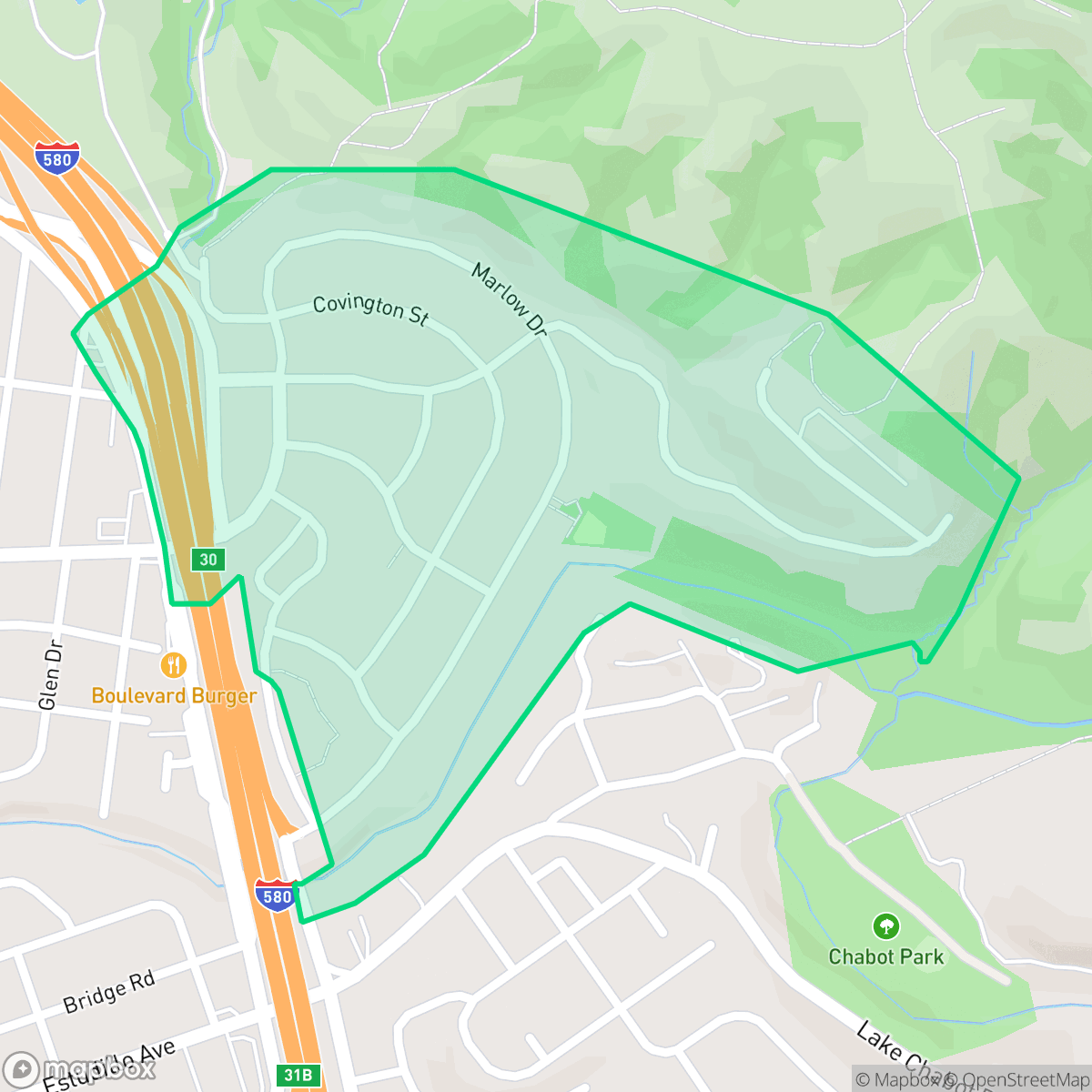
Located in the southeast corner of Oakland, California, Sheffield Village is a historic 100-acre neighborhood originally developed by the E.B. Field Company between 1939 and the 1950s. Once a fertile ranch during the Peralta era, it was designed as an FHA-financed, master-planned enclave of single-family homes featuring traditional, bungalow, and mid-century modern architectural styles. The neighborhood is notable for establishing one of the first homeowners associations on the West Coast to maintain its cohesive character. A unique local quirk is that while residents pay Oakland property taxes, their school taxes have been paid to the San Leandro Unified School District since the local elementary school closed in 1964. The City of Oakland designated Sheffield Village a Historic District in 2005.
The neighborhood maintains a distinct character defined by its master-planned layout and visual appeal, which remains a standout quality for those seeking a cohesive aesthetic. According to iHuus data, the area is exceptionally walkable, allowing residents to easily reach local staples such as Sabino's Coffee Shop, Boulevard Burgers, and Slice Pizza. The community benefits from high rates of health insurance coverage and a stable, albeit academically mixed, educational environment through the San Leandro Unified School District. It serves as a quiet, residential pocket that retains a suburban feel despite its proximity to major transit corridors.
Prospective residents should weigh the benefits of this walkable, historic setting against specific environmental trade-offs. The area experiences notable noise levels due to its proximity to major roadways, resulting in a lower acoustic comfort score. Additionally, while the neighborhood is well-positioned for flood safety, it faces challenges regarding fire safety that are common to the region. It is best suited for individuals or families who prioritize a traditional, architecturally significant environment and value the convenience of a walkable lifestyle over absolute silence.
Neighborhood Scores Across 15 Qualities
Residential spacing varies throughout the area, featuring some shared property lines and closely spaced houses. According to iHuus data, this level of separation is higher than the city average for Oakland.
Sidewalks are consistent throughout residential blocks and safe crossings are available, though the nearby freeway serves as a significant pedestrian barrier. This level of walkability is slightly lower than the Oakland average according to iHuus data.
Large homes and frequent upscale amenities contribute to an aesthetic that is more visually appealing than the Oakland average. According to iHuus data, the area features spacious driveways and well-maintained properties throughout the neighborhood.
Abundant green space from nearby school grounds and a large regional park to the northeast provides ample room for exercise. According to iHuus data, this area offers much more accessible space for dogs than the Oakland average.
Scattered homes and frequent open land provide a more semi-rural feel than the Oakland average. This landscape consists of a dense suburban environment featuring single-family homes and nearby woodland areas, according to iHuus data.
Low levels of activity and limited commercial density create a tranquil environment that is less active than the Oakland average. Residents will find a peaceful, car-dependent landscape with a small selection of local eateries, according to iHuus data.
Persistent noise from the nearby airport runway and heavy rail infrastructure creates significant acoustic disruption. This level of sound pollution is substantially higher than the average found throughout Oakland.
Air quality levels fluctuate between acceptable and unhealthy, presenting occasional concerns for sensitive groups. This neighborhood experiences lower air quality than the Oakland average, according to iHuus data.
Residential tranquility defines this area, as no warehouses or heavy industrial facilities are present. This lack of industrial presence is even more pronounced here than in the rest of Oakland, according to iHuus data.
Health insurance enrollment is exceptionally high among Sheffield Village residents, significantly surpassing the Oakland average according to iHuus data.
Voting patterns and census indicators show a deeply liberal political leaning that is consistent with the broader Oakland area, according to iHuus data.
Residents live alongside a balanced blend of young professionals, families, and seniors. This demographic spread is slightly more varied than the average seen across Oakland, according to iHuus data.
Flood risk in this area is significantly lower than the Oakland average, though some residual risk remains within the 500-year floodplain according to iHuus data.
Significant wildfire risks exist in this area, which is notably higher than the Oakland city average according to iHuus data. Residents should be prepared for extreme fire safety precautions and emergency preparedness requirements.
Address-Level Insights for Sheffield Village


iHuus Neighborhood Intelligence Insights
Get address-level neighborhood insights for Sheffield Village
- Street-level scores — see how individual blocks compare, not just neighborhood averages
- Micro-zone boundaries — identify quiet pockets, flood boundaries, and walkable clusters before you visit
- 15 dimensions in full — walkability, noise, air quality, school quality, insurance coverage, population age profile, urban/rural index, and more
- Boundary risk alerts — know if your address sits near a block boundary where scores drop, the kind of detail no listing will ever mention
- School insights — individual school ratings and insights, not just district-level data
- Compare before you commit — side-by-side data across neighborhoods, down to block precision
No credit card required
Compare with Any Neighborhood
| Dimension | Sheffield Village | Acorn |
|---|---|---|
| 🚶 Walkabilityavg 8.99 | ||
| 🔊 Acoustic Comfortavg 3.24 | ||
| 🤫 Privacy Indexavg 3.74 | ||
| 🎨 Visual Appealavg 6.28 | ||
| 🐕 Dog Friendlinessavg 5.74 | ||
| 🗺️ Urban-Rural Indexavg 6.02 | ||
| ✨ Neighborhood Vibeavg 5.22 | ||
| 🏥 Health Insurance Coverageavg 7.4 | ||
| 🌿 Air Qualityavg 8.06 | ||
| 🏭 Industrial Proximityavg 8.37 | ||
| 🌊 Flood Safetyavg 2.61 | ||
| 🗳️ Ideological Leanavg 9.95 | ||
| 👥 Population Age Profileavg 4.92 | ||
| 🔥 Fire Safetyavg 0.17 | ||
| 🏫 School Quality |
Sheffield Village Rankings
School Districts Serving Sheffield Village
School Insights for Sheffield Village
Below average outcomes; significant attendance and academic challenges.
School Insights
See what's really behind every school rating near Sheffield Village
- Individual school ratings — each school's own score with outcome context, not just a district average
- Enrollment & class size data — student-to-teacher ratio and how it compares to the state average
- Full demographics breakdown — ethnicity and gender composition for every school in the enrollment zone
- Every school in the district — all schools within the enrollment boundary ranked by rating, not just the closest one
- Grade levels & benchmarks — elementary through high school, with below/above state-average flags
No credit card required