Shafter, Oakland
Updated · 3,306 residents
Shafter is a highly walkable North Oakland enclave defined by its dense, historic residential grid and proximity to vibrant commercial corridors. While the area offers excellent air quality and immediate access to diverse local dining, residents should be prepared for significant road traffic noise and limited private outdoor space.
Key Highlights
About Shafter
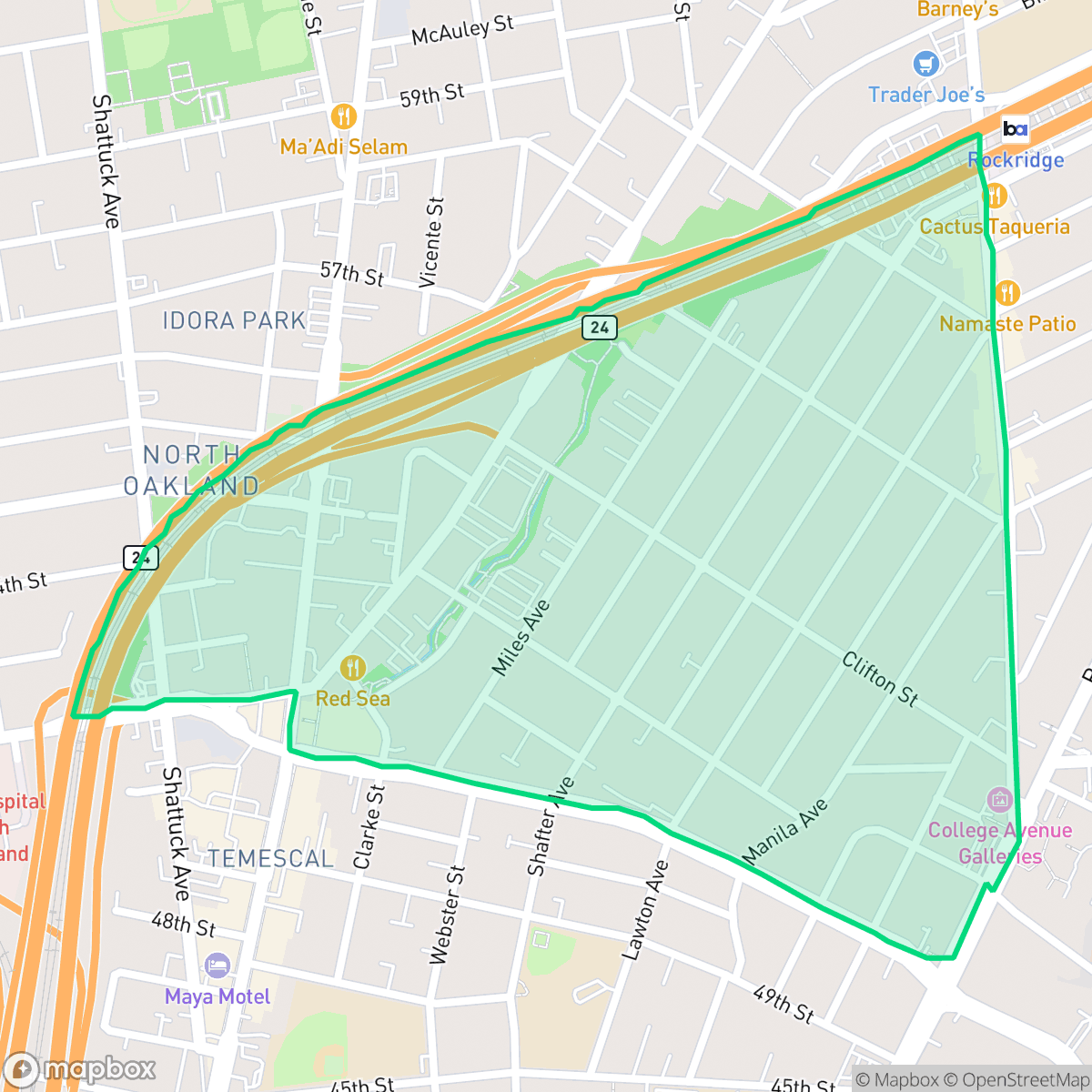
The Shafter neighborhood in North Oakland, California, is historically defined by its association with the Sacramento Northern Railway. Beginning in 1913, the railway operated its western passenger and freight hub at 40th Street and Shafter Avenue, running trains directly down Shafter Avenue. Following decades of resident protests over noise and safety, the rail yard was demolished and the tracks were removed in 1957. Architecturally, Shafter is characterized by a rich stock of early 20th-century Craftsman bungalows, Dutch Colonials, and cottages built primarily before 1939. The neighborhood is bordered by Temescal and Rockridge, sharing local landmarks like FROG Park and the vibrant commercial corridors of College and Telegraph avenues.
The neighborhood serves as a dense urban hub situated between Temescal and Rockridge, characterized by a high level of walkability and a mix of early 20th-century housing alongside mid-rise residential blocks. According to iHuus data, the area maintains a high level of liveliness, supported by local establishments such as Burma Bites, Asmara Restaurant, and Alem's Coffee. The community is strictly residential and light commercial, remaining free from heavy industrial hazards and warehouses. Residents benefit from consistent sidewalk infrastructure that connects the entire grid, making it a convenient location for those who rely on walking to access daily amenities.
Living in this area involves specific trade-offs, particularly regarding acoustic comfort and privacy. The proximity to major thoroughfares results in elevated road traffic noise, and the high-density housing layout means homes are often spaced closely together on narrow lots. Families should be aware that the local school district currently faces significant financial and organizational challenges, including a large budget deficit and recent staff reductions. The neighborhood is best suited for individuals who prioritize a walkable, transit-adjacent lifestyle over quiet seclusion or expansive private yards.
Neighborhood Scores Across 15 Qualities
Residential structures are positioned in very close proximity with minimal separation between buildings. This level of density is slightly higher than the Oakland average, often resulting in narrow lots and shared property lines.
Continuous sidewalks and clear crosswalks exist on nearly every street corner throughout the area. This level of pedestrian connectivity is even higher than the Oakland average, according to iHuus data.
Residential streetscapes consist primarily of mid-century homes and multi-unit buildings with small yards and modest architecture. This visual character is slightly below the Oakland average for aesthetic variety.
Access to pet-friendly areas is somewhat below the city average due to dense housing and narrow sidewalks in certain sections. While some parts of Shafter benefit from proximity to golf courses and school fields, other pockets lack significant public parks or wide green verges.
Residential streets feature a balanced blend of single-family homes and mid-rise apartments with a distribution of green space and pavement similar to the Oakland average. According to iHuus data, the area maintains a dense urban grid that lacks significant open natural space.
Active streets and a concentrated collection of local dining options provide a more vibrant atmosphere than the Oakland average. According to iHuus data, various pockets of the area feature walkable access to diverse restaurants and coffee shops amidst a mix of urban and suburban landscapes.
Frequent noise from nearby heavy rail lines and major freeways characterizes this area. Acoustic comfort is lower than the Oakland average according to iHuus data.
Air quality remains exceptionally clean with minimal pollution concerns. According to iHuus data, the air quality in Shafter is notably better than the Oakland average.
Residential and light commercial uses dominate the area with no detected warehouses or heavy industrial facilities. According to iHuus data, this lack of industrial proximity is notably higher than the Oakland average.
Health insurance accessibility is notably higher here than the Oakland average, according to iHuus data. Residents benefit from a significantly larger proportion of the population having verified coverage.
Voting patterns and census indicators reflect a deeply liberal political landscape that is slightly more pronounced than the Oakland average, according to iHuus data.
A diverse mix of young adults, families, and older residents characterizes the area. This demographic spread is largely in line with the average seen across Oakland.
Located within a designated floodplain, this area faces a higher risk of flooding than most of Oakland. According to iHuus data, residents may find that flood insurance is a typical requirement for properties in this neighborhood.
Address-Level Insights for Shafter


iHuus Neighborhood Intelligence Insights
Get address-level neighborhood insights for Shafter
- Street-level scores — see how individual blocks compare, not just neighborhood averages
- Micro-zone boundaries — identify quiet pockets, flood boundaries, and walkable clusters before you visit
- 15 dimensions in full — walkability, noise, air quality, school quality, insurance coverage, population age profile, urban/rural index, and more
- Boundary risk alerts — know if your address sits near a block boundary where scores drop, the kind of detail no listing will ever mention
- School insights — individual school ratings and insights, not just district-level data
- Compare before you commit — side-by-side data across neighborhoods, down to block precision
No credit card required
Compare with Any Neighborhood
| Dimension | Shafter | Acorn |
|---|---|---|
| 🚶 Walkabilityavg 8.99 | ||
| 🔊 Acoustic Comfortavg 3.24 | ||
| 🤫 Privacy Indexavg 3.74 | ||
| 🎨 Visual Appealavg 6.28 | ||
| 🐕 Dog Friendlinessavg 5.74 | ||
| 🗺️ Urban-Rural Indexavg 6.02 | ||
| ✨ Neighborhood Vibeavg 5.22 | ||
| 🏥 Health Insurance Coverageavg 7.4 | ||
| 🌿 Air Qualityavg 8.06 | ||
| 🏭 Industrial Proximityavg 8.37 | ||
| 🌊 Flood Safetyavg 2.61 | ||
| 🗳️ Ideological Leanavg 9.95 | ||
| 👥 Population Age Profileavg 4.92 | ||
| 🔥 Fire Safetyavg 0.17 | ||
| 🏫 School Quality |
Shafter Rankings
School Districts Serving Shafter
School Insights for Shafter
Below average outcomes; significant attendance and academic challenges.
School Insights
See what's really behind every school rating near Shafter
- Individual school ratings — each school's own score with outcome context, not just a district average
- Enrollment & class size data — student-to-teacher ratio and how it compares to the state average
- Full demographics breakdown — ethnicity and gender composition for every school in the enrollment zone
- Every school in the district — all schools within the enrollment boundary ranked by rating, not just the closest one
- Grade levels & benchmarks — elementary through high school, with below/above state-average flags
No credit card required