Sequoyah, Oakland
Updated · 5,031 residents
Sequoyah is a quiet, low-density neighborhood in the Oakland Hills characterized by its scenic landscapes and mid-century architectural heritage. While the area provides significant open space and high dog friendliness, it remains largely car-dependent with limited local commercial activity.
Key Highlights
About Sequoyah
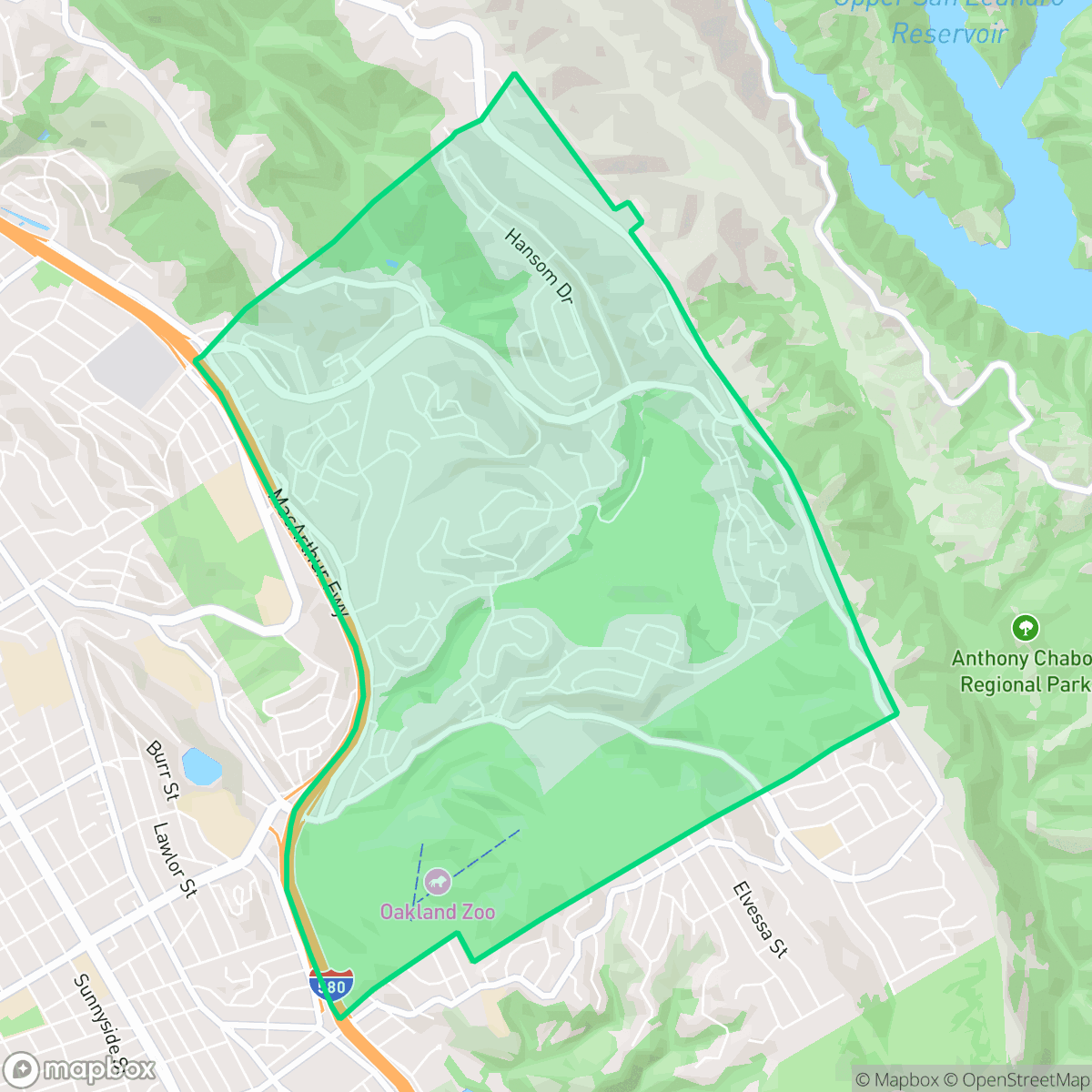
Nestled in the Oakland Hills, the Sequoyah neighborhood (also known as Sequoyah Hills) developed around the historic Sequoyah Country Club, established in 1913. Envisioned in the 1920s as the "Piedmont of East Oakland," the area initially attracted wealthy buyers seeking large hillside lots near the golf course. During World War II, the neighborhood became home to the sprawling San Leandro Naval Hospital (later Oak Knoll Naval Hospital), which operated until 1996. Sequoyah is architecturally renowned for its mid-century modern heritage, specifically hosting a rare enclave of homes built between 1965 and 1966 by developer Joseph Eichler. Designed by architects Claude Oakland and Jones & Emmons to adapt to the steep terrain, this collection of roughly 50 homes is famously nicknamed the "Lost Eichlers of the Oakland Hills" due to the project's premature end.
The neighborhood offers a serene, rural-like atmosphere that stands in contrast to the denser urban core of Oakland. Residents benefit from high visual appeal and a quiet environment, though the area is defined by its reliance on personal vehicles for daily errands and services. The landscape is marked by scattered structures and expansive green spaces, providing a sense of seclusion that is rare within the city limits. While the area lacks a high level of commercial activity or nightlife, it serves as a retreat for those who prioritize privacy and a connection to the natural environment.
Living in this area requires navigating specific trade-offs, including a limited selection of nearby businesses and a significant distance from major urban amenities. Prospective residents should be aware of the neighborhood's vulnerability to wildfire risks and the split in school district boundaries, as portions of the area fall under the high-performing Castro Valley Unified School District while others are served by the Oakland Unified School District. It is best suited for individuals or families seeking a quiet, remote residential experience who are comfortable with a car-dependent lifestyle.
Neighborhood Scores Across 15 Qualities
Homes in this area are positioned with some spacing between neighbors, offering more separation than is typical for the Oakland average. While some houses sit close together, most properties remain detached with small side yards providing a modest buffer.
Pedestrian access is supported by a grid system with dedicated sidewalks and safe crossings, though connectivity is lower than the Oakland average. According to iHuus data, while residential streets are navigable, some areas may lack sidewalks on both sides of the street.
Large homes and frequent upscale amenities contribute to a visual appeal that is notably higher than the Oakland average. While some areas contain standard residential tract housing with smaller yards, much of the neighborhood features spacious driveways and premium residential features according to iHuus data.
Continuous sidewalks with grassy verges and a large public park provide ample space for pets. According to iHuus data, the area offers significantly better access to safe, connected green spaces than the Oakland average.
Frequent open land and significant tree canopy create a more rural atmosphere than the Oakland average. Residential areas feature scattered homes amidst woodlands and larger lots, according to iHuus data.
Local activity is sparse and centered around a few essential services, making the area significantly less lively than the Oakland average. Most of the landscape consists of low-density residential blocks and open spaces with very few commercial destinations or social hubs nearby.
Frequent noise from nearby heavy transit corridors and rail lines characterizes the area. According to iHuus data, acoustic levels in this neighborhood are slightly higher than the Oakland average.
Air quality in this area fluctuates between acceptable and unhealthy levels, appearing lower than the Oakland average according to iHuus data. Sensitive groups may experience occasional concern during certain periods.
Residential life is largely undisturbed by heavy industry, as the area lacks warehouses and hazardous facilities. According to iHuus data, this neighborhood is even more free of industrial proximity than the Oakland average.
Health insurance access among residents is notably higher than the Oakland average, according to iHuus data.
Voting patterns and census indicators show a predominantly liberal political leaning, which is consistent with the city average.
Residents live alongside a balanced demographic of young professionals, families, and seniors. This age distribution is slightly more varied than the average found across Oakland, according to iHuus data.
Located within a designated floodplain, this area carries a significant risk of flooding during major weather events. According to iHuus data, the risk level here is slightly higher than the Oakland city average, which may necessitate flood insurance for property owners.
Fire hazards in this area are significantly higher than the Oakland average; residents should be prepared for extreme fire safety risks and implement maximum protection measures.
Address-Level Insights for Sequoyah


iHuus Neighborhood Intelligence Insights
Get address-level neighborhood insights for Sequoyah
- Street-level scores — see how individual blocks compare, not just neighborhood averages
- Micro-zone boundaries — identify quiet pockets, flood boundaries, and walkable clusters before you visit
- 15 dimensions in full — walkability, noise, air quality, school quality, insurance coverage, population age profile, urban/rural index, and more
- Boundary risk alerts — know if your address sits near a block boundary where scores drop, the kind of detail no listing will ever mention
- School insights — individual school ratings and insights, not just district-level data
- Compare before you commit — side-by-side data across neighborhoods, down to block precision
No credit card required
Compare with Any Neighborhood
| Dimension | Sequoyah | Acorn |
|---|---|---|
| 🚶 Walkabilityavg 8.99 | ||
| 🔊 Acoustic Comfortavg 3.24 | ||
| 🤫 Privacy Indexavg 3.74 | ||
| 🎨 Visual Appealavg 6.28 | ||
| 🐕 Dog Friendlinessavg 5.74 | ||
| 🗺️ Urban-Rural Indexavg 6.02 | ||
| ✨ Neighborhood Vibeavg 5.22 | ||
| 🏥 Health Insurance Coverageavg 7.4 | ||
| 🌿 Air Qualityavg 8.06 | ||
| 🏭 Industrial Proximityavg 8.37 | ||
| 🌊 Flood Safetyavg 2.61 | ||
| 🗳️ Ideological Leanavg 9.95 | ||
| 👥 Population Age Profileavg 4.92 | ||
| 🔥 Fire Safetyavg 0.17 | ||
| 🏫 School Quality |
Sequoyah Rankings
School Districts Serving Sequoyah
School Insights for Sequoyah
Below average outcomes; significant attendance and academic challenges.
School Insights
See what's really behind every school rating near Sequoyah
- Individual school ratings — each school's own score with outcome context, not just a district average
- Enrollment & class size data — student-to-teacher ratio and how it compares to the state average
- Full demographics breakdown — ethnicity and gender composition for every school in the enrollment zone
- Every school in the district — all schools within the enrollment boundary ranked by rating, not just the closest one
- Grade levels & benchmarks — elementary through high school, with below/above state-average flags
No credit card required