Seminary, Oakland
Updated · 4,780 residents
Seminary is a highly walkable, dense residential neighborhood in East Oakland defined by its compact grid and proximity to local transit routes. While the area offers excellent access to daily necessities, residents experience significant road traffic noise and limited private outdoor space.
Key Highlights
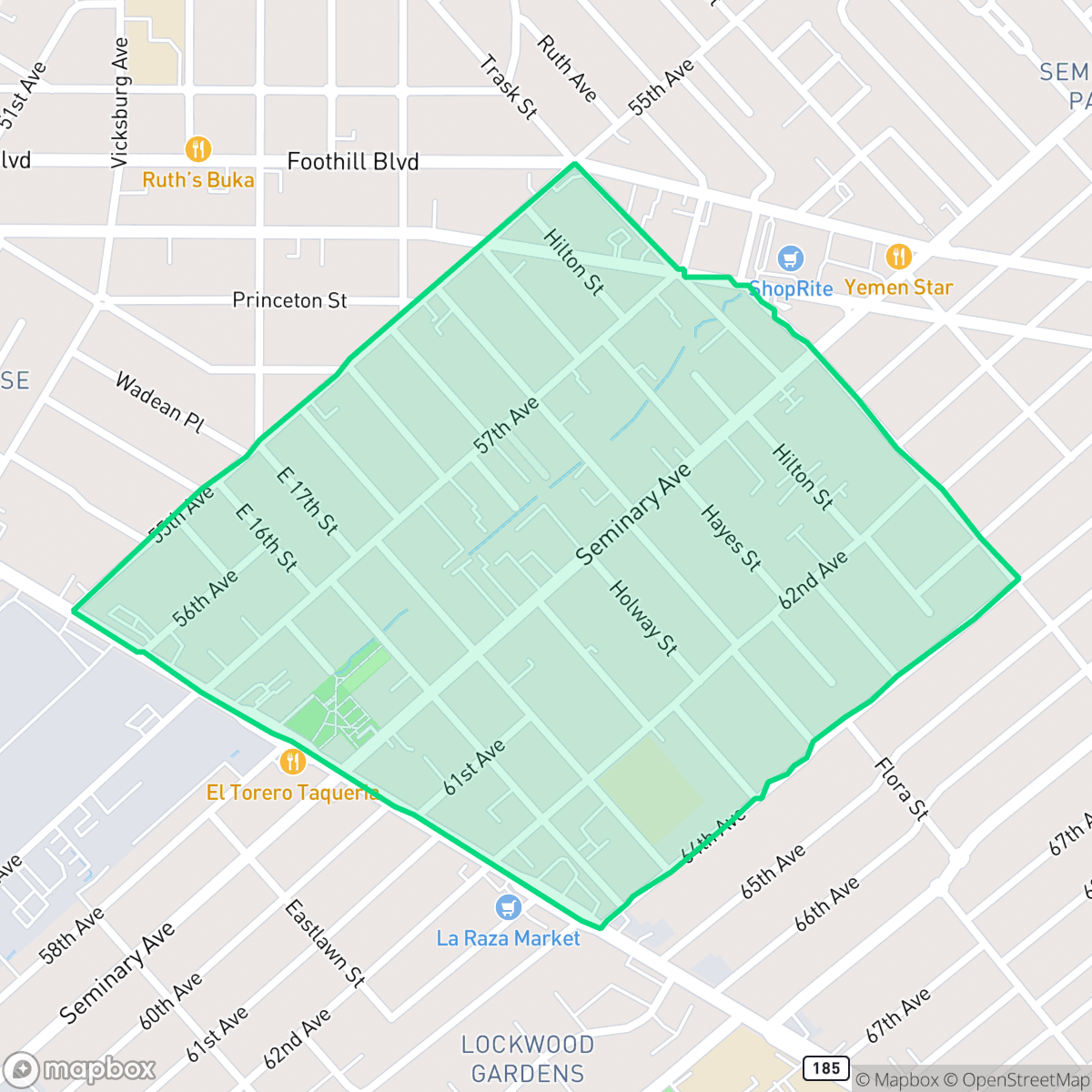
About Seminary
The Seminary neighborhood in East Oakland, California, is historically rooted in its close proximity to Mills College. The neighborhood and its central thoroughfare, Seminary Avenue, were named after the college, which was originally established in Benicia in 1852 as the "Young Ladies' Seminary" before relocating to its current Oakland campus in 1871. Seminary Avenue served as the primary transit route connecting the San Francisco Bay shoreline to the college. The neighborhood’s residential landscape features a mix of older, well-established housing stock, including 1920s Arts and Crafts bungalows alongside mid-century single-family homes and duplexes. Today, the neighborhood maintains a distinct, densely populated urban identity and is celebrated for its deep historical connection to one of the oldest women's colleges in the United States.
The neighborhood is characterized by a dense urban residential grid featuring small single-family homes and multi-unit buildings. It maintains a consistent, light commercial presence along its main thoroughfares, providing residents with access to diverse dining options and local services. The area benefits from high air quality and a complete absence of heavy industrial zones, contributing to a clean, albeit busy, urban environment.
Prospective residents should consider the trade-offs of living in a high-density environment, including limited privacy due to close building proximity and elevated noise levels from consistent road traffic. While the area is exceptionally walkable, those seeking expansive green spaces or quiet suburban retreats may find the setting restrictive. The local educational landscape is currently challenged by systemic issues within the Oakland Unified School District, and prospective families should research specific school performance metrics carefully.
Neighborhood Scores Across 15 Qualities
Houses are positioned in close quarters with minimal separation between structures. According to iHuus data, this density is slightly higher than the Oakland average.
Pedestrian navigation is easy due to a dense grid of streets featuring continuous sidewalks and numerous marked crosswalks. This level of accessibility is slightly above the Oakland average.
Standard tract housing dominates the area, featuring small lots and consistent rooflines. The visual landscape is slightly less varied than the Oakland average, as according to iHuus data, the neighborhood lacks large yards or luxury amenities.
Public park access and wide walking verges are sparse throughout the area. Most available green space is found in private backyards, making the neighborhood less dog friendly than the Oakland average.
Open land and woodland areas are more prevalent here than in most of Oakland. This provides a landscape of scattered homes and green spaces that feels less dense than the city average.
Limited commercial activity and industrial-suburban zones result in a subdued atmosphere that is less active than the Oakland average. While some pockets offer accessible cafes and dining, the area is primarily defined by quiet streets and significant green space.
Steady traffic sounds from nearby busy streets are present, though acoustic conditions are notably more peaceful than the Oakland average according to iHuus data.
Air quality remains consistently high with rare instances of elevated readings. This level of cleanliness is roughly in line with the broader Oakland area, according to iHuus data.
Residential and light commercial zones dominate the area, though some large warehouses and truck docks are visible in the southwest corner. This lack of heavy industry is largely consistent with the broader Oakland average according to iHuus data.
Health insurance access in this area is notably lower than the Oakland average. Residents may face greater challenges in finding local provider networks compared to other parts of the city.
Voting patterns and census indicators reflect a very strong liberal leaning that is slightly more pronounced than the Oakland average.
Residents live alongside a balanced mix of young adults, families, and seniors. This age distribution is slightly lower than the Oakland average, according to iHuus data.
Address-Level Insights for Seminary


iHuus Neighborhood Intelligence Insights
Get address-level neighborhood insights for Seminary
- Street-level scores — see how individual blocks compare, not just neighborhood averages
- Micro-zone boundaries — identify quiet pockets, flood boundaries, and walkable clusters before you visit
- 15 dimensions in full — walkability, noise, air quality, school quality, insurance coverage, population age profile, urban/rural index, and more
- Boundary risk alerts — know if your address sits near a block boundary where scores drop, the kind of detail no listing will ever mention
- School insights — individual school ratings and insights, not just district-level data
- Compare before you commit — side-by-side data across neighborhoods, down to block precision
No credit card required
Compare with Any Neighborhood
| Dimension | Seminary | Acorn |
|---|---|---|
| 🚶 Walkabilityavg 8.99 | ||
| 🔊 Acoustic Comfortavg 3.24 | ||
| 🤫 Privacy Indexavg 3.74 | ||
| 🎨 Visual Appealavg 6.28 | ||
| 🐕 Dog Friendlinessavg 5.74 | ||
| 🗺️ Urban-Rural Indexavg 6.02 | ||
| ✨ Neighborhood Vibeavg 5.22 | ||
| 🏥 Health Insurance Coverageavg 7.4 | ||
| 🌿 Air Qualityavg 8.06 | ||
| 🏭 Industrial Proximityavg 8.37 | ||
| 🌊 Flood Safetyavg 2.61 | ||
| 🗳️ Ideological Leanavg 9.95 | ||
| 👥 Population Age Profileavg 4.92 | ||
| 🔥 Fire Safetyavg 0.17 | ||
| 🏫 School Quality |
Seminary Rankings
School Districts Serving Seminary
School Insights for Seminary
Below average outcomes; significant attendance and academic challenges.
School Insights
See what's really behind every school rating near Seminary
- Individual school ratings — each school's own score with outcome context, not just a district average
- Enrollment & class size data — student-to-teacher ratio and how it compares to the state average
- Full demographics breakdown — ethnicity and gender composition for every school in the enrollment zone
- Every school in the district — all schools within the enrollment boundary ranked by rating, not just the closest one
- Grade levels & benchmarks — elementary through high school, with below/above state-average flags
No credit card required