Sausal Creek, Oakland
Updated · 2,131 residents
Sausal Creek is a dense, highly walkable residential community known for its convenient access to daily amenities and local social hubs. While it offers excellent connectivity, residents should expect significant road traffic noise and tightly packed housing with limited private outdoor space.
Key Highlights
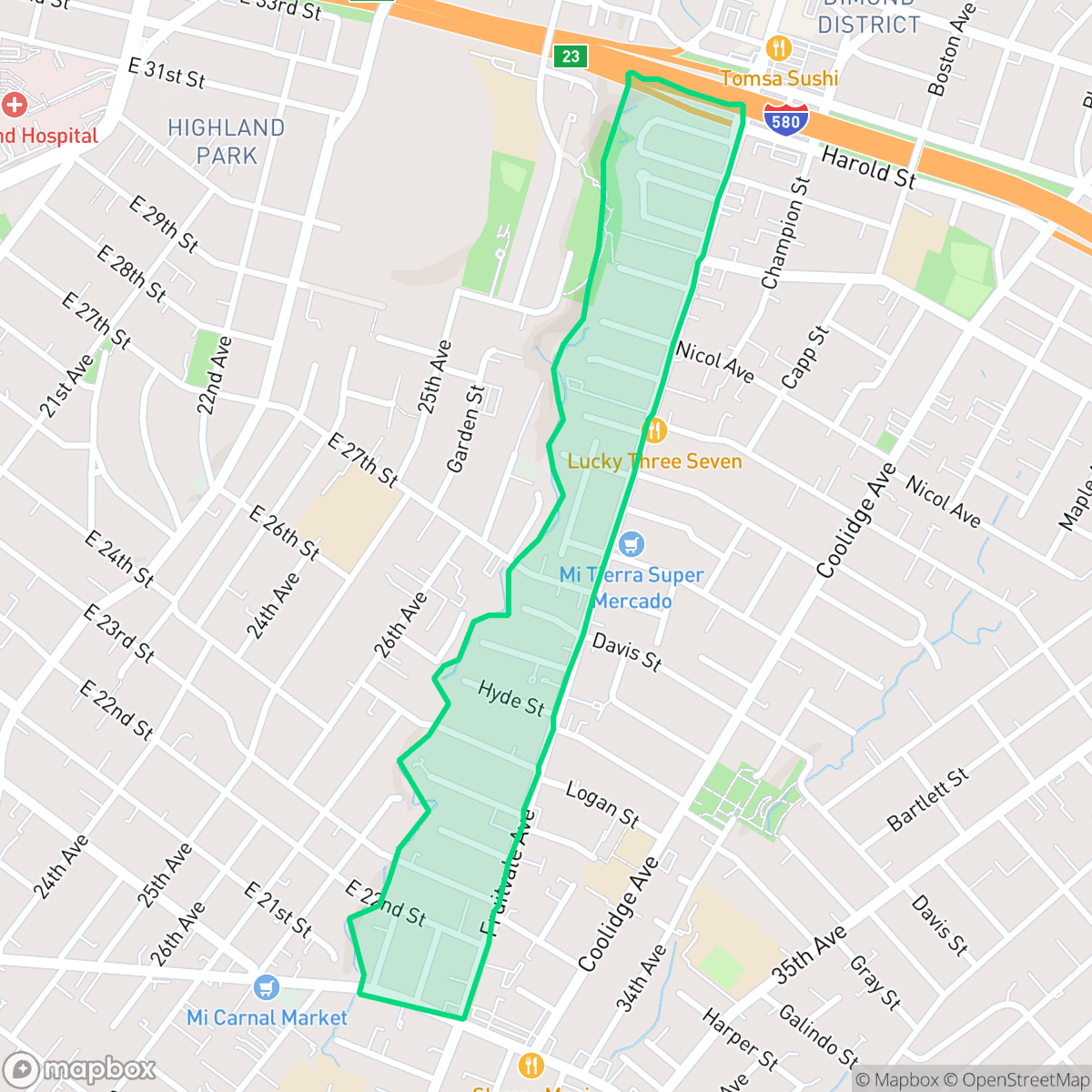
About Sausal Creek
The Sausal Creek neighborhood in Oakland, California, is a quiet residential enclave named after the 3.1-mile-long urban stream that runs through it. Historically, the creek was a vital resource for the Ohlone people and later served as a boundary marker for the 1820 Spanish land grant, Rancho San Antonio, given to Luis Maria Peralta. In 1856, Quaker nurseryman Henderson Luelling planted hundreds of cherry trees along the creek's banks, establishing the area's identity as "Fruit Vale". The neighborhood's landscape is defined by Dimond Canyon and Dimond Park, as well as the historic Leimert Bridge (Sausal Creek Arch Bridge), a 117-foot-high concrete arch bridge built in 1926. In the 1930s, the Works Progress Administration channelized portions of the creek. Today, the neighborhood is characterized by its urban-nature balance, supported by the local conservation efforts of the Friends of Sausal Creek.
The area functions as a dense urban enclave where residents benefit from a highly connected street grid and a consistent sidewalk network. According to iHuus data, the community maintains a strong urban-rural balance, blending single-family homes with mid-sized apartment buildings. Local life centers around popular spots like Bombera and Hasta Muerte Coffee, which provide a steady, moderate level of activity for those living near the local green spaces. Prospective residents should weigh the high walkability against notable trade-offs, including elevated ambient noise levels from nearby road traffic and a lack of private outdoor space due to high housing density. The neighborhood faces challenges common to the broader Oakland Unified School District, and those considering a move should be aware of the local fire safety profile. It is best suited for individuals who prioritize transit accessibility and a vibrant, community-oriented atmosphere over total acoustic seclusion or expansive private yards.
Neighborhood Scores Across 15 Qualities
Residential structures and apartment blocks are positioned in close proximity with minimal separation between property lines. According to iHuus data, this level of density results in less privacy than the typical Oakland neighborhood.
Continuous sidewalks and frequent crosswalks make navigating the area on foot very easy. According to iHuus data, the sidewalk network is more comprehensive and consistent than the average found in Oakland.
Typical middle-class residential lots feature small yards and older bungalows. This area presents a visual profile that is slightly below the Oakland average due to a lack of large private amenities or luxury landscaping.
Narrow sidewalks and a dense urban grid offer few grassy verges for walking dogs. While some residents can access the large reservoir park, overall amenities for pet owners are below the Oakland average according to iHuus data.
Frequent open land and scattered homes among woodland create a more semi-rural feel than the typical Oakland urban environment. According to iHuus data, this area provides more natural spacing and greenery than the city average.
Diverse dining options and local coffee shops provide a social atmosphere that is more active than the Oakland average. While some blocks are quiet and suburban, others sit near industrial units and railways, creating a mix of tranquil green spaces and lively street life.
Frequent noise from nearby railroad tracks and freeway traffic is a characteristic of this area. According to iHuus data, acoustic comfort is significantly lower than the Oakland average.
Air quality remains consistently good with infrequent periods of elevated readings, performing nearly in line with the Oakland average according to iHuus data.
Residential and light commercial uses dominate the area, making it comparable to the Oakland average for industrial proximity. While a railway corridor and some warehouses exist on the edge of the neighborhood, no heavy industrial activity or significant hazards are present.
Health insurance access is lower than the Oakland average. According to iHuus data, a significant portion of the population lacks coverage.
Voting patterns and census indicators reflect a deeply liberal political identity that is slightly more pronounced than the Oakland city average, according to iHuus data.
Residents live alongside a balanced variety of young adults, families, and seniors. This demographic spread is roughly in line with the broader Oakland area according to iHuus data.
Properties in Sausal Creek are located within a designated floodplain, which is consistent with the average risk level seen across Oakland. Residents should be aware that flood insurance is typically a requirement for homes in this area according to iHuus data.
Address-Level Insights for Sausal Creek


iHuus Neighborhood Intelligence Insights
Get address-level neighborhood insights for Sausal Creek
- Street-level scores — see how individual blocks compare, not just neighborhood averages
- Micro-zone boundaries — identify quiet pockets, flood boundaries, and walkable clusters before you visit
- 15 dimensions in full — walkability, noise, air quality, school quality, insurance coverage, population age profile, urban/rural index, and more
- Boundary risk alerts — know if your address sits near a block boundary where scores drop, the kind of detail no listing will ever mention
- School insights — individual school ratings and insights, not just district-level data
- Compare before you commit — side-by-side data across neighborhoods, down to block precision
No credit card required
Compare with Any Neighborhood
| Dimension | Sausal Creek | Acorn |
|---|---|---|
| 🚶 Walkabilityavg 8.99 | ||
| 🔊 Acoustic Comfortavg 3.24 | ||
| 🤫 Privacy Indexavg 3.74 | ||
| 🎨 Visual Appealavg 6.28 | ||
| 🐕 Dog Friendlinessavg 5.74 | ||
| 🗺️ Urban-Rural Indexavg 6.02 | ||
| ✨ Neighborhood Vibeavg 5.22 | ||
| 🏥 Health Insurance Coverageavg 7.4 | ||
| 🌿 Air Qualityavg 8.06 | ||
| 🏭 Industrial Proximityavg 8.37 | ||
| 🌊 Flood Safetyavg 2.61 | ||
| 🗳️ Ideological Leanavg 9.95 | ||
| 👥 Population Age Profileavg 4.92 | ||
| 🔥 Fire Safetyavg 0.17 | ||
| 🏫 School Quality |
Sausal Creek Rankings
School Districts Serving Sausal Creek
School Insights for Sausal Creek
Below average outcomes; significant attendance and academic challenges.
School Insights
See what's really behind every school rating near Sausal Creek
- Individual school ratings — each school's own score with outcome context, not just a district average
- Enrollment & class size data — student-to-teacher ratio and how it compares to the state average
- Full demographics breakdown — ethnicity and gender composition for every school in the enrollment zone
- Every school in the district — all schools within the enrollment boundary ranked by rating, not just the closest one
- Grade levels & benchmarks — elementary through high school, with below/above state-average flags
No credit card required