Rockridge, Oakland
Updated · 3,456 residents
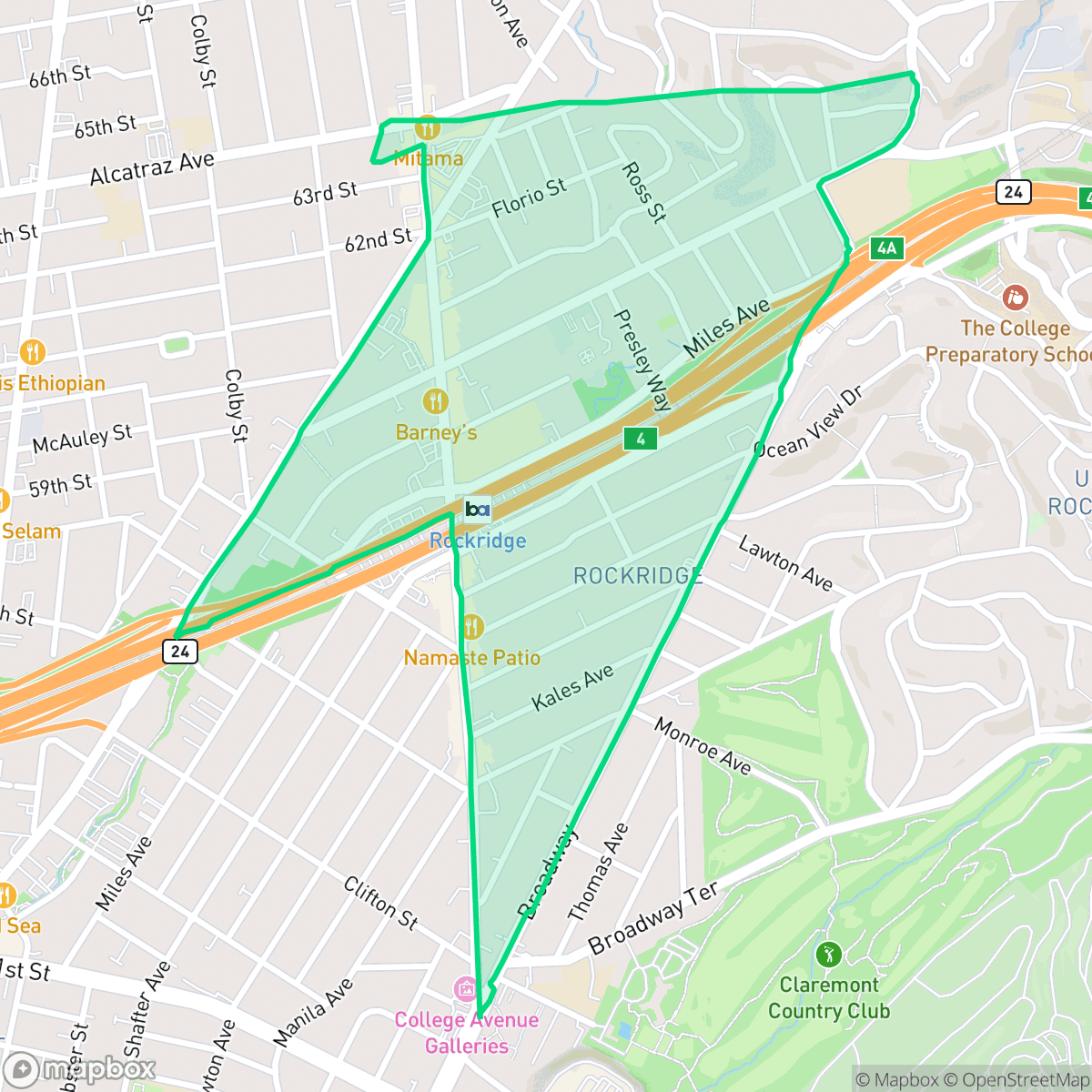
Rockridge is a highly walkable neighborhood defined by its dense residential grid and vibrant commercial corridor along College Avenue. While the area offers excellent air quality and convenient access to local dining, residents should be aware of high noise levels from nearby traffic and significant fire safety risks.
Key Highlights
About Rockridge
Originally part of the 1842 Peralta land grant, the North Oakland neighborhood of Rockridge was sold in 1869 to the Livermore family, who initiated its residential development. The area flourished in the early 1900s, particularly after the 1906 San Francisco earthquake spurred an influx of new residents. Today, Rockridge is celebrated for its historic, early 20th-century California bungalows, craftsman cottages, and irregular street layouts shaped by early streetcar lines. College Avenue serves as the neighborhood's bustling commercial spine, hosting local landmarks like the artisanal Market Hall and the historic Dreyer's Ice Cream Parlor, where Rocky Road ice cream was invented. At the neighborhood's center, the Rockridge BART station features a prominent 2,000-tile mosaic mural commemorating the devastating 1991 Oakland Hills firestorm.
The neighborhood functions as a dense, transit-oriented community where a continuous sidewalk network makes daily errands and dining convenient. It maintains a strong sense of community with high rates of health insurance coverage and a consistent ideological alignment among residents. While the residential blocks offer a calm atmosphere, the proximity to major highway corridors results in persistent road noise. The housing stock consists of a mix of single-family homes and multi-unit buildings, though the close proximity of structures means that private outdoor space is often limited.
Prospective residents should weigh the benefits of the area's urban amenities against specific environmental trade-offs. The neighborhood faces notable fire safety risks, which is a critical consideration for those living in this part of Oakland. Despite these challenges, the presence of top-rated educational institutions like Claremont Middle School and a lack of industrial hazards make this a stable, highly desirable location for families and professionals who prioritize walkability and access to essential services.
Neighborhood Scores Across 15 Qualities
Residential structures are positioned with moderate spacing, though some areas feature closely packed houses and shared property lines. This level of density is slightly higher than the Oakland average, according to iHuus data.
Extensive sidewalk networks and clear crosswalks make most errands easily accessible on foot. According to iHuus data, the connectivity and continuous street grids here are even more robust than the Oakland average.
Larger, well-maintained homes and premium amenities provide a visual landscape that is slightly more polished than the Oakland average. According to iHuus data, the hilly terrain features complex architecture and more spacious lots compared to standard urban density.
Wide sidewalk verges and proximity to large golf courses and public parks provide ample space for pet walking. According to iHuus data, this access to green space is slightly higher than the Oakland average.
Residential streets and green spaces are found in roughly equal measure, mirroring the broader city average. According to iHuus data, the area features a mix of dense urban grids and low-rise multi-family housing alongside moderate tree canopy.
Diverse dining and local coffee shops create a noticeable energy that is higher than the Oakland average. According to iHuus data, the area features a steady rhythm of social activity centered around various street-level eateries and community parks.
Frequent sound from nearby railroad tracks and major roadways contributes to lower acoustic comfort than the Oakland average. Residents may experience persistent ambient noise levels according to iHuus data.
Air quality in this area is exceptionally high, remaining significantly cleaner than the Oakland average. Residents can expect minimal exposure to pollutants according to iHuus data.
Industrial hazards and large warehouses are entirely absent from this area, providing a cleaner environment than the Oakland average. According to iHuus data, the neighborhood consists exclusively of residential and light commercial uses.
Health insurance access is very high among residents, significantly surpassing the Oakland average according to iHuus data.
Voting patterns and census indicators show a strong liberal leaning that is consistent with the broader Oakland area. According to iHuus data, the political landscape remains highly aligned with the citywide average.
Residents live alongside a balanced spread of young professionals, families, and older adults. This demographic diversity is slightly more varied than the Oakland average, according to iHuus data.
Residual flood risk exists within this area as it falls within a 500-year floodplain, though the level of safety remains significantly higher than the Oakland average according to iHuus data.
Address-Level Insights for Rockridge


iHuus Neighborhood Intelligence Insights
Get address-level neighborhood insights for Rockridge
- Street-level scores — see how individual blocks compare, not just neighborhood averages
- Micro-zone boundaries — identify quiet pockets, flood boundaries, and walkable clusters before you visit
- 15 dimensions in full — walkability, noise, air quality, school quality, insurance coverage, population age profile, urban/rural index, and more
- Boundary risk alerts — know if your address sits near a block boundary where scores drop, the kind of detail no listing will ever mention
- School insights — individual school ratings and insights, not just district-level data
- Compare before you commit — side-by-side data across neighborhoods, down to block precision
No credit card required
Compare with Any Neighborhood
| Dimension | Rockridge | Acorn |
|---|---|---|
| 🚶 Walkabilityavg 8.99 | ||
| 🔊 Acoustic Comfortavg 3.24 | ||
| 🤫 Privacy Indexavg 3.74 | ||
| 🎨 Visual Appealavg 6.28 | ||
| 🐕 Dog Friendlinessavg 5.74 | ||
| 🗺️ Urban-Rural Indexavg 6.02 | ||
| ✨ Neighborhood Vibeavg 5.22 | ||
| 🏥 Health Insurance Coverageavg 7.4 | ||
| 🌿 Air Qualityavg 8.06 | ||
| 🏭 Industrial Proximityavg 8.37 | ||
| 🌊 Flood Safetyavg 2.61 | ||
| 🗳️ Ideological Leanavg 9.95 | ||
| 👥 Population Age Profileavg 4.92 | ||
| 🔥 Fire Safetyavg 0.17 | ||
| 🏫 School Quality |
Rockridge Rankings
School Districts Serving Rockridge
School Insights for Rockridge
Below average outcomes; significant attendance and academic challenges.
School Insights
See what's really behind every school rating near Rockridge
- Individual school ratings — each school's own score with outcome context, not just a district average
- Enrollment & class size data — student-to-teacher ratio and how it compares to the state average
- Full demographics breakdown — ethnicity and gender composition for every school in the enrollment zone
- Every school in the district — all schools within the enrollment boundary ranked by rating, not just the closest one
- Grade levels & benchmarks — elementary through high school, with below/above state-average flags
No credit card required