Redwood Heights, Oakland
Updated · 8,435 residents
Redwood Heights is a quiet, tree-lined hillside community in Oakland known for its diverse architecture and strong local elementary school. While the area offers high air quality and minimal industrial presence, residents should expect moderate traffic noise from the adjacent highway and a suburban environment that often requires a vehicle for daily errands.
Key Highlights
About Redwood Heights
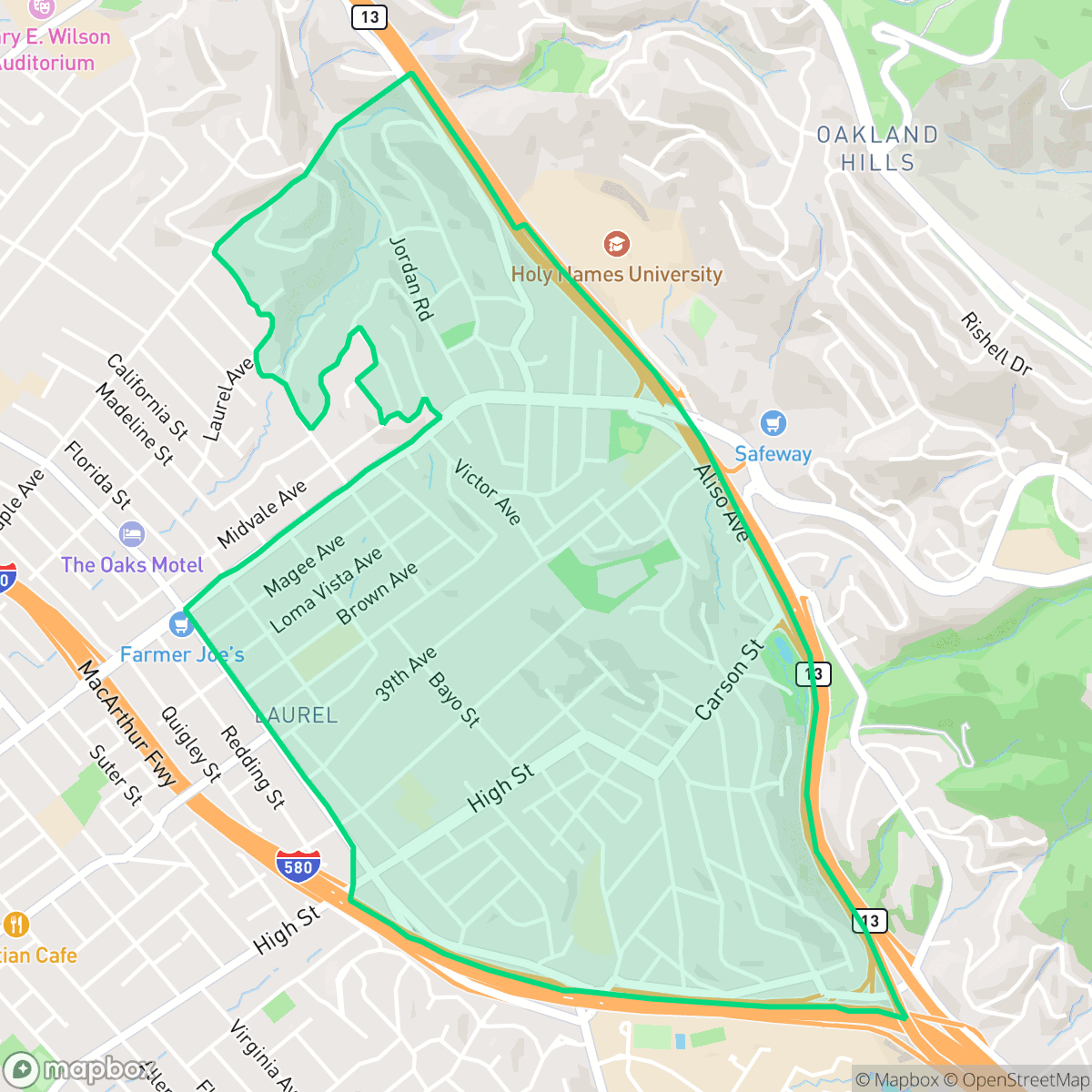
Located in the Oakland Hills, Redwood Heights has roots in the mid-19th-century logging boom, when local old-growth redwoods were harvested and hauled down what is now Redwood Road. Residential development began in earnest during the 1920s with "Avenue Terrace," a subdivision marketed as "the Piedmont of East Oakland". A historic stone obelisk still stands at 35th Avenue and Victor Avenue, marking the entrance to this early tract. Built up primarily between the 1920s and 1950s, the neighborhood features a diverse mix of Craftsman, Storybook, Monterey-Colonial, and Ranch-style homes, many of which were built by the Flagg Brothers. Today, the neighborhood is celebrated as one of Oakland's most ethnically diverse, middle-class communities, centered around the Redwood Heights Elementary School and its active recreation center.
The area maintains a distinct suburban character defined by its hilly terrain and mature tree canopy, which provides a sense of seclusion despite its proximity to major transit corridors. Residents benefit from excellent air quality and a lack of industrial activity, contributing to a stable living environment. According to iHuus data, the community features high rates of health insurance coverage, reflecting a population that prioritizes long-term stability. The presence of a highly rated elementary school serves as a central hub for families, anchoring the social fabric of the neighborhood.
Prospective residents should consider the trade-offs inherent in this location, particularly regarding acoustic comfort and fire safety. The proximity to a major freeway results in consistent road noise, and the hillside setting presents significant fire safety challenges that are common throughout the Oakland Hills. While the sidewalk network is well-maintained, the hilly topography and highway barriers limit overall walkability compared to flatter parts of the city. This neighborhood is well-suited for those who value a quiet, residential atmosphere and access to green spaces over immediate urban density.
Neighborhood Scores Across 15 Qualities
Residential spacing is somewhat varied, with some areas featuring closely packed houses and shared property lines. According to iHuus data, this level of separation is higher than the Oakland average.
Established sidewalk networks and tree-lined residential cul-de-sacs facilitate easy movement, although a major high-traffic freeway corridor impacts overall connectivity. According to iHuus data, the ease of walking here is slightly lower than the Oakland average.
Manicured properties and large homes with private amenities create a visual landscape that is more polished than the Oakland average. According to iHuus data, the area features complex architectural details and spacious lots that contribute to a premium aesthetic.
Tree-lined streets and proximity to large forested park areas provide more opportunities for pet exercise than the Oakland average. While some denser pockets lack private yards, the presence of connected green spaces makes the area more dog friendly than much of the city.
Frequent open land and scattered homes among woodland create a more semi-rural environment than the typical Oakland landscape. According to iHuus data, this area features a notable amount of greenery and natural space compared to the city average.
Suburban streets and green spaces offer a calm atmosphere with a moderate selection of local dining and amenities. This level of activity is in line with the Oakland average.
Frequent disturbances from nearby freeway traffic and railroad corridors characterize the area. According to iHuus data, acoustic comfort in this neighborhood is lower than the Oakland average.
Air quality remains consistently high with minimal health concerns. This level of purity is notably better than the Oakland average, according to iHuus data.
Industrial presence is virtually non-existent in this area, which contains no warehouses, heavy machinery, or hazardous facilities. According to iHuus data, this lack of industrial proximity is notably higher than the Oakland average.
Health insurance access is widespread among residents, significantly outpacing the Oakland city average according to iHuus data.
Voting patterns and census indicators show a very high concentration of liberal-leaning residents, slightly above the Oakland average according to iHuus data.
Residents live alongside a balanced mix of young adults, families, and older populations. This age distribution is slightly more varied than the average found across Oakland, according to iHuus data.
Flood risk in this area is notably higher than the Oakland average, though official FEMA studies for this specific location remain incomplete.
Extreme fire hazards are present in this area, representing a significantly higher risk level than the Oakland average according to iHuus data. Residents should prioritize maximum fire protection measures and remain vigilant regarding local safety protocols.
Address-Level Insights for Redwood Heights


iHuus Neighborhood Intelligence Insights
Get address-level neighborhood insights for Redwood Heights
- Street-level scores — see how individual blocks compare, not just neighborhood averages
- Micro-zone boundaries — identify quiet pockets, flood boundaries, and walkable clusters before you visit
- 15 dimensions in full — walkability, noise, air quality, school quality, insurance coverage, population age profile, urban/rural index, and more
- Boundary risk alerts — know if your address sits near a block boundary where scores drop, the kind of detail no listing will ever mention
- School insights — individual school ratings and insights, not just district-level data
- Compare before you commit — side-by-side data across neighborhoods, down to block precision
No credit card required
Compare with Any Neighborhood
| Dimension | Redwood Heights | Acorn |
|---|---|---|
| 🚶 Walkabilityavg 8.99 | ||
| 🔊 Acoustic Comfortavg 3.24 | ||
| 🤫 Privacy Indexavg 3.74 | ||
| 🎨 Visual Appealavg 6.28 | ||
| 🐕 Dog Friendlinessavg 5.74 | ||
| 🗺️ Urban-Rural Indexavg 6.02 | ||
| ✨ Neighborhood Vibeavg 5.22 | ||
| 🏥 Health Insurance Coverageavg 7.4 | ||
| 🌿 Air Qualityavg 8.06 | ||
| 🏭 Industrial Proximityavg 8.37 | ||
| 🌊 Flood Safetyavg 2.61 | ||
| 🗳️ Ideological Leanavg 9.95 | ||
| 👥 Population Age Profileavg 4.92 | ||
| 🔥 Fire Safetyavg 0.17 | ||
| 🏫 School Quality |
Redwood Heights Rankings
School Districts Serving Redwood Heights
School Insights for Redwood Heights
Below average outcomes; significant attendance and academic challenges.
School Insights
See what's really behind every school rating near Redwood Heights
- Individual school ratings — each school's own score with outcome context, not just a district average
- Enrollment & class size data — student-to-teacher ratio and how it compares to the state average
- Full demographics breakdown — ethnicity and gender composition for every school in the enrollment zone
- Every school in the district — all schools within the enrollment boundary ranked by rating, not just the closest one
- Grade levels & benchmarks — elementary through high school, with below/above state-average flags
No credit card required