Rancho San Antonio, Oakland
Updated · 5,709 residents
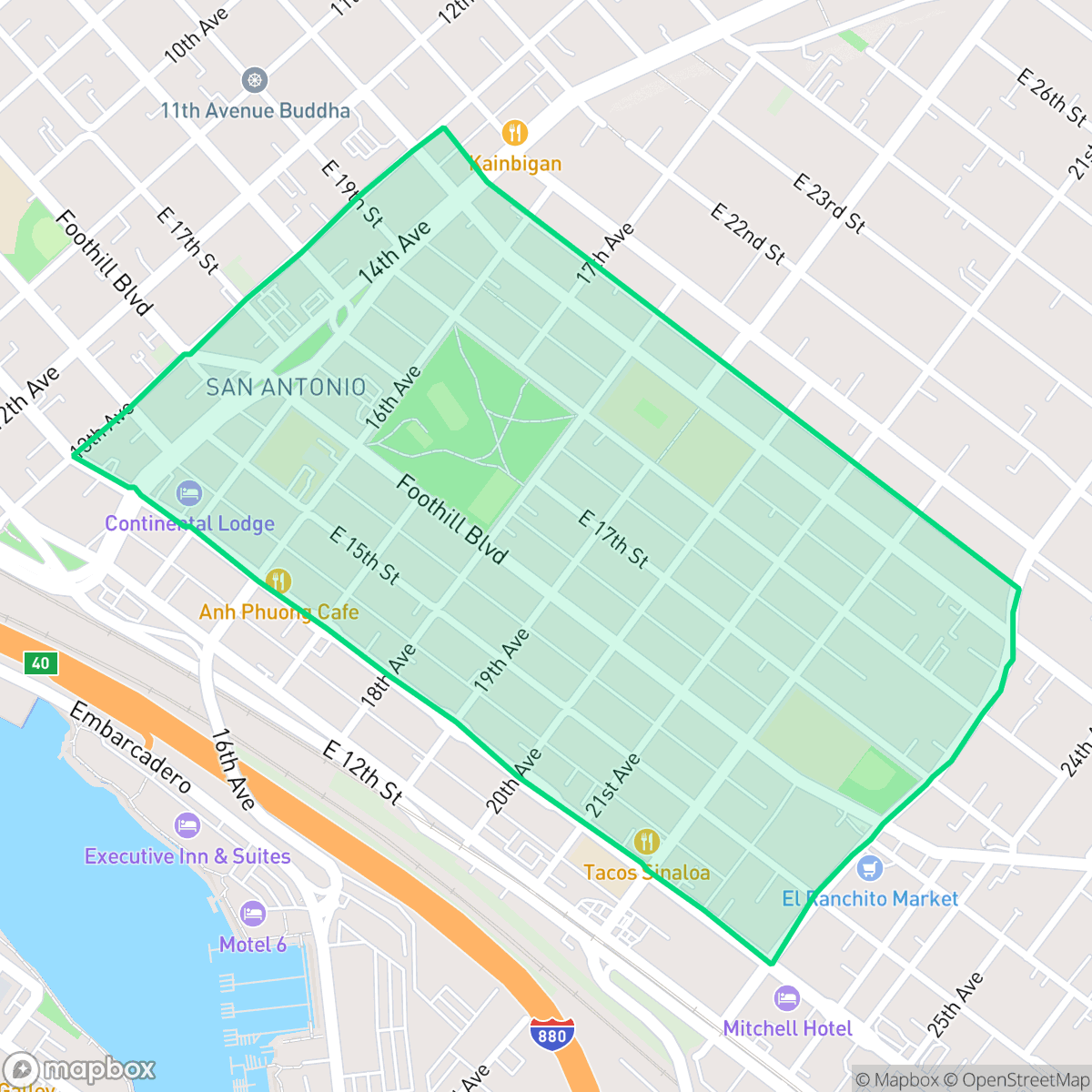
Rancho San Antonio is a dense, highly walkable neighborhood in Oakland characterized by its rich multicultural history and quiet residential atmosphere. Residents benefit from excellent pedestrian accessibility and a strong sense of community, though the area features compact housing with limited privacy.
Key Highlights
About Rancho San Antonio
The Rancho San Antonio neighborhood in Oakland, California, traces its origins to the 1820 Spanish land grant awarded to Luís María Peralta. In 1851, James LaRue purchased and later subdivided the land, which briefly became part of the township of Brooklyn before its 1872 annexation by Oakland. Historically, 13th Avenue served as a vital logging road transporting lumber to the waterfront. Originally settled by Portuguese immigrants, the neighborhood underwent significant demographic shifts. During the 1960s and 1970s, urban renewal brought Black and Latino families to the area, fostering activism; the Black Panthers operated a Free Breakfast Program here, and San Antonio Park hosted the 1970 Oakland Chicano Moratorium Protest. By the 1980s and 1990s, a large influx of Vietnamese and Cambodian families transformed the neighborhood into a vibrant, multilingual cultural hub.
The neighborhood functions as a dense, low-rise urban environment that balances quiet residential streets with pockets of local dining. While the area maintains a suburban feel, its layout is exceptionally walkable, offering residents easy access to local amenities like San Antonio Park. The built environment consists primarily of standard, compact housing structures, which results in a high-density living experience with minimal space between properties. According to data, the area maintains a stable air quality profile despite its location near major transit corridors.
Prospective residents should consider the trade-offs associated with the local school district, which currently faces significant budgetary and operational challenges. While the neighborhood offers a progressive community environment, the proximity to major highway corridors contributes to moderate ambient noise levels. It is best suited for those who prioritize walkability and cultural diversity over expansive private living spaces or proximity to high-performing public schools.
Neighborhood Scores Across 15 Qualities
Residential structures are positioned in close proximity with minimal separation between property lines. According to iHuus data, this density results in lower privacy levels compared to the Oakland average.
Pedestrian infrastructure is generally reliable with consistent sidewalks and marked crossings, though a major highway corridor creates a significant break in the street grid. This level of walkability is slightly lower than the Oakland average.
Typical tract housing dominates the area with small yards and boxy rooflines. According to iHuus data, the visual variety in this neighborhood is slightly below the Oakland average.
Limited public park access and narrow sidewalk verges make pet walking more challenging here than in most of Oakland. While a large central park provides significant green space for some residents, much of the neighborhood lacks wide, accessible greenery for animals.
Residential streets and green spaces exist in roughly equal measure, offering a suburban feel that is slightly more balanced than the Oakland average. According to iHuus data, the area features a blend of low-rise residential structures alongside industrial and marina interfaces.
Residential life here is characterized by a subdued atmosphere with pockets of localized activity, falling below the Oakland average for urban vibrancy. While certain blocks feature small clusters of dining and community hubs, much of the landscape remains comprised of quiet streets, green spaces, and light industrial zones.
A steady hum of local traffic from nearby busy streets is noticeable, though acoustic comfort remains higher than the Oakland average according to iHuus data.
Air quality in this area remains consistently high with rare instances of poor readings. According to iHuus data, the air quality is roughly in line with the average for Oakland.
Large logistics warehouses and active railway corridors are present alongside residential areas, making industrial proximity notably higher than the Oakland average. Residents may experience moderate noise from nearby highway corridors and heavy truck traffic near commercial zones.
Health insurance coverage among residents is notably lower than the Oakland city average, according to iHuus data.
Voting patterns and census indicators show a highly liberal political leaning, which aligns with the broader Oakland average according to iHuus data.
Residents live alongside a balanced mix of young adults, families, and older individuals. This age distribution is largely consistent with the broader Oakland area, according to iHuus data.
Located in a coastal high-hazard zone with potential wave action, this area faces significantly higher flood risks than most of Oakland. Residents should prepare for elevated or potentially prohibitive flood insurance costs according to iHuus data.
Address-Level Insights for Rancho San Antonio


iHuus Neighborhood Intelligence Insights
Get address-level neighborhood insights for Rancho San Antonio
- Street-level scores — see how individual blocks compare, not just neighborhood averages
- Micro-zone boundaries — identify quiet pockets, flood boundaries, and walkable clusters before you visit
- 15 dimensions in full — walkability, noise, air quality, school quality, insurance coverage, population age profile, urban/rural index, and more
- Boundary risk alerts — know if your address sits near a block boundary where scores drop, the kind of detail no listing will ever mention
- School insights — individual school ratings and insights, not just district-level data
- Compare before you commit — side-by-side data across neighborhoods, down to block precision
No credit card required
Compare with Any Neighborhood
| Dimension | Rancho San Antonio | Acorn |
|---|---|---|
| 🚶 Walkabilityavg 8.99 | ||
| 🔊 Acoustic Comfortavg 3.24 | ||
| 🤫 Privacy Indexavg 3.74 | ||
| 🎨 Visual Appealavg 6.28 | ||
| 🐕 Dog Friendlinessavg 5.74 | ||
| 🗺️ Urban-Rural Indexavg 6.02 | ||
| ✨ Neighborhood Vibeavg 5.22 | ||
| 🏥 Health Insurance Coverageavg 7.4 | ||
| 🌿 Air Qualityavg 8.06 | ||
| 🏭 Industrial Proximityavg 8.37 | ||
| 🌊 Flood Safetyavg 2.61 | ||
| 🗳️ Ideological Leanavg 9.95 | ||
| 👥 Population Age Profileavg 4.92 | ||
| 🔥 Fire Safetyavg 0.17 | ||
| 🏫 School Quality |
Rancho San Antonio Rankings
School Districts Serving Rancho San Antonio
School Insights for Rancho San Antonio
Below average outcomes; significant attendance and academic challenges.
School Insights
See what's really behind every school rating near Rancho San Antonio
- Individual school ratings — each school's own score with outcome context, not just a district average
- Enrollment & class size data — student-to-teacher ratio and how it compares to the state average
- Full demographics breakdown — ethnicity and gender composition for every school in the enrollment zone
- Every school in the district — all schools within the enrollment boundary ranked by rating, not just the closest one
- Grade levels & benchmarks — elementary through high school, with below/above state-average flags
No credit card required