Ralph Bunche, Oakland
Updated · 2,622 residents
Ralph Bunche is a highly walkable West Oakland neighborhood characterized by dense, historic housing and a vibrant, mixed-use atmosphere. While residents enjoy excellent air quality and a central location, the area experiences significant noise from nearby highway traffic and limited residential privacy.
Key Highlights
About Ralph Bunche
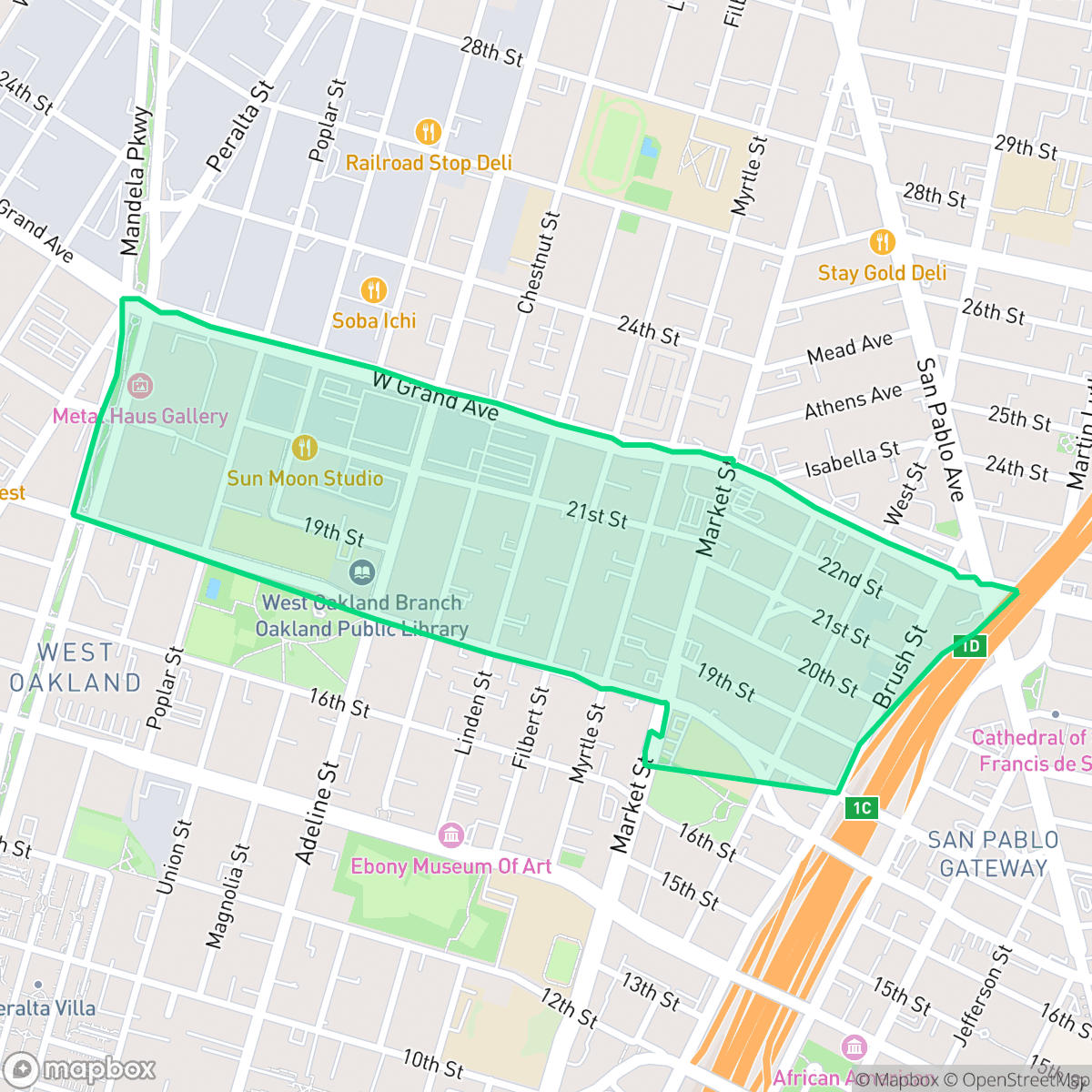
Situated in West Oakland, the Ralph Bunche neighborhood is bounded by the Prescott and Oak Center areas near Interstate 980. The neighborhood took its name from the local Ralph J. Bunche Elementary School (now Ralph Bunche High School), which was dedicated in 1963 to honor the Nobel Peace Prize-winning diplomat. Bunche himself visited the school and its students in 1966. Architecturally, the area features a dense stock of historic Victorian-era homes, duplexes, and multi-unit flats, many constructed before 1939 to house the diverse working-class families and railroad workers who settled in West Oakland. Over the decades, the neighborhood has maintained a resilient, tight-knit community identity amidst the mid-century urban renewal and freeway construction projects that reshaped the surrounding West Oakland landscape.
The area serves as a dense urban enclave where historic Victorian architecture meets modern industrial and commercial activity. According to iHuus data, the neighborhood maintains a perfect walkability score, allowing residents easy access to local amenities such as the Transmission Gallery and various neighborhood dining spots. The environment is distinctly urban, with a tight-knit layout that emphasizes proximity over private outdoor space, creating a setting where residential life and active commercial traffic frequently intersect. Prospective residents should note that the neighborhood presents specific trade-offs regarding acoustic comfort due to its proximity to major transit corridors. While the area boasts high marks for air quality and health insurance coverage, the local school district faces significant institutional challenges. The neighborhood is best suited for individuals who prioritize walkability and urban accessibility over quiet, suburban-style seclusion, as iHuus data indicates a high-density environment that remains deeply connected to the broader West Oakland landscape.
Neighborhood Scores Across 15 Qualities
Residential density is high, with many homes positioned very close to one another or sharing walls. This level of separation is noticeably lower than the average for Oakland, according to iHuus data.
Pedestrian movement is highly efficient due to a complete street grid with dedicated sidewalks on both sides of most roads and frequent marked crossings. This level of walkability is notably higher than the Oakland average, according to iHuus data.
Standard urban housing dominates the area, featuring dense multi-family units and boxy rooflines with minimal private yard space. This visual landscape is slightly less varied than the Oakland average, according to iHuus data.
Limited access to public parks and narrow street verges make pet walking more challenging here than in much of Oakland. While some areas feature linear green strips, several parts of the neighborhood consist of dense concrete environments with negligible green space.
Largely composed of industrial warehouses and tightly packed residential blocks, this area feels significantly less urban than the Oakland average. According to iHuus data, the landscape is dominated by low-rise structures and occasional patches of greenery rather than dense high-rise development.
Mixed-use blocks offer a blend of industrial calm and high-energy activity near major transit corridors. According to iHuus data, the neighborhood maintains a level of activity and amenity access that is slightly above the Oakland average.
Frequent sounds from nearby freeway and railroad corridors contribute to a level of acoustic disturbance that is higher than the Oakland average, according to iHuus data.
Air quality remains consistently high with minimal health concerns. This level of air purity is notably better than the Oakland average, according to iHuus data.
Mixed-use zones containing light commercial units and heavy industrial facilities with significant freight traffic are present here. This level of industrial density is notably higher than the Oakland average, and residents should be aware of a nearby EPA Superfund site according to iHuus data.
Access to health insurance is less common here than in the rest of Oakland. According to iHuus data, fewer residents in this area are covered by health plans compared to the city average.
Voting patterns and census indicators reflect a deeply liberal political landscape that is consistent with the broader Oakland area.
A diverse range of age groups resides here, including young adults, families, and seniors. This demographic distribution is largely in line with the overall Oakland average, according to iHuus data.
Properties in this area are situated within a designated floodplain, which may necessitate flood insurance. According to iHuus data, the risk of flooding in Ralph Bunche is higher than the average for Oakland.
Address-Level Insights for Ralph Bunche


iHuus Neighborhood Intelligence Insights
Get address-level neighborhood insights for Ralph Bunche
- Street-level scores — see how individual blocks compare, not just neighborhood averages
- Micro-zone boundaries — identify quiet pockets, flood boundaries, and walkable clusters before you visit
- 15 dimensions in full — walkability, noise, air quality, school quality, insurance coverage, population age profile, urban/rural index, and more
- Boundary risk alerts — know if your address sits near a block boundary where scores drop, the kind of detail no listing will ever mention
- School insights — individual school ratings and insights, not just district-level data
- Compare before you commit — side-by-side data across neighborhoods, down to block precision
No credit card required
Compare with Any Neighborhood
| Dimension | Ralph Bunche | Acorn |
|---|---|---|
| 🚶 Walkabilityavg 8.99 | ||
| 🔊 Acoustic Comfortavg 3.24 | ||
| 🤫 Privacy Indexavg 3.74 | ||
| 🎨 Visual Appealavg 6.28 | ||
| 🐕 Dog Friendlinessavg 5.74 | ||
| 🗺️ Urban-Rural Indexavg 6.02 | ||
| ✨ Neighborhood Vibeavg 5.22 | ||
| 🏥 Health Insurance Coverageavg 7.4 | ||
| 🌿 Air Qualityavg 8.06 | ||
| 🏭 Industrial Proximityavg 8.37 | ||
| 🌊 Flood Safetyavg 2.61 | ||
| 🗳️ Ideological Leanavg 9.95 | ||
| 👥 Population Age Profileavg 4.92 | ||
| 🔥 Fire Safetyavg 0.17 | ||
| 🏫 School Quality |
Ralph Bunche Rankings
School Districts Serving Ralph Bunche
School Insights for Ralph Bunche
Below average outcomes; significant attendance and academic challenges.
School Insights
See what's really behind every school rating near Ralph Bunche
- Individual school ratings — each school's own score with outcome context, not just a district average
- Enrollment & class size data — student-to-teacher ratio and how it compares to the state average
- Full demographics breakdown — ethnicity and gender composition for every school in the enrollment zone
- Every school in the district — all schools within the enrollment boundary ranked by rating, not just the closest one
- Grade levels & benchmarks — elementary through high school, with below/above state-average flags
No credit card required