Produce & Waterfront, Oakland
Updated · 4,733 residents
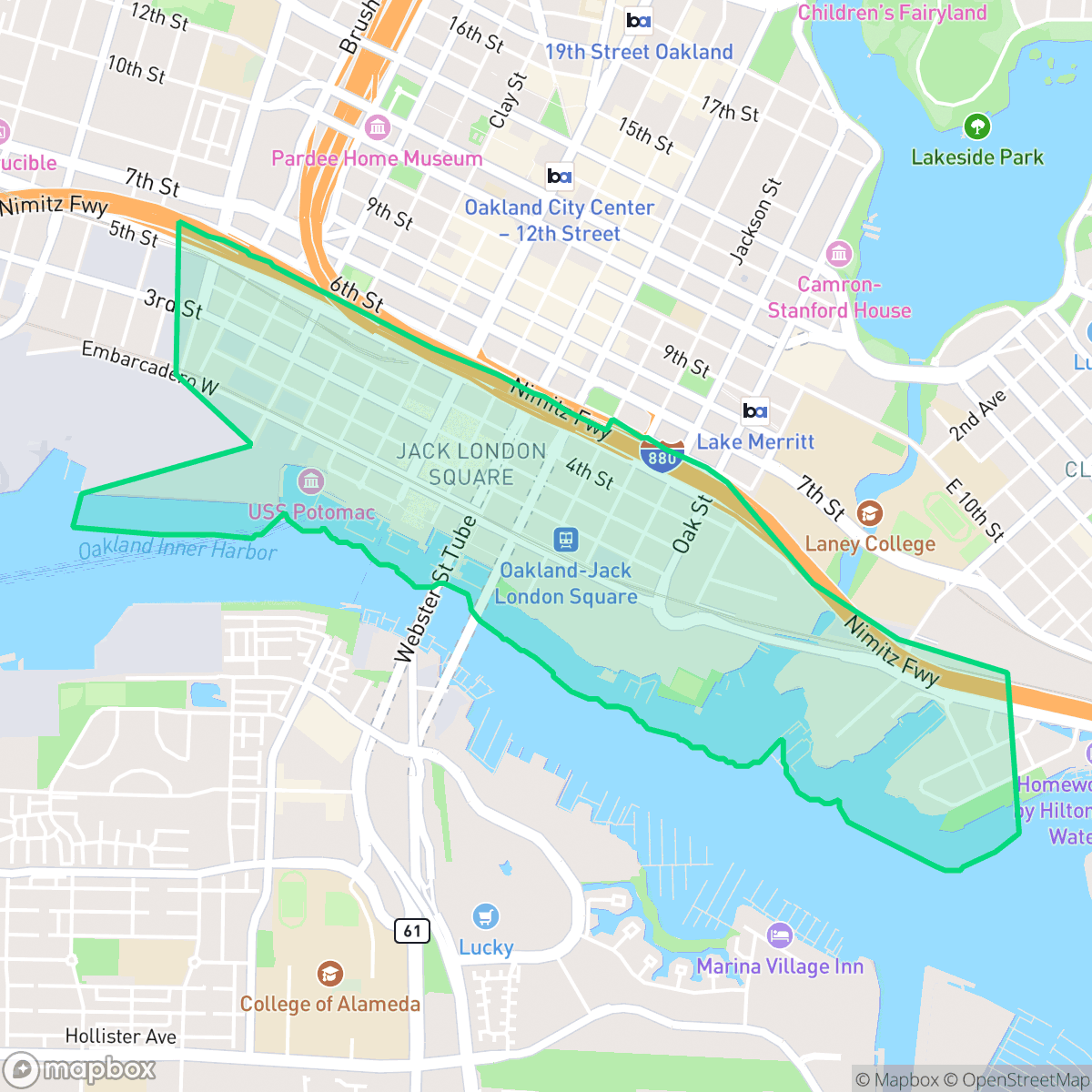
Produce & Waterfront is a historic industrial hub defined by its exceptional walkability and direct access to the Oakland waterfront. While the area offers a vibrant, liberal atmosphere, residents must navigate high noise levels from nearby rail and freeway traffic, alongside significant coastal flood risks.
Key Highlights
About Produce & Waterfront
The Produce and Waterfront neighborhood, historically known as the Produce District, emerged as a vital maritime and industrial hub following Oakland's 1852 incorporation. Central to its character is the wholesale produce market, which relocated to the area between Broadway, Fallon, and the waterfront around 1916. Designed by architect Charles McCall, the district’s market buildings remain notable examples of early 20th-century industrial architecture. The area’s cultural identity is deeply intertwined with its working-class roots, the Italian and Chinese merchants who anchored the produce trade, and author Jack London, who frequented local waterfront landmarks like the 1883 Heinold’s First and Last Chance Saloon. Once a bustling center for canning and rail-side commerce, the district underwent significant transformation in the mid-20th century, eventually becoming the modern Jack London Square, a recreational and commercial destination that preserves its maritime heritage.
Produce & Waterfront functions as a dense, urban environment where industrial warehouses and modern transit infrastructure coexist with residential living. The neighborhood is characterized by a high degree of connectivity, featuring wide sidewalks and dedicated pedestrian paths that facilitate easy movement throughout the district. Despite its industrial roots, the area maintains a lively social scene with various dining and brewery operations, though the prevalence of multi-unit housing and narrow building setbacks results in limited residential privacy for those living in the heart of the district.
Prospective residents should weigh the benefits of a highly walkable lifestyle against several practical trade-offs. The area faces significant environmental challenges, including a high risk of flooding due to its coastal location and elevated noise levels from constant traffic on nearby freeways and rail lines. Furthermore, individuals should be aware of the limited local health insurance coverage and the current academic and financial instability within the Oakland Unified School District. This neighborhood is best suited for those who prioritize immediate access to waterfront amenities and urban convenience over quiet, suburban-style living.
Neighborhood Scores Across 15 Qualities
Residential structures are tightly packed with minimal separation between buildings, resulting in lower privacy levels than the Oakland average. Many dwellings consist of high-density multi-unit housing or detached homes with very narrow setbacks between neighbors.
Pedestrian infrastructure is exceptional here, featuring wide sidewalks, dedicated waterfront paths, and frequent crosswalks. According to iHuus data, the dense grid and pedestrian-priority zones offer superior connectivity compared to the Oakland average.
Visual variety is limited by modest lot sizes and standard multi-unit architecture. The area features a mix of mid-rise apartments and commercial structures, appearing less visually diverse than the Oakland average according to iHuus data.
Proximity to Lake Merritt and waterfront parks provides reliable access to green space, even though much of the immediate area consists of dense urban concrete. According to iHuus data, dog-friendly amenities in this neighborhood are slightly above the city average.
Dense industrial warehouses and large-scale port infrastructure define this area, making it significantly less urban than the Oakland average. Most of the landscape consists of heavy commercial blocks and multi-story transit hubs with only occasional patches of greenery.
Active dining and social hubs are interspersed with quieter, industrial, and suburban pockets. This area possesses a slightly more vibrant atmosphere than the Oakland average, though many amenities remain car-dependent due to the presence of warehouses and highways.
Constant noise from nearby freeways and railroad tracks is a significant feature of this area. According to iHuus data, acoustic comfort in this neighborhood is notably lower than the Oakland average.
Air quality remains mostly clean with only rare instances of elevated readings. This level of air quality is nearly identical to the Oakland average according to iHuus data.
Significant industrial activity, including rail yards, warehouses, and a nearby EPA Superfund site, creates a much higher level of commercial traffic and potential noise than is typical for Oakland. Residents should expect a blend of residential life and active daytime logistics, such as brewery operations and intermittent loading activity, according to iHuus data.
Health insurance accessibility is lower than the Oakland average. Residents may face greater challenges accessing medical services compared to other parts of the city, according to iHuus data.
Voting patterns and census indicators reflect a strongly liberal community, mirroring the broader political landscape of Oakland. According to iHuus data, the area's ideological lean is slightly more progressive than the city average.
Residents live alongside a balanced range of young adults, families, and older individuals. This demographic distribution is slightly more varied than the Oakland average, according to iHuus data.
Significant flood risk exists due to the area's location in a coastal high-hazard zone with wave action. According to iHuus data, this risk is considerably higher than the Oakland average and may lead to elevated or prohibitive insurance costs.
Address-Level Insights for Produce & Waterfront


iHuus Neighborhood Intelligence Insights
Get address-level neighborhood insights for Produce & Waterfront
- Street-level scores — see how individual blocks compare, not just neighborhood averages
- Micro-zone boundaries — identify quiet pockets, flood boundaries, and walkable clusters before you visit
- 15 dimensions in full — walkability, noise, air quality, school quality, insurance coverage, population age profile, urban/rural index, and more
- Boundary risk alerts — know if your address sits near a block boundary where scores drop, the kind of detail no listing will ever mention
- School insights — individual school ratings and insights, not just district-level data
- Compare before you commit — side-by-side data across neighborhoods, down to block precision
No credit card required
Compare with Any Neighborhood
| Dimension | Produce & Waterfront | Acorn |
|---|---|---|
| 🚶 Walkabilityavg 8.99 | ||
| 🔊 Acoustic Comfortavg 3.24 | ||
| 🤫 Privacy Indexavg 3.74 | ||
| 🎨 Visual Appealavg 6.28 | ||
| 🐕 Dog Friendlinessavg 5.74 | ||
| 🗺️ Urban-Rural Indexavg 6.02 | ||
| ✨ Neighborhood Vibeavg 5.22 | ||
| 🏥 Health Insurance Coverageavg 7.4 | ||
| 🌿 Air Qualityavg 8.06 | ||
| 🏭 Industrial Proximityavg 8.37 | ||
| 🌊 Flood Safetyavg 2.61 | ||
| 🗳️ Ideological Leanavg 9.95 | ||
| 👥 Population Age Profileavg 4.92 | ||
| 🔥 Fire Safetyavg 0.17 | ||
| 🏫 School Quality |
Produce & Waterfront Rankings
School Districts Serving Produce & Waterfront
School Insights for Produce & Waterfront
Below average outcomes; significant attendance and academic challenges.
School Insights
See what's really behind every school rating near Produce & Waterfront
- Individual school ratings — each school's own score with outcome context, not just a district average
- Enrollment & class size data — student-to-teacher ratio and how it compares to the state average
- Full demographics breakdown — ethnicity and gender composition for every school in the enrollment zone
- Every school in the district — all schools within the enrollment boundary ranked by rating, not just the closest one
- Grade levels & benchmarks — elementary through high school, with below/above state-average flags
No credit card required