Produce & Waterfront, Oakland
Updated · 4,733 residents
The Produce & Waterfront district offers a high-energy, walkable urban experience centered around historic warehouses and the Oakland waterfront. While residents benefit from immediate access to diverse dining and transit hubs, the area is characterized by dense, multi-unit housing and significant noise from nearby highway and rail traffic.
Key Highlights
About Produce & Waterfront
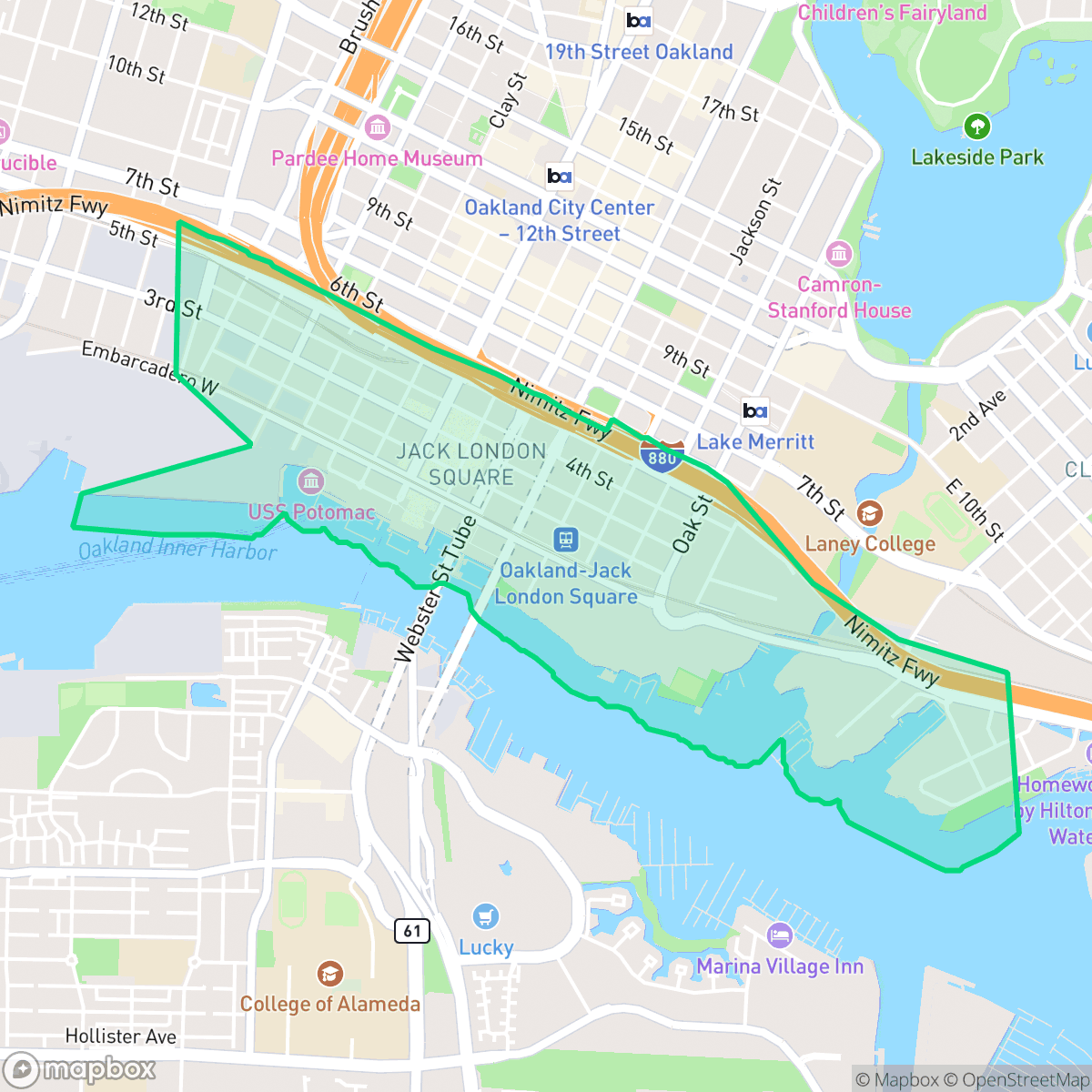
Oakland’s Produce & Waterfront neighborhood, largely overlapping with the Jack London District, originated as a vital maritime and transit hub. In 1917, a city ordinance prompted local merchants to relocate from downtown to the waterfront near the transcontinental railroad. This established the historic Oakland Produce Market between Broadway and Harrison streets, cementing the area as a booming distribution center for agricultural goods and canned products. Architecturally, the neighborhood is defined by its industrial Waterfront Warehouse District, a National Register Historic District featuring early 20th-century brick warehouses. Key cultural landmarks include Jack London Square and Heinold’s First and Last Chance Saloon, a historic tavern built in 1884 from the timbers of an old steamboat, famous for its slanted floor caused by the 1906 earthquake. The neighborhood remains anchored by its century-old wholesale produce trade and iconic local establishments like Merchant’s Saloon.
The neighborhood functions as a dense, transit-oriented hub that balances its industrial heritage with modern urban living. Its grid-based street network provides exceptional pedestrian access to the waterfront, where residents frequent established social anchors like local cafes and historic taverns. The area maintains a high level of activity, driven by its proximity to major logistics infrastructure and a vibrant mix of commercial and residential blocks.
Prospective residents should account for the trade-offs inherent in such a centralized location. According to iHuus data, acoustic comfort is notably low due to consistent road and rail traffic, and the dense housing layout results in limited privacy. The area faces specific environmental challenges, including low scores for flood and fire safety, and families should consider the current instability within the local school district. This location is best suited for individuals who prioritize walkability and urban connectivity over quiet, suburban-style living.
Neighborhood Scores Across 15 Qualities
Buildings are tightly packed with minimal separation between structures, resulting in lower privacy levels than the Oakland average. Many residents live in high-density housing where units share walls or are positioned very close to neighboring properties.
Extensive sidewalk networks and dedicated waterfront paths make walking easy throughout the area. This neighborhood offers a more pedestrian-oriented environment than the Oakland average, featuring consistent crosswalks and specialized zones for foot traffic.
Standard urban density characterizes the area with modest lot sizes and multi-story apartments. The visual landscape features more functional, compact architecture than the Oakland average.
Proximity to Lake Merritt and waterfront parks provides reliable access to green space, even though much of the immediate area consists of dense urban concrete. According to iHuus data, dog-friendly amenities in this neighborhood are slightly above the city average.
Heavy industrial infrastructure and massive port facilities characterize this area, creating a landscape that is significantly less urbanized than the Oakland average. Large warehouses and multi-story commercial blocks dominate the terrain, with relatively sparse greenery interspersed among the transit and maritime hubs.
Lively street life and diverse dining options are concentrated near the coastline and major transit corridors, making the area slightly more active than the Oakland average. While some blocks feature high-energy social hubs, other sections remain quiet and more dependent on vehicles due to the presence of industrial zones and warehouses.
Persistent noise from nearby freeways and railroad tracks characterizes this area. According to iHuus data, acoustic comfort is significantly lower than the Oakland average.
Air quality remains mostly clean with only rare instances of elevated readings. This level of air quality is nearly identical to the Oakland average according to iHuus data.
Significant industrial activity, including rail yards and warehouses, is present alongside residential areas. According to iHuus data, this neighborhood has a much higher concentration of industrial and logistics facilities than the Oakland average.
Health insurance coverage among residents is notably lower than the Oakland average, according to iHuus data. This indicates a higher proportion of uninsured individuals living in the area compared to the rest of the city.
Voting patterns and census indicators reflect a strongly liberal community, mirroring the broader political landscape of Oakland. According to iHuus data, the area's ideological lean is slightly more progressive than the city average.
A diverse range of age groups resides here, including young adults, families, and older residents. This demographic spread is slightly more varied than the typical Oakland profile, according to iHuus data.
Significant flood risk exists due to the area's location in a coastal high-hazard zone with wave action. According to iHuus data, this risk is considerably higher than the Oakland average and may lead to elevated or prohibitive insurance costs.
Address-Level Insights for Produce & Waterfront


iHuus Neighborhood Intelligence Insights
Get address-level neighborhood insights for Produce & Waterfront
- Street-level scores — see how individual blocks compare, not just neighborhood averages
- Micro-zone boundaries — identify quiet pockets, flood boundaries, and walkable clusters before you visit
- 15 dimensions in full — walkability, noise, air quality, school quality, insurance coverage, population age profile, urban/rural index, and more
- Boundary risk alerts — know if your address sits near a block boundary where scores drop, the kind of detail no listing will ever mention
- School insights — individual school ratings and insights, not just district-level data
- Compare before you commit — side-by-side data across neighborhoods, down to block precision
No credit card required
Compare with Any Neighborhood
| Dimension | Produce & Waterfront | Acorn |
|---|---|---|
| 🚶 Walkabilityavg 8.99 | ||
| 🔊 Acoustic Comfortavg 3.24 | ||
| 🤫 Privacy Indexavg 3.74 | ||
| 🎨 Visual Appealavg 6.28 | ||
| 🐕 Dog Friendlinessavg 5.74 | ||
| 🗺️ Urban-Rural Indexavg 6.02 | ||
| ✨ Neighborhood Vibeavg 5.22 | ||
| 🏥 Health Insurance Coverageavg 7.4 | ||
| 🌿 Air Qualityavg 8.06 | ||
| 🏭 Industrial Proximityavg 8.37 | ||
| 🌊 Flood Safetyavg 2.61 | ||
| 🗳️ Ideological Leanavg 9.95 | ||
| 👥 Population Age Profileavg 4.92 | ||
| 🔥 Fire Safetyavg 0.17 | ||
| 🏫 School Quality |
Produce & Waterfront Rankings
School Districts Serving Produce & Waterfront
School Insights for Produce & Waterfront
Below average outcomes; significant attendance and academic challenges.
School Insights
See what's really behind every school rating near Produce & Waterfront
- Individual school ratings — each school's own score with outcome context, not just a district average
- Enrollment & class size data — student-to-teacher ratio and how it compares to the state average
- Full demographics breakdown — ethnicity and gender composition for every school in the enrollment zone
- Every school in the district — all schools within the enrollment boundary ranked by rating, not just the closest one
- Grade levels & benchmarks — elementary through high school, with below/above state-average flags
No credit card required