Prescott, Oakland
Updated · 3,202 residents
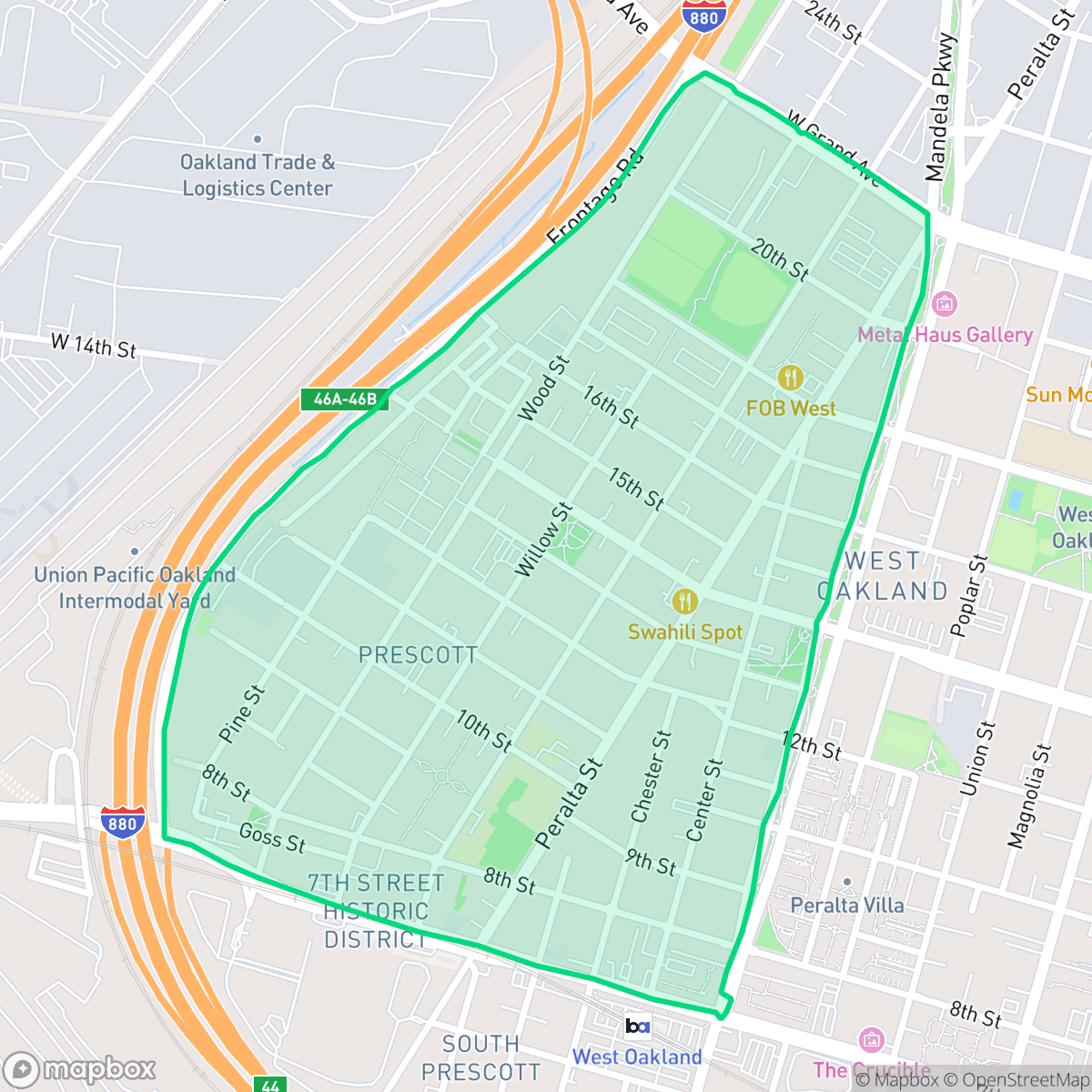
Prescott is a dense, industrial-adjacent neighborhood in West Oakland characterized by its historic worker cottages and proximity to major transit corridors. While rich in cultural legacy, the area faces significant challenges with noise from road traffic and limited public green space.
Key Highlights
About Prescott
Originally known as Oakland Point, the Prescott neighborhood in West Oakland developed starting in 1869 alongside the transcontinental railroad, taking its name from the historic Prescott School. Characterized by its Victorian-era worker cottages and homes, Prescott became a hub for Pullman Porters and home to the 1872 Shorey House, residence of prominent Black sea captain William Shorey. In the mid-20th century, Seventh Street emerged as a vibrant jazz and blues epicenter known as the "Harlem of the West," featuring iconic venues like Esther's Orbit Room. The neighborhood also housed the Black Panther Party’s first headquarters on Peralta Street in the late 1960s. Other notable landmarks include the Beaux-Arts 16th Street Station (1912). Prescott was later nicknamed the "Lower Bottoms" after the construction of the Cypress Freeway divided the community in the 1950s.
The area is defined by its compact residential grid and heavy industrial surroundings, which create a distinct urban landscape. The neighborhood maintains a high level of health insurance coverage among its residents, though it remains physically constrained by nearby logistics infrastructure and major highways. Residents live in close proximity to one another, with minimal setbacks between homes that reflect the neighborhood's original development as a worker-focused community.
Prospective residents should consider the trade-offs of living in an area with high acoustic levels, primarily driven by road traffic. According to iHuus data, the neighborhood presents significant concerns regarding flood and fire safety, alongside limited walkability compared to the broader Oakland average. It is best suited for those seeking a central location with deep historical roots, provided they are prepared for the environmental and infrastructure realities of a dense, industrial-adjacent urban zone.
Neighborhood Scores Across 15 Qualities
Residential density is high with homes situated very close to one another. According to iHuus data, property setbacks are minimal compared to the Oakland average, resulting in reduced separation between neighbors.
Pedestrian movement is supported by a consistent grid with sidewalks on most streets, though heavy rail and highway proximity create notable barriers. This connectivity is lower than the Oakland average.
Dense housing with minimal private yards and boxy rooflines characterizes this area. The visual landscape is less varied than the Oakland average, featuring tightly packed structures and limited greenery according to iHuus data.
Limited public green space and narrow sidewalk verges make off-leash exercise difficult. Most greenery in this area is confined to private yards, placing the neighborhood below the Oakland average for dog accessibility.
Residential streets and green spaces are balanced with industrial infrastructure, making the area less urban than the Oakland average. According to iHuus data, the landscape consists of a mix of low-rise residential blocks and dense commercial zones.
Residential life here is primarily characterized by a calm, low-activity environment consisting of established housing blocks and light industrial zones. According to iHuus data, the level of social activity and commercial density is significantly lower than the Oakland average.
Frequent acoustic disturbances from nearby railroad tracks and heavy freeway traffic characterize this area. According to iHuus data, noise levels in Prescott are higher than the Oakland average.
Air quality remains consistently high with very few health concerns. According to iHuus data, these conditions are notably better than the Oakland average.
Proximity to heavy industrial zones and an EPA Superfund site characterizes this area, which contains significantly less industrial density than the Oakland average. According to iHuus data, residents may encounter freight traffic and large-scale commercial facilities near certain residential pockets.
Health insurance enrollment among residents is slightly below the Oakland average. According to iHuus data, a significant portion of the population maintains coverage, though access is less widespread than in other parts of the city.
Voting patterns and census indicators show a very strong liberal leaning that is consistent with the broader Oakland area. According to iHuus data, the political landscape here is slightly more progressive than the city average.
Residents encounter a balanced mix of young professionals, families, and seniors. This age distribution is slightly more varied than the average across Oakland, according to iHuus data.
Properties in this area are located within a designated floodplain, which indicates a significantly higher risk of flooding than the Oakland average. According to iHuus data, residents should anticipate that flood insurance is likely a requirement for properties in this neighborhood.
Address-Level Insights for Prescott


iHuus Neighborhood Intelligence Insights
Get address-level neighborhood insights for Prescott
- Street-level scores — see how individual blocks compare, not just neighborhood averages
- Micro-zone boundaries — identify quiet pockets, flood boundaries, and walkable clusters before you visit
- 15 dimensions in full — walkability, noise, air quality, school quality, insurance coverage, population age profile, urban/rural index, and more
- Boundary risk alerts — know if your address sits near a block boundary where scores drop, the kind of detail no listing will ever mention
- School insights — individual school ratings and insights, not just district-level data
- Compare before you commit — side-by-side data across neighborhoods, down to block precision
No credit card required
Compare with Any Neighborhood
| Dimension | Prescott | Acorn |
|---|---|---|
| 🚶 Walkabilityavg 8.99 | ||
| 🔊 Acoustic Comfortavg 3.24 | ||
| 🤫 Privacy Indexavg 3.74 | ||
| 🎨 Visual Appealavg 6.28 | ||
| 🐕 Dog Friendlinessavg 5.74 | ||
| 🗺️ Urban-Rural Indexavg 6.02 | ||
| ✨ Neighborhood Vibeavg 5.22 | ||
| 🏥 Health Insurance Coverageavg 7.4 | ||
| 🌿 Air Qualityavg 8.06 | ||
| 🏭 Industrial Proximityavg 8.37 | ||
| 🌊 Flood Safetyavg 2.61 | ||
| 🗳️ Ideological Leanavg 9.95 | ||
| 👥 Population Age Profileavg 4.92 | ||
| 🔥 Fire Safetyavg 0.17 | ||
| 🏫 School Quality |
Prescott Rankings
School Districts Serving Prescott
School Insights for Prescott
Below average outcomes; significant attendance and academic challenges.
School Insights
See what's really behind every school rating near Prescott
- Individual school ratings — each school's own score with outcome context, not just a district average
- Enrollment & class size data — student-to-teacher ratio and how it compares to the state average
- Full demographics breakdown — ethnicity and gender composition for every school in the enrollment zone
- Every school in the district — all schools within the enrollment boundary ranked by rating, not just the closest one
- Grade levels & benchmarks — elementary through high school, with below/above state-average flags
No credit card required