Piedmont Pines, Oakland
Updated · 2,979 residents
Piedmont Pines is a serene, wooded enclave in the Oakland Hills known for its high visual appeal and tranquil, low-density atmosphere. Residents enjoy a quiet, car-dependent lifestyle with excellent access to nature, though the area faces significant fire safety challenges and limited local commercial activity.
Key Highlights
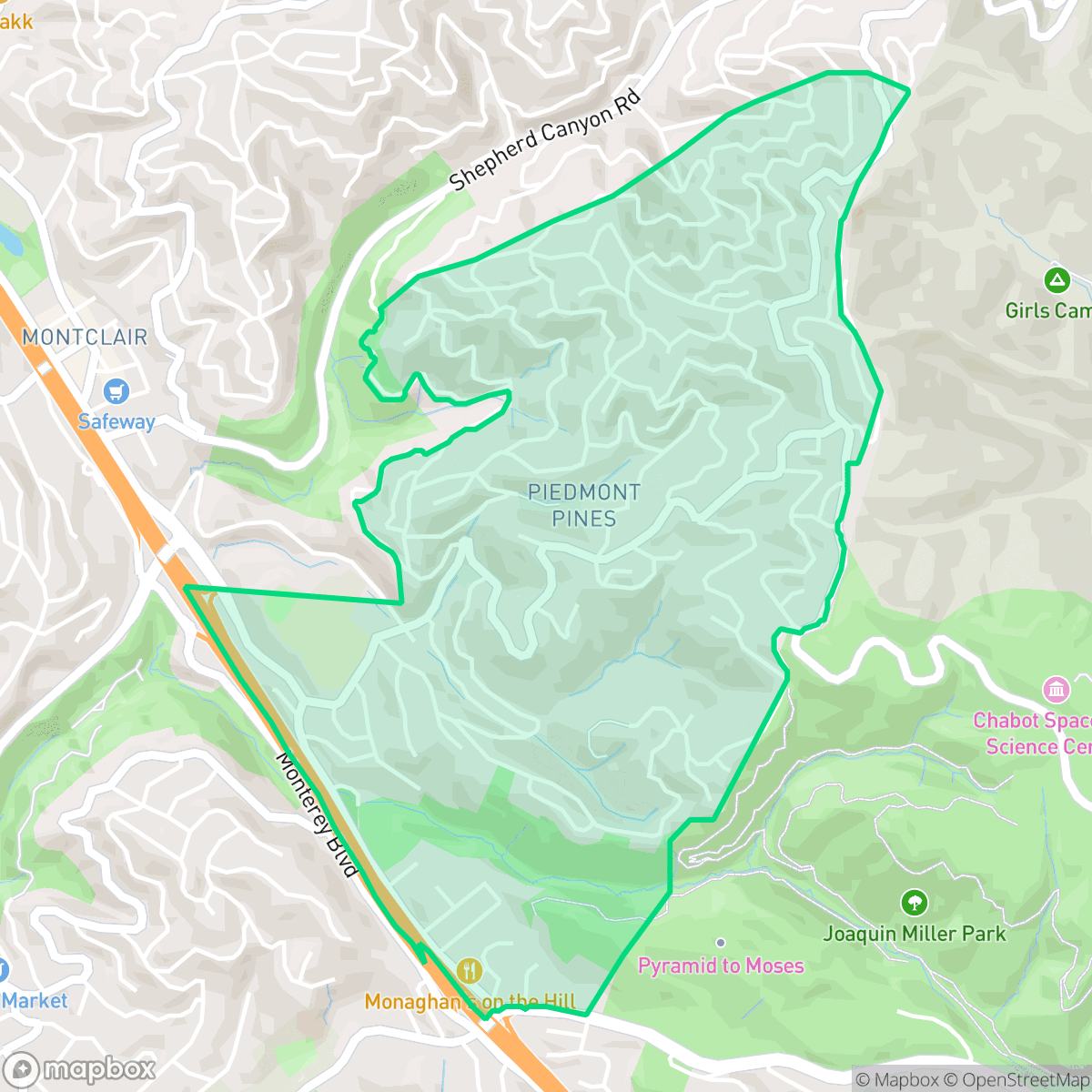
About Piedmont Pines
Piedmont Pines, a wooded neighborhood in the Oakland Hills, was originally developed in 1926 as the "Smith Reserve" on land previously owned by mining magnate Francis Marion "Borax" Smith. Marketed by the Realty Syndicate, the subdivision featured English-themed street names like Ascot and Chelsea. In the early 1930s, the tract was re-subdivided and officially renamed Piedmont Pines. Before its residential boom, a 25-acre parcel hosted the Boy Scouts' Camp Dimond (1919–1948), which later became the site of Montera Middle and Joaquin Miller Elementary schools. Architecturally, the neighborhood features Frederick L. Confer’s 1935 "Style House", mid-century modern designs by Roger Lee, and an Arts and Crafts residence once rented by Grateful Dead sound engineer Owsley Stanley. The Piedmont Pines Neighborhood Association, established in 1941, remains one of the area's defining civic institutions.
The neighborhood functions as a quiet residential retreat characterized by its steep, winding streets and mature forest canopy. It offers a distinct sense of seclusion compared to the busier parts of Oakland, with a high urban-rural index that emphasizes open space and natural beauty. According to iHuus data, the area maintains high air quality and strong health insurance coverage, contributing to a stable environment for its residents.
Prospective residents should note that the area is primarily car-oriented, as walkability is limited and local businesses are scarce. While the setting provides exceptional acoustic comfort and privacy, the trade-off includes a heightened risk regarding fire safety. This neighborhood is well-suited for individuals or families who prioritize a peaceful, nature-adjacent lifestyle over urban convenience and are prepared for the logistical realities of living in a remote, hillside setting.
Neighborhood Scores Across 15 Qualities
Homes in this area feature mixed spacing and some buffer between neighbors. This level of separation is notably higher than the Oakland average, according to iHuus data.
Low sidewalk availability makes navigating on foot less convenient than the Oakland average, though the quiet streets remain suitable for casual walking. According to iHuus data, the area lacks the pedestrian infrastructure found in more dense parts of the city.
Large residences and high-end amenities define the local landscape. According to iHuus data, the area offers significantly more visual appeal than the Oakland average.
Expansive green spaces and wide, traffic-safe paths provide an environment significantly more dog-friendly than the Oakland average, according to iHuus data.
Frequent open land and scattered homes amid woodland characterize this area. According to iHuus data, the landscape feels significantly more semi-rural than the typical Oakland urban environment.
This low-density area offers a serene, suburban atmosphere with significant open space and minimal commercial activity. According to iHuus data, the neighborhood lacks the bustling energy found in other parts of the city and relies primarily on vehicles for access to most businesses and services.
Steady traffic sounds from nearby thoroughfares are present, though the level of acoustic disturbance remains slightly lower than the Oakland average according to iHuus data.
Air quality remains consistently high with rare instances of elevated readings; this level is roughly in line with the average for Oakland.
Residential streets and open green spaces define this area, which is free from warehouses, industrial facilities, or hazard sites. This lack of industrial presence is notably higher than the Oakland average, according to iHuus data.
Health insurance access is exceptionally high among residents, significantly exceeding the Oakland average according to iHuus data.
Voting patterns and census indicators reflect a deeply liberal political landscape that is consistent with the broader Oakland area, according to iHuus data.
Residents live alongside a balanced variety of young adults, families, and seniors. This demographic spread is more diverse than the typical age profile found across Oakland, according to iHuus data.
Residual flood risk exists within certain areas of the neighborhood, though safety levels remain significantly higher than the Oakland city average according to iHuus data.
Fire hazard levels are significantly higher than the Oakland average, requiring heightened awareness and maximum protection measures. Residents should prioritize rigorous wildfire preparedness and emergency planning according to iHuus data.
Address-Level Insights for Piedmont Pines


iHuus Neighborhood Intelligence Insights
Get address-level neighborhood insights for Piedmont Pines
- Street-level scores — see how individual blocks compare, not just neighborhood averages
- Micro-zone boundaries — identify quiet pockets, flood boundaries, and walkable clusters before you visit
- 15 dimensions in full — walkability, noise, air quality, school quality, insurance coverage, population age profile, urban/rural index, and more
- Boundary risk alerts — know if your address sits near a block boundary where scores drop, the kind of detail no listing will ever mention
- School insights — individual school ratings and insights, not just district-level data
- Compare before you commit — side-by-side data across neighborhoods, down to block precision
No credit card required
Compare with Any Neighborhood
| Dimension | Piedmont Pines | Acorn |
|---|---|---|
| 🚶 Walkabilityavg 8.99 | ||
| 🔊 Acoustic Comfortavg 3.24 | ||
| 🤫 Privacy Indexavg 3.74 | ||
| 🎨 Visual Appealavg 6.28 | ||
| 🐕 Dog Friendlinessavg 5.74 | ||
| 🗺️ Urban-Rural Indexavg 6.02 | ||
| ✨ Neighborhood Vibeavg 5.22 | ||
| 🏥 Health Insurance Coverageavg 7.4 | ||
| 🌿 Air Qualityavg 8.06 | ||
| 🏭 Industrial Proximityavg 8.37 | ||
| 🌊 Flood Safetyavg 2.61 | ||
| 🗳️ Ideological Leanavg 9.95 | ||
| 👥 Population Age Profileavg 4.92 | ||
| 🔥 Fire Safetyavg 0.17 | ||
| 🏫 School Quality |
Piedmont Pines Rankings
School Districts Serving Piedmont Pines
School Insights for Piedmont Pines
Below average outcomes; significant attendance and academic challenges.
School Insights
See what's really behind every school rating near Piedmont Pines
- Individual school ratings — each school's own score with outcome context, not just a district average
- Enrollment & class size data — student-to-teacher ratio and how it compares to the state average
- Full demographics breakdown — ethnicity and gender composition for every school in the enrollment zone
- Every school in the district — all schools within the enrollment boundary ranked by rating, not just the closest one
- Grade levels & benchmarks — elementary through high school, with below/above state-average flags
No credit card required