Piedmont Avenue, Oakland
Updated · 5,183 residents
Piedmont Avenue is an exceptionally walkable district defined by its dense urban grid and vibrant commercial corridor. Residents benefit from good air quality and excellent access to diverse local dining, though the area features tightly packed housing with limited privacy and moderate road traffic noise.
Key Highlights
About Piedmont Avenue
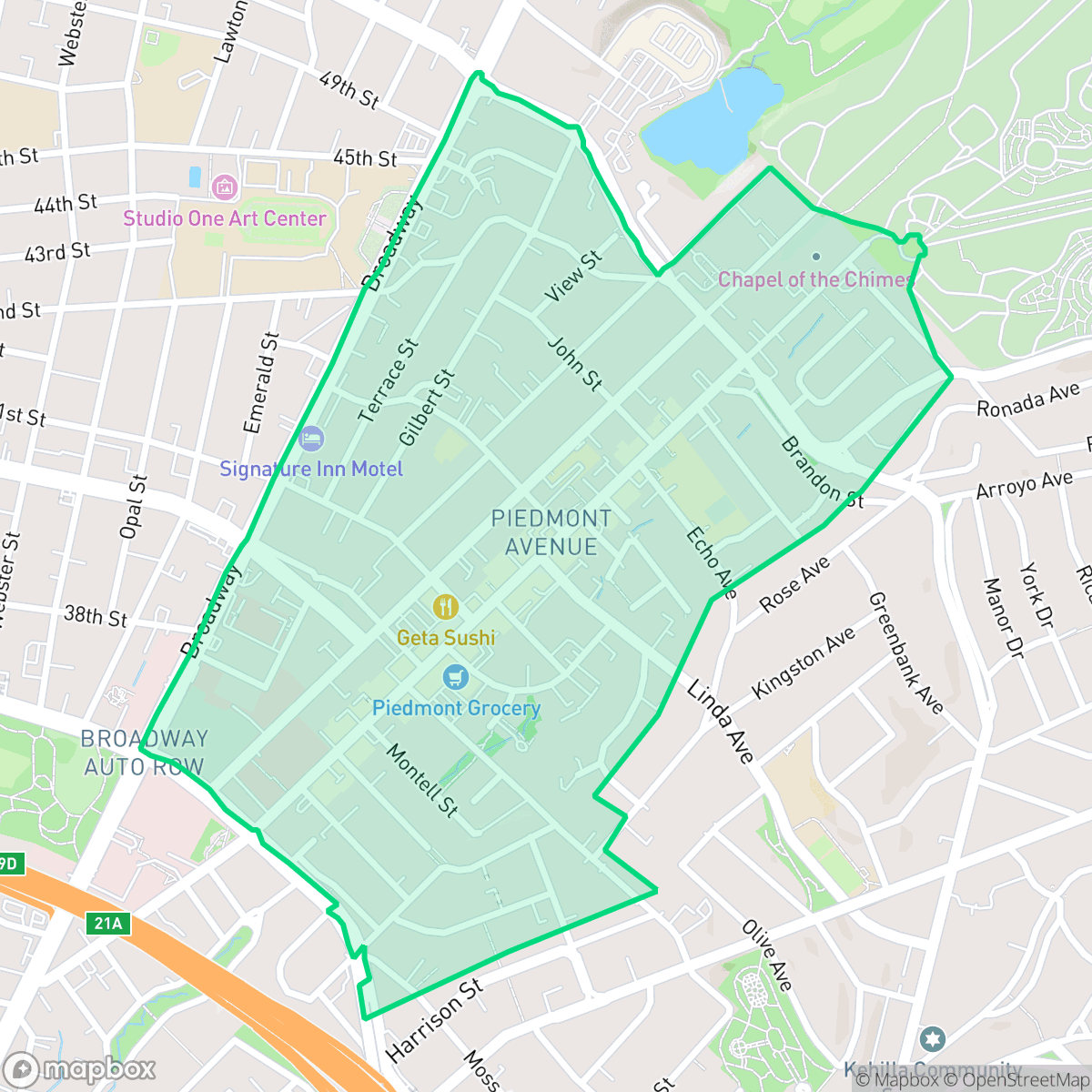
Founded in the late 1800s, Oakland's Piedmont Avenue neighborhood developed rapidly following the 1863 opening of the historic Mountain View Cemetery at its northern terminus. Designed by Frederick Law Olmsted, the cemetery and the adjacent Chapel of the Chimes—a Gothic and Moorish-style columbarium redesigned by Julia Morgan in 1928—anchor the neighborhood's historic identity. Morgan also designed the 1916 Fred C. Turner Stores on the avenue. Originally a streetcar suburb served by the Key System's C-Line, the neighborhood retains its historic Key Route Plaza. Today, Piedmont Avenue is a vibrant, walkable commercial district defined by long-standing local institutions, including the 1917 Piedmont Theatre (Oakland's oldest operating cinema) and Fentons Creamery, a beloved ice cream parlor operating since 1894.
The neighborhood functions as a dense urban core where residential life and commercial activity intersect. The area is characterized by a mix of mid-rise apartment buildings and single-family homes that are closely situated, often with shared walls or minimal separation between structures. This high-density environment contributes to a lively atmosphere, supported by a variety of local cafes, restaurants, and long-standing institutions that draw residents and visitors alike. According to iHuus data, the district maintains a high level of walkability, providing residents with easy access to daily necessities and public spaces without the need for a vehicle.
Prospective residents should consider several trade-offs regarding living in this environment. While the neighborhood offers strong health insurance coverage and clean air, the high density results in lower privacy levels and moderate noise from road traffic. The area presents a complex educational landscape, as it is served by both the Oakland Unified School District and the highly rated Piedmont City Unified School District, with significant performance variations between them. Additionally, while the neighborhood is well-positioned for daily living, it faces specific challenges regarding fire safety that should be factored into long-term residential planning.
Neighborhood Scores Across 15 Qualities
Buildings and homes are positioned in close proximity with minimal separation between structures. This level of density is slightly higher than the Oakland average, resulting in many shared property lines and tightly packed residential units.
Pedestrian transit is exceptionally easy due to a dense grid of streets featuring sidewalks on both sides and frequent crosswalks. This level of accessibility is significantly higher than the Oakland average, including specialized infrastructure like pedestrian bridges for safe highway crossings.
Large homes with well-kept gardens and proximity to park grounds provide a scenic quality that sits slightly above the Oakland average. According to iHuus data, the area also contains standard urban density with smaller lots and shared amenities.
Ample green space and continuous sidewalks provide excellent opportunities for pet exercise. This area offers much better access to parks and tree-lined walking paths than the Oakland average, according to iHuus data.
A dense mix of multi-story apartments and single-family homes characterizes the area, providing a slightly more open environment than the typical Oakland urban core. According to iHuus data, the landscape features more frequent residential pockets and integrated greenery compared to the city average.
Frequent social activity and a notable concentration of local dining and community spaces make this area more active than the Oakland average. While many streets offer diverse culinary options, some residential blocks remain primarily suburban with limited business walkability.
Frequent vehicle movement along major thoroughfares creates a continuous ambient sound level that is notably higher than the Oakland average. According to iHuus data, residents can expect moderate levels of street noise throughout the day.
Air quality is consistently good with rare instances of elevated readings, performing slightly better than the Oakland average according to iHuus data.
Industrial hazards and large warehouses are absent from this area. According to iHuus data, the neighborhood remains exclusively residential and light commercial, making it significantly cleaner of heavy industry than the Oakland average.
Health insurance accessibility is exceptionally high in this area, significantly outperforming the Oakland city average according to iHuus data.
Voting patterns and census indicators show a deeply progressive political landscape that is slightly more liberal than the Oakland average, according to iHuus data.
Residents live alongside a balanced distribution of young professionals, families, and seniors; according to iHuus data, this demographic spread is slightly more varied than the Oakland average.
Flood risk levels in this area are higher than the Oakland average, though a lack of detailed federal studies makes the precise level of vulnerability difficult to determine. According to iHuus data, the neighborhood sits in an area where flood patterns have not been fully assessed by FEMA.
Address-Level Insights for Piedmont Avenue


iHuus Neighborhood Intelligence Insights
Get address-level neighborhood insights for Piedmont Avenue
- Street-level scores — see how individual blocks compare, not just neighborhood averages
- Micro-zone boundaries — identify quiet pockets, flood boundaries, and walkable clusters before you visit
- 15 dimensions in full — walkability, noise, air quality, school quality, insurance coverage, population age profile, urban/rural index, and more
- Boundary risk alerts — know if your address sits near a block boundary where scores drop, the kind of detail no listing will ever mention
- School insights — individual school ratings and insights, not just district-level data
- Compare before you commit — side-by-side data across neighborhoods, down to block precision
No credit card required
Compare with Any Neighborhood
| Dimension | Piedmont Avenue | Acorn |
|---|---|---|
| 🚶 Walkabilityavg 8.99 | ||
| 🔊 Acoustic Comfortavg 3.24 | ||
| 🤫 Privacy Indexavg 3.74 | ||
| 🎨 Visual Appealavg 6.28 | ||
| 🐕 Dog Friendlinessavg 5.74 | ||
| 🗺️ Urban-Rural Indexavg 6.02 | ||
| ✨ Neighborhood Vibeavg 5.22 | ||
| 🏥 Health Insurance Coverageavg 7.4 | ||
| 🌿 Air Qualityavg 8.06 | ||
| 🏭 Industrial Proximityavg 8.37 | ||
| 🌊 Flood Safetyavg 2.61 | ||
| 🗳️ Ideological Leanavg 9.95 | ||
| 👥 Population Age Profileavg 4.92 | ||
| 🔥 Fire Safetyavg 0.17 | ||
| 🏫 School Quality |
Piedmont Avenue Rankings
School Districts Serving Piedmont Avenue
School Insights for Piedmont Avenue
Below average outcomes; significant attendance and academic challenges.
School Insights
See what's really behind every school rating near Piedmont Avenue
- Individual school ratings — each school's own score with outcome context, not just a district average
- Enrollment & class size data — student-to-teacher ratio and how it compares to the state average
- Full demographics breakdown — ethnicity and gender composition for every school in the enrollment zone
- Every school in the district — all schools within the enrollment boundary ranked by rating, not just the closest one
- Grade levels & benchmarks — elementary through high school, with below/above state-average flags
No credit card required