Peralta Hacienda, Oakland
Updated · 1,989 residents
Peralta Hacienda is a highly walkable urban neighborhood defined by its rich cultural diversity and dense residential layout. Residents enjoy convenient access to local dining and community spaces, though the area is characterized by closely spaced homes and limited private outdoor space.
Key Highlights
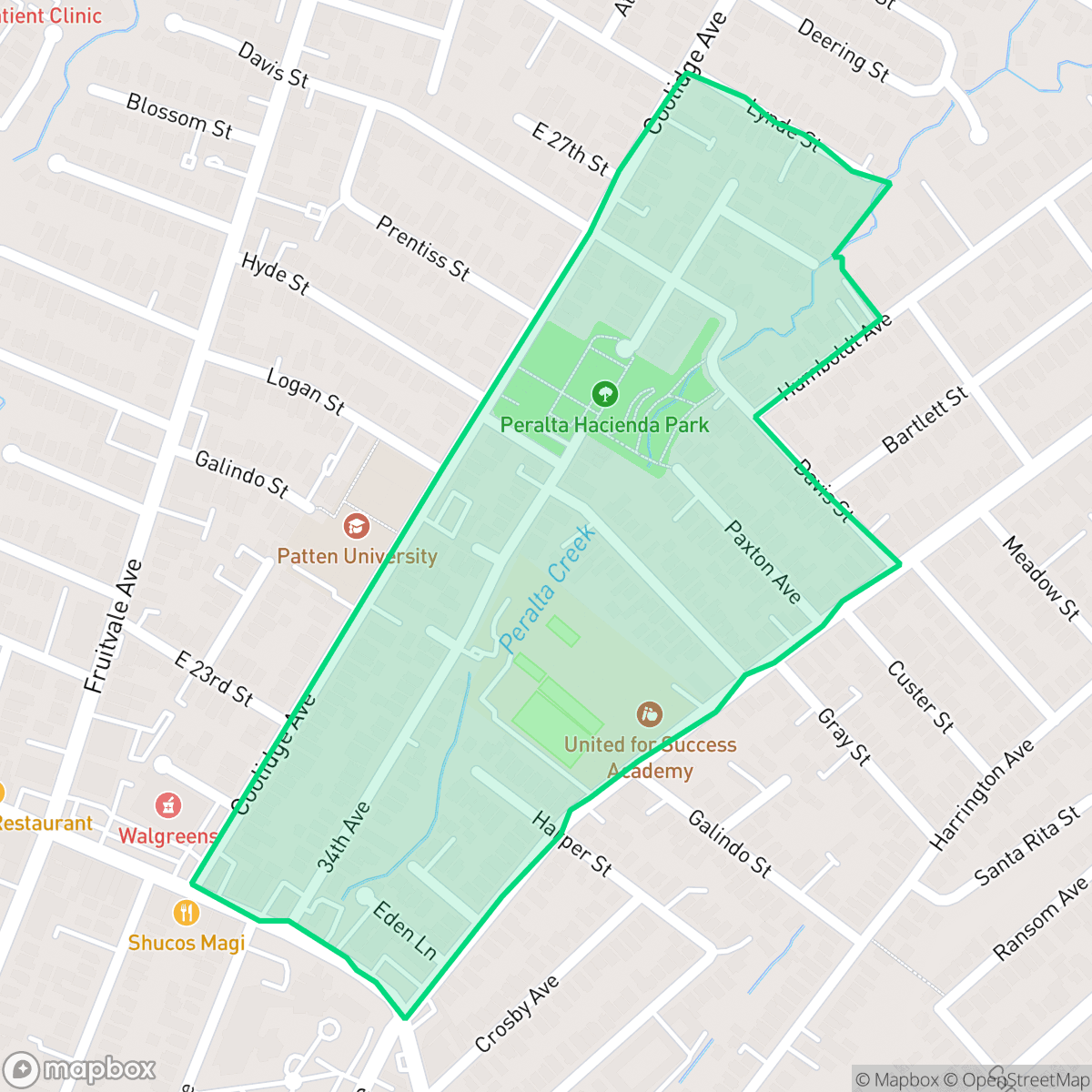
About Peralta Hacienda
Centered around the Peralta Hacienda Historical Park, the Peralta Hacienda neighborhood in Oakland's Fruitvale district is the historic birthplace of Oakland. Originally part of the 44,800-acre Rancho San Antonio granted to Luis María Peralta in 1820, the area transitioned from a vast rancho to a residential neighborhood after developer Henry Z. Jones purchased the remaining land in 1897, establishing the local street grid. The neighborhood’s architectural anchor is the 1870 Italianate Victorian Peralta House, built by Antonio Peralta after the 1868 Hayward earthquake destroyed his family's adobes. Today, the neighborhood is a vibrant multicultural hub. The historic park serves as a vital community space, featuring the Mien Garden—cultivated by Laotian Mien immigrant women—and hosting key local cultural events, including the annual Cambodian New Year and Latino Culture Festival.
The area offers a high degree of walkability, with a structured grid of sidewalks that makes daily errands and local exploration easy for residents. The streetscape features a mix of residential housing and light commercial activity, including diverse dining options and community landmarks like the True Buddha Vijaya Temple. This environment fosters a lively, multicultural atmosphere that benefits from consistent air quality and a lack of heavy industrial interference. Prospective residents should note that the neighborhood features tightly clustered housing, resulting in limited privacy and minimal private green space. While the area is well-connected, families should consider the challenges facing the local school district, which currently struggles with budget deficits and inconsistent performance across its facilities. Additionally, the neighborhood faces significant risks regarding flood and fire safety, making it essential for homeowners to review local hazard disclosures carefully.
Neighborhood Scores Across 15 Qualities
Residential structures and apartment blocks are situated very close to one another with minimal separation between property lines. This level of density is noticeably higher than the average for Oakland, according to iHuus data.
Continuous sidewalks on both sides of every street and frequent crosswalks make navigating the neighborhood easy on foot. This dense, grid-based layout offers a more pedestrian-friendly environment than the Oakland average, according to iHuus data.
Residential streetscapes consist of consistent, middle-class bungalows and multi-unit buildings with small yards. This visual profile is slightly below the Oakland average for architectural variety and greenery.
Limited public green space and narrow sidewalks make it difficult to find easy walking routes for pets. According to iHuus data, the availability of grassy verges and accessible parks is below the Oakland average.
Open land and scattered greenery provide a more semi-rural atmosphere than most parts of Oakland. While some pockets feature dense apartment buildings and tight street grids, the area generally contains more woodland and field elements than the city average.
Diverse dining spots and social hubs provide a more active atmosphere than the Oakland average, though quiet suburban blocks and industrial zones create pockets of stillness. Residents can find a mix of lively street life and peaceful green spaces throughout the area.
Steady traffic sounds from nearby busy streets are present, though the acoustic environment remains slightly calmer than the Oakland average according to iHuus data.
Air quality remains consistently high with rare instances of elevated readings. This level of cleanliness is slightly better than the Oakland average, according to iHuus data.
Industrial presence is minimal across most of the area, as the neighborhood consists largely of residential and light commercial structures. While a railway corridor and some warehouses are located near the edge of the district, the area remains notably clearer of heavy industrial hazards than the Oakland average.
Health insurance access among residents is lower than the Oakland average, according to iHuus data. This indicates a higher proportion of uninsured individuals living in the area compared to the rest of the city.
Voting patterns and census indicators show a highly liberal political leaning, which is consistent with the overall trend seen across Oakland.
Residents live alongside a diverse range of age groups, including young professionals, families, and seniors. This demographic distribution is slightly more centered around middle-aged and older populations than the typical Oakland profile.
Significant flood risk exists due to the area's location within a designated floodplain. According to iHuus data, this vulnerability is notably higher than the Oakland average and may necessitate specialized flood insurance.
Address-Level Insights for Peralta Hacienda


iHuus Neighborhood Intelligence Insights
Get address-level neighborhood insights for Peralta Hacienda
- Street-level scores — see how individual blocks compare, not just neighborhood averages
- Micro-zone boundaries — identify quiet pockets, flood boundaries, and walkable clusters before you visit
- 15 dimensions in full — walkability, noise, air quality, school quality, insurance coverage, population age profile, urban/rural index, and more
- Boundary risk alerts — know if your address sits near a block boundary where scores drop, the kind of detail no listing will ever mention
- School insights — individual school ratings and insights, not just district-level data
- Compare before you commit — side-by-side data across neighborhoods, down to block precision
No credit card required
Compare with Any Neighborhood
| Dimension | Peralta Hacienda | Acorn |
|---|---|---|
| 🚶 Walkabilityavg 8.99 | ||
| 🔊 Acoustic Comfortavg 3.24 | ||
| 🤫 Privacy Indexavg 3.74 | ||
| 🎨 Visual Appealavg 6.28 | ||
| 🐕 Dog Friendlinessavg 5.74 | ||
| 🗺️ Urban-Rural Indexavg 6.02 | ||
| ✨ Neighborhood Vibeavg 5.22 | ||
| 🏥 Health Insurance Coverageavg 7.4 | ||
| 🌿 Air Qualityavg 8.06 | ||
| 🏭 Industrial Proximityavg 8.37 | ||
| 🌊 Flood Safetyavg 2.61 | ||
| 🗳️ Ideological Leanavg 9.95 | ||
| 👥 Population Age Profileavg 4.92 | ||
| 🔥 Fire Safetyavg 0.17 | ||
| 🏫 School Quality |
Peralta Hacienda Rankings
School Districts Serving Peralta Hacienda
School Insights for Peralta Hacienda
Below average outcomes; significant attendance and academic challenges.
School Insights
See what's really behind every school rating near Peralta Hacienda
- Individual school ratings — each school's own score with outcome context, not just a district average
- Enrollment & class size data — student-to-teacher ratio and how it compares to the state average
- Full demographics breakdown — ethnicity and gender composition for every school in the enrollment zone
- Every school in the district — all schools within the enrollment boundary ranked by rating, not just the closest one
- Grade levels & benchmarks — elementary through high school, with below/above state-average flags
No credit card required