Patten, Oakland
Updated · 2,504 residents
Patten is a highly walkable residential enclave in Oakland known for its dense, grid-based street layout and proximity to local cultural hubs like Hasta Muerte Coffee. While the neighborhood offers excellent pedestrian access, residents should expect limited privacy due to closely spaced housing and elevated noise levels from road traffic.
Key Highlights
About Patten
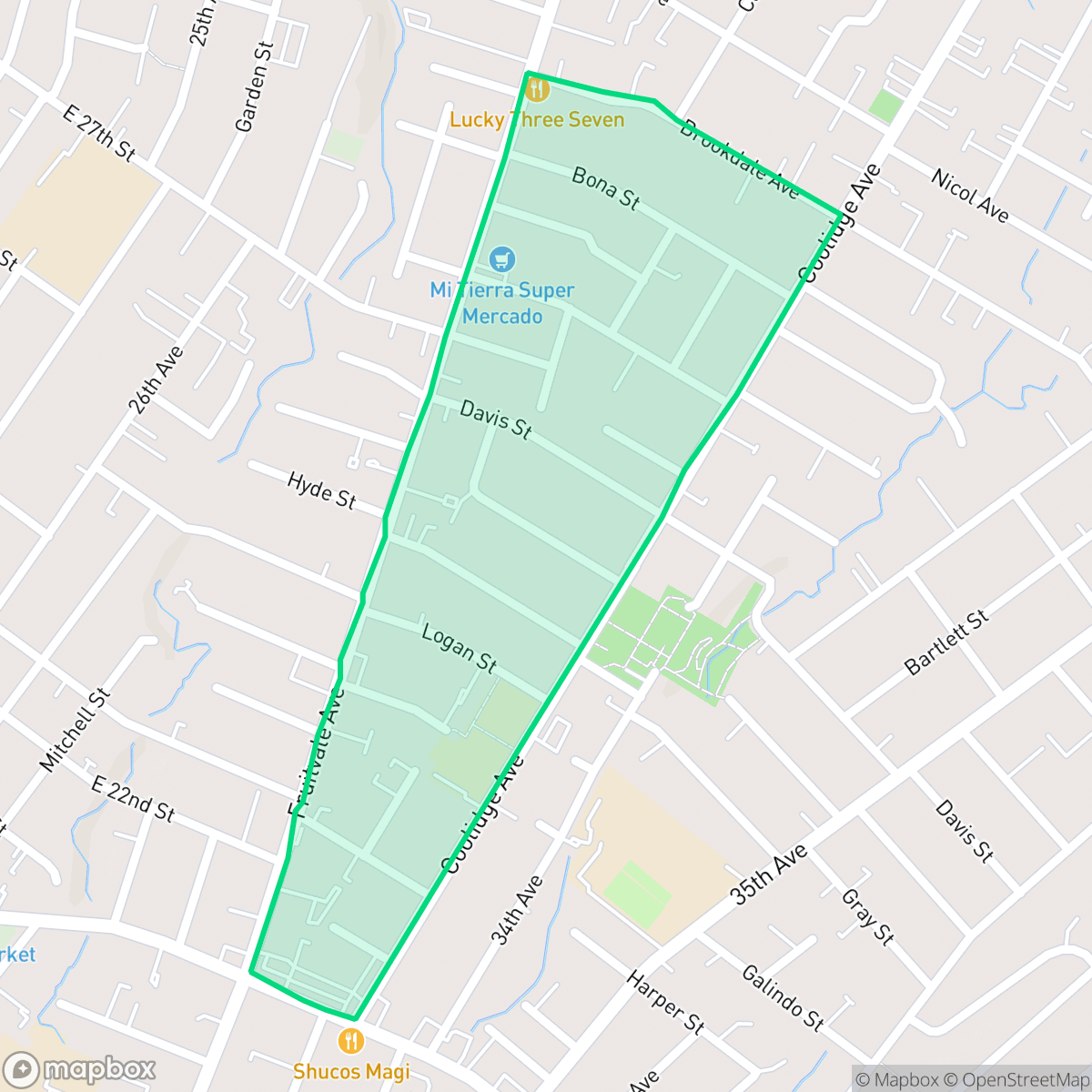
Located in Oakland's Fruitvale district, the small, primarily residential neighborhood of Patten is named after Patten University, which was founded on Coolidge Avenue in 1944 by Dr. Bebe Patten as the Oakland Bible Institute. The university's campus serves as a central landmark for the neighborhood, which features a mix of mid-century and older residential housing stock. The neighborhood is bordered by other historic areas, including the adjacent Peralta Hacienda Historical Park, which preserves the cultural history of the region's Native and Mexican American heritages.
The area maintains a vibrant, community-focused character, supported by local social anchors such as the Christian Cathedral Church and popular eateries like Las Palmas Super Burrito. As a strictly residential and light commercial zone, it benefits from a complete absence of industrial hazards, contributing to a favorable air quality environment. The dense, urban street grid fosters a high level of connectivity, making it an ideal location for those who prioritize walkability and access to neighborhood-level amenities over expansive personal space. Prospective residents should weigh the benefits of the neighborhood's connectivity against its inherent trade-offs. The high density results in compact housing with minimal privacy, and the acoustic environment is influenced by consistent road traffic noise. Additionally, while the area is well-positioned for daily errands, families should consider the challenges facing the local school district. According to iHuus data, the area is particularly suited for individuals or couples who value an active, transit-oriented lifestyle in a tight-knit urban setting.
Neighborhood Scores Across 15 Qualities
Residential structures and apartment blocks are situated very close together, often sharing narrow property lines or having minimal separation. This level of density is notably higher than the Oakland average, according to iHuus data.
Pedestrian movement is seamless due to a dense grid of continuous sidewalks and frequent crosswalks. This level of walkability is even higher than the Oakland average, providing an excellent urban layout for those traveling on foot.
Standard middle-class housing dominates the landscape, characterized by small yards and simple rooflines. This area offers a typical urban aesthetic that is slightly below the Oakland average for visual variety.
Access to pet-friendly areas varies, as some dense residential blocks lack grassy verges and wide sidewalks. While a large reservoir park provides excellent walking opportunities, overall dog friendliness is below the Oakland average according to iHuus data.
Open land and scattered greenery are more prevalent here than in the typical Oakland urban landscape. Residents will find a mix of wooded areas and fields interspersed with residential pockets, according to iHuus data.
Residential blocks offer a mix of quiet, suburban atmosphere and active social hubs near local eateries. According to iHuus data, the level of activity and access to amenities is slightly higher than the Oakland average.
Frequent noise from nearby freeway and railroad corridors makes this area louder than the Oakland average. Residents may experience consistent auditory disturbances from heavy transit activity, according to iHuus data.
Air quality remains consistently high with only rare instances of elevated readings. This level of cleanliness is slightly better than the Oakland average, according to iHuus data.
Industrial activity is minimal throughout most of the area, offering a cleaner environment than the Oakland average. While a railway corridor and some warehouses exist on the edge of the neighborhood, the vast majority of the district consists of residential and light commercial structures.
Health insurance coverage among residents is lower than the Oakland average. According to iHuus data, a significant portion of the population lacks employer-sponsored or private coverage.
Voting patterns and census indicators show a heavily liberal political leaning that is consistent with the broader Oakland area, according to iHuus data.
Residents live alongside a balanced demographic of young professionals, families, and seniors. This age distribution is consistent with the broader Oakland area according to iHuus data.
Significant flood risk exists because portions of the area fall within a designated floodplain. According to iHuus data, this risk is higher than the average for Oakland, which may necessitate the purchase of flood insurance.
Address-Level Insights for Patten


iHuus Neighborhood Intelligence Insights
Get address-level neighborhood insights for Patten
- Street-level scores — see how individual blocks compare, not just neighborhood averages
- Micro-zone boundaries — identify quiet pockets, flood boundaries, and walkable clusters before you visit
- 15 dimensions in full — walkability, noise, air quality, school quality, insurance coverage, population age profile, urban/rural index, and more
- Boundary risk alerts — know if your address sits near a block boundary where scores drop, the kind of detail no listing will ever mention
- School insights — individual school ratings and insights, not just district-level data
- Compare before you commit — side-by-side data across neighborhoods, down to block precision
No credit card required
Compare with Any Neighborhood
| Dimension | Patten | Acorn |
|---|---|---|
| 🚶 Walkabilityavg 8.99 | ||
| 🔊 Acoustic Comfortavg 3.24 | ||
| 🤫 Privacy Indexavg 3.74 | ||
| 🎨 Visual Appealavg 6.28 | ||
| 🐕 Dog Friendlinessavg 5.74 | ||
| 🗺️ Urban-Rural Indexavg 6.02 | ||
| ✨ Neighborhood Vibeavg 5.22 | ||
| 🏥 Health Insurance Coverageavg 7.4 | ||
| 🌿 Air Qualityavg 8.06 | ||
| 🏭 Industrial Proximityavg 8.37 | ||
| 🌊 Flood Safetyavg 2.61 | ||
| 🗳️ Ideological Leanavg 9.95 | ||
| 👥 Population Age Profileavg 4.92 | ||
| 🔥 Fire Safetyavg 0.17 | ||
| 🏫 School Quality |
Patten Rankings
School Districts Serving Patten
School Insights for Patten
Below average outcomes; significant attendance and academic challenges.
School Insights
See what's really behind every school rating near Patten
- Individual school ratings — each school's own score with outcome context, not just a district average
- Enrollment & class size data — student-to-teacher ratio and how it compares to the state average
- Full demographics breakdown — ethnicity and gender composition for every school in the enrollment zone
- Every school in the district — all schools within the enrollment boundary ranked by rating, not just the closest one
- Grade levels & benchmarks — elementary through high school, with below/above state-average flags
No credit card required