Paradise Park, Oakland
Updated · 2,195 residents
Paradise Park is a highly walkable North Oakland neighborhood defined by its dense urban grid and historic residential character. Residents benefit from excellent air quality and high health insurance coverage, though the area experiences notable road traffic noise and limited private outdoor space.
Key Highlights
About Paradise Park
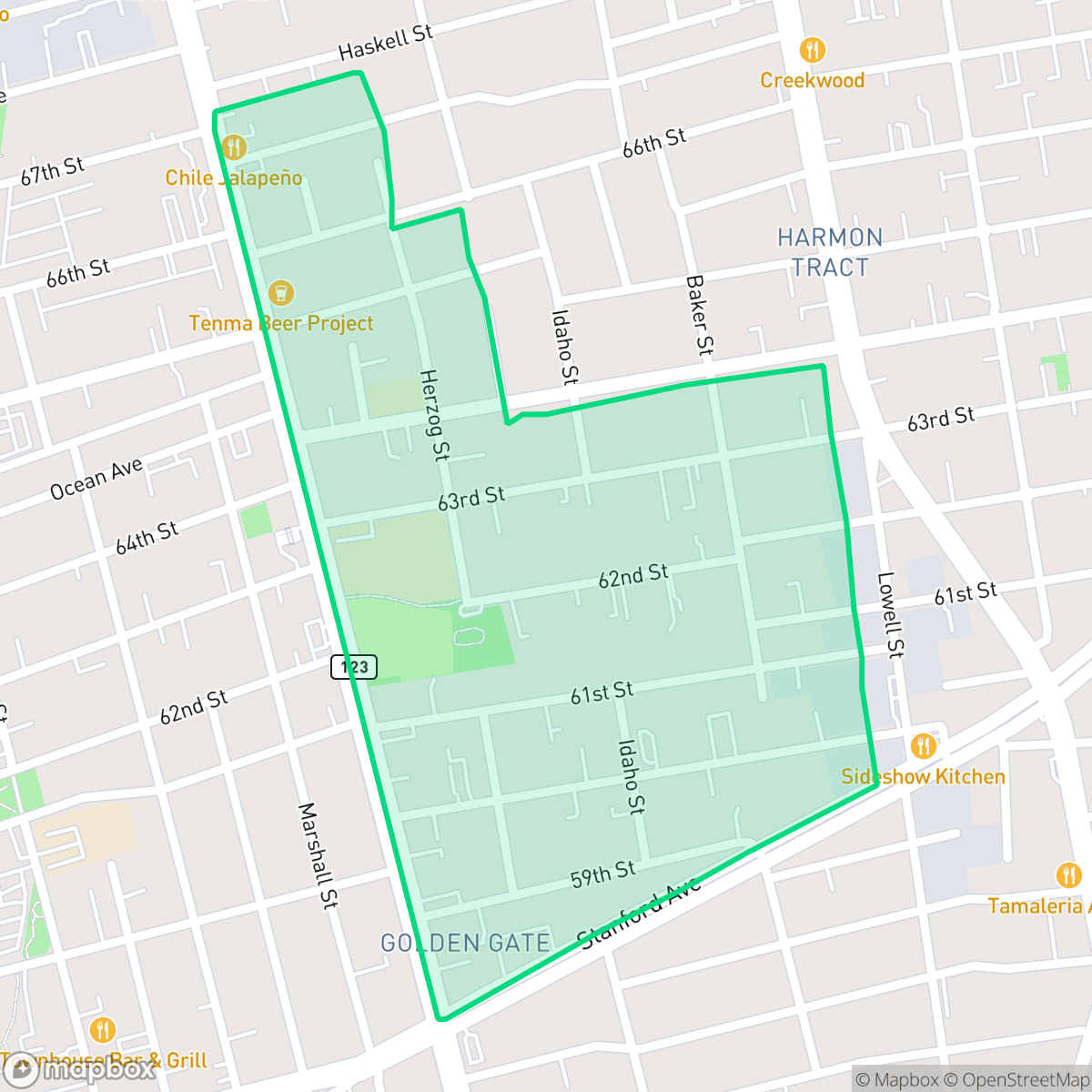
Located in North Oakland near the Emeryville border, the historic Paradise Park neighborhood began in the 1880s as a rural retreat briefly known as "Klinknerville". A prominent local landmark is the DeRome House on 59th Street, a whimsical 1885 Victorian mansion built by brass and bronze foundry partner Louis DeRome. Following the 1906 earthquake, DeRome operated his foundry on-site, casting iconic Bay Area monuments, including the bronze doors of UC Berkeley's Doe Library. Additionally, the neighborhood is culturally famous as the birthplace of the Mai Tai. In 1944, Victor "The Trader" Bergeron invented the legendary cocktail at 6500 San Pablo Avenue, the original location of his tropical-themed saloon, Trader Vic's (originally Hinky Dinks). Today, the area features a mix of historic Edwardian and Craftsman bungalows.
The neighborhood is characterized by a dense, low-rise urban fabric where Edwardian and Craftsman homes sit on small, tightly-packed lots. Its location near the Emeryville border provides a central hub for commuters, supported by a perfect walkability score that ensures easy access to local amenities like Sideshow Kitchen and various neighborhood taquerias. The area maintains a calm, suburban feel despite its high density, with social hubs and community spaces contributing to a stable, albeit quiet, local environment.
Prospective residents should be aware of the trade-offs inherent in this urban setting. While the area offers superior air quality and strong community health metrics, the high density leads to reduced privacy and increased road traffic noise. The neighborhood is well-suited for those who prioritize pedestrian access and proximity to regional transit over expansive private yards or quiet acoustic environments. According to iHuus data, the area remains a consistent choice for those seeking a dense, established community with deep historical roots.
Neighborhood Scores Across 15 Qualities
Residential structures are situated in close proximity with minimal separation between property lines. This density of housing results in a slightly lower level of privacy compared to the Oakland average, according to iHuus data.
Pedestrian navigation is seamless due to a complete grid of sidewalks and well-defined crosswalks. This area offers superior walkability compared to the Oakland average, featuring dense, pedestrian-friendly intersections and block sizes.
Residential landscapes consist of high density housing with modest yards and functional architecture. According to iHuus data, the area features a typical urban mix of small residential lots and commercial warehouses, appearing slightly less visually varied than the Oakland average.
Limited sidewalk verges and few accessible green spaces make long walks with pets less convenient here than in most of Oakland. While a public park with tennis courts is available in the northern portion of the neighborhood, residential areas are characterized by denser housing and narrower walkways.
Frequent open land and scattered homes amid woodland characterize this area, providing a slightly more open environment than the Oakland average. According to iHuus data, the landscape features a mix of low-rise urban structures and pockets of natural space.
Quiet residential streets and green spaces are punctuated by localized social hubs and diverse dining options. This level of activity is roughly in line with the Oakland average according to iHuus data.
Frequent noise from nearby freeway and railroad corridors characterizes the area. This level of acoustic disturbance is slightly higher than the Oakland average, according to iHuus data.
Air quality remains consistently high and presents minimal health concerns for residents. This level of purity is notably better than the average found throughout Oakland, according to iHuus data.
Residential and small commercial buildings dominate the area, meaning there is less industrial activity here than is typical for Oakland. According to iHuus data, residents can expect a lack of heavy industrial hazards or large-scale warehouses within the neighborhood.
Health insurance access is exceptionally high among residents here, significantly surpassing the Oakland average according to iHuus data.
Voting patterns and census indicators show a very strong liberal leaning, which is consistent with the broader Oakland area according to iHuus data.
Residents live alongside a balanced mix of young professionals, families, and seniors. This demographic spread is consistent with the broader Oakland area, according to iHuus data.
Flood risk levels in this area are higher than the Oakland average, though detailed federal studies for this specific neighborhood remain incomplete. Residents should note that according to iHuus data, the precise level of susceptibility is currently undetermined due to a lack of recent mapping.
Address-Level Insights for Paradise Park


iHuus Neighborhood Intelligence Insights
Get address-level neighborhood insights for Paradise Park
- Street-level scores — see how individual blocks compare, not just neighborhood averages
- Micro-zone boundaries — identify quiet pockets, flood boundaries, and walkable clusters before you visit
- 15 dimensions in full — walkability, noise, air quality, school quality, insurance coverage, population age profile, urban/rural index, and more
- Boundary risk alerts — know if your address sits near a block boundary where scores drop, the kind of detail no listing will ever mention
- School insights — individual school ratings and insights, not just district-level data
- Compare before you commit — side-by-side data across neighborhoods, down to block precision
No credit card required
Compare with Any Neighborhood
| Dimension | Paradise Park | Acorn |
|---|---|---|
| 🚶 Walkabilityavg 8.99 | ||
| 🔊 Acoustic Comfortavg 3.24 | ||
| 🤫 Privacy Indexavg 3.74 | ||
| 🎨 Visual Appealavg 6.28 | ||
| 🐕 Dog Friendlinessavg 5.74 | ||
| 🗺️ Urban-Rural Indexavg 6.02 | ||
| ✨ Neighborhood Vibeavg 5.22 | ||
| 🏥 Health Insurance Coverageavg 7.4 | ||
| 🌿 Air Qualityavg 8.06 | ||
| 🏭 Industrial Proximityavg 8.37 | ||
| 🌊 Flood Safetyavg 2.61 | ||
| 🗳️ Ideological Leanavg 9.95 | ||
| 👥 Population Age Profileavg 4.92 | ||
| 🔥 Fire Safetyavg 0.17 | ||
| 🏫 School Quality |
Paradise Park Rankings
School Districts Serving Paradise Park
School Insights for Paradise Park
Below average outcomes; significant attendance and academic challenges.
School Insights
See what's really behind every school rating near Paradise Park
- Individual school ratings — each school's own score with outcome context, not just a district average
- Enrollment & class size data — student-to-teacher ratio and how it compares to the state average
- Full demographics breakdown — ethnicity and gender composition for every school in the enrollment zone
- Every school in the district — all schools within the enrollment boundary ranked by rating, not just the closest one
- Grade levels & benchmarks — elementary through high school, with below/above state-average flags
No credit card required