Panoramic Hill, Oakland
Updated · 1,159 residents
Panoramic Hill is a quiet, rural enclave defined by its exceptional visual appeal and high air quality. While it offers a serene environment for residents, the area has limited walkability and minimal commercial activity, making it best suited for those who prioritize seclusion over urban convenience.
Key Highlights
About Panoramic Hill
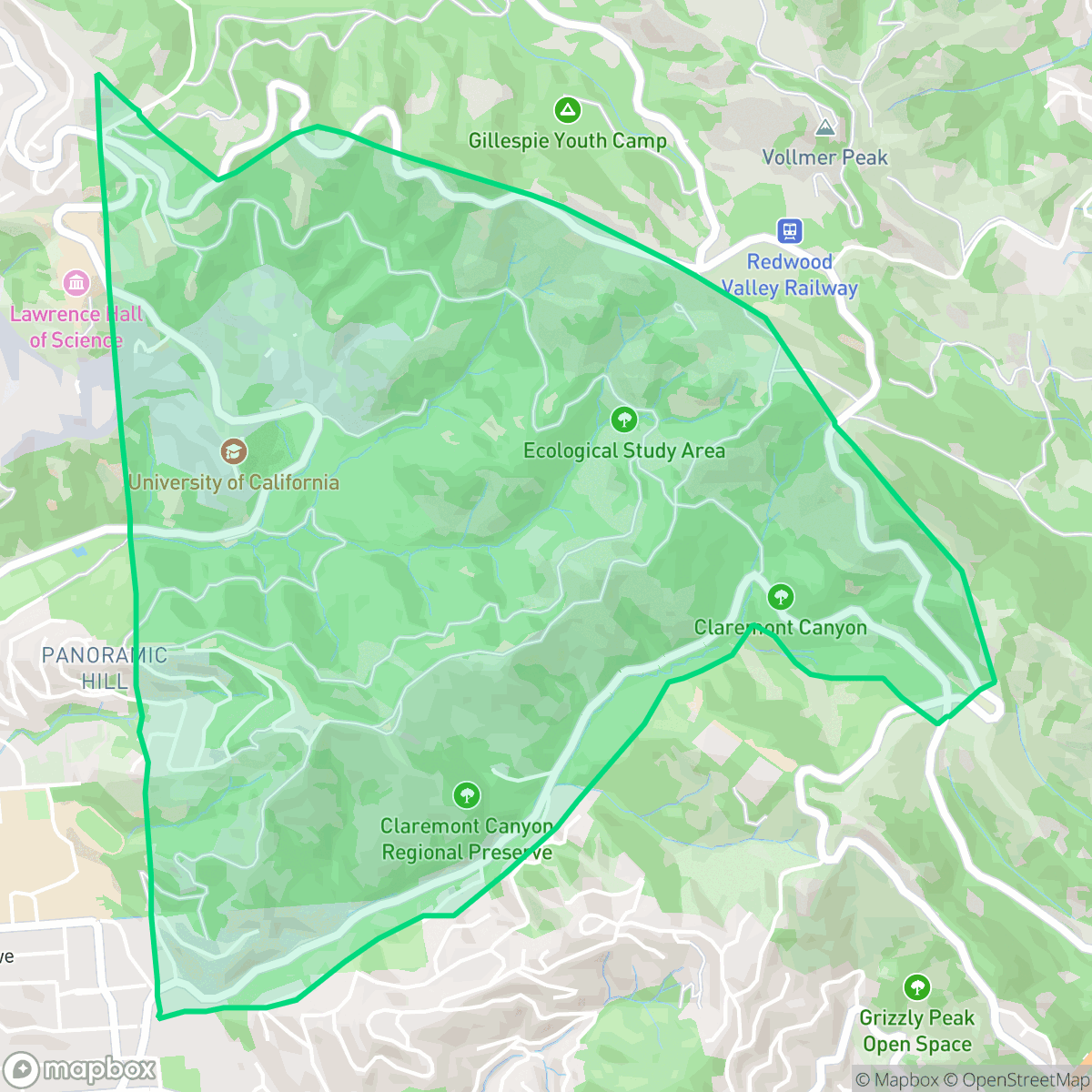
Spanning the border of Oakland and Berkeley, the Panoramic Hill neighborhood is a historic residential enclave developed starting in 1904 by Warren Cheney. Added to the National Register of Historic Places in 2005, the neighborhood is celebrated as one of the region's most significant Arts and Crafts and First Bay Tradition architectural districts. Its steep, winding roads are lined with rustic, brown-shingle homes designed by legendary architects including Bernard Maybeck, Julia Morgan, Ernest Coxhead, and Frank Lloyd Wright. Early residents predominantly consisted of university professors and pioneering Sierra Club members. Panoramic Hill is highly defined by its intricate network of public hillside pathways and historic pedestrian staircases, most notably Orchard Lane, a formal 1910 Beaux-Arts concrete staircase that serves as the neighborhood's signature entrance.
The area maintains a distinct rural atmosphere, characterized by vast open spaces and a low-density residential layout. Residents benefit from excellent air quality and a serene environment that feels far removed from the bustle of central Oakland. The presence of the University of California Botanical Garden enhances the local landscape, providing a natural setting that contributes to the neighborhood's high visual appeal and quiet, tranquil character.
Living here requires a trade-off between natural beauty and accessibility. With a low liveliness score and few local businesses, daily errands typically require a vehicle. Prospective residents should also be aware of the area's fire safety profile, as the hillside location presents specific environmental risks. Despite these considerations, the neighborhood remains a top choice for those seeking a quiet, dog-friendly retreat with a strong sense of privacy.
Neighborhood Scores Across 15 Qualities
Residential lots feature significant separation between structures, providing much more privacy than the Oakland average. According to iHuus data, the neighborhood layout emphasizes larger parcels with substantial distance between neighboring homes.
Sidewalks and safe crossings facilitate easy pedestrian movement, though walking accessibility is slightly lower than the Oakland average.
Low density estates with custom architecture and significant privacy buffers define this area. According to iHuus data, the visual landscape is considerably more manicured and open than the Oakland average.
Extensive trail networks and large open spaces provide ample opportunities for pet owners. According to iHuus data, this access to nature is significantly higher than the Oakland average.
Frequent open spaces and scattered homes among woodlands provide a more semi-rural atmosphere than the Oakland average, according to iHuus data.
Low-density residential blocks and vast open spaces create a tranquil atmosphere that is noticeably more subdued than the Oakland average. Local commercial activity is limited, meaning most daily errands require a vehicle as few businesses are within walking distance.
Steady sounds from nearby busy streets provide a consistent hum that is slightly more noticeable than the average noise level across Oakland. According to iHuus data, this area experiences more frequent acoustic activity than many other parts of the city.
Air quality in this area is exceptionally high with minimal health concerns. This level of air purity is notably better than the average found throughout Oakland, according to iHuus data.
Industrial activity is virtually non-existent here, providing a residential environment that is significantly cleaner of warehouses and heavy facilities than the Oakland average. According to iHuus data, the area is characterized by quiet streets and open green spaces without nearby hazard sites.
Health insurance access is exceptionally high among residents, significantly surpassing the Oakland average according to iHuus data.
Voting patterns and census indicators reflect a deeply liberal political landscape, consistent with the broader Oakland area.
Residents live alongside a balanced mix of young professionals, families, and seniors. This age distribution is slightly more varied than the Oakland average, according to iHuus data.
Flood risk in this area is notably higher than the Oakland average, though specific details remain undetermined due to incomplete federal studies. According to iHuus data, residents should remain aware of potential vulnerabilities during extreme weather events.
Significant fire hazards exist in this area, which represents a much higher risk level than the rest of Oakland. Residents should prioritize enhanced mitigation and wildfire preparedness according to iHuus data.
Address-Level Insights for Panoramic Hill


iHuus Neighborhood Intelligence Insights
Get address-level neighborhood insights for Panoramic Hill
- Street-level scores — see how individual blocks compare, not just neighborhood averages
- Micro-zone boundaries — identify quiet pockets, flood boundaries, and walkable clusters before you visit
- 15 dimensions in full — walkability, noise, air quality, school quality, insurance coverage, population age profile, urban/rural index, and more
- Boundary risk alerts — know if your address sits near a block boundary where scores drop, the kind of detail no listing will ever mention
- School insights — individual school ratings and insights, not just district-level data
- Compare before you commit — side-by-side data across neighborhoods, down to block precision
No credit card required
Compare with Any Neighborhood
| Dimension | Panoramic Hill | Acorn |
|---|---|---|
| 🚶 Walkabilityavg 8.99 | ||
| 🔊 Acoustic Comfortavg 3.24 | ||
| 🤫 Privacy Indexavg 3.74 | ||
| 🎨 Visual Appealavg 6.28 | ||
| 🐕 Dog Friendlinessavg 5.74 | ||
| 🗺️ Urban-Rural Indexavg 6.02 | ||
| ✨ Neighborhood Vibeavg 5.22 | ||
| 🏥 Health Insurance Coverageavg 7.4 | ||
| 🌿 Air Qualityavg 8.06 | ||
| 🏭 Industrial Proximityavg 8.37 | ||
| 🌊 Flood Safetyavg 2.61 | ||
| 🗳️ Ideological Leanavg 9.95 | ||
| 👥 Population Age Profileavg 4.92 | ||
| 🔥 Fire Safetyavg 0.17 | ||
| 🏫 School Quality |
Panoramic Hill Rankings
School Districts Serving Panoramic Hill
School Insights for Panoramic Hill
Below average outcomes; significant attendance and academic challenges.
School Insights
See what's really behind every school rating near Panoramic Hill
- Individual school ratings — each school's own score with outcome context, not just a district average
- Enrollment & class size data — student-to-teacher ratio and how it compares to the state average
- Full demographics breakdown — ethnicity and gender composition for every school in the enrollment zone
- Every school in the district — all schools within the enrollment boundary ranked by rating, not just the closest one
- Grade levels & benchmarks — elementary through high school, with below/above state-average flags
No credit card required