Old City, Oakland
Updated · 1,624 residents
Old City is a high-energy, historic urban district in Oakland defined by its exceptional walkability and dense, brick-lined streetscapes. While the area offers immediate access to diverse dining and cultural hubs, residents should expect significant road noise and limited private green space.
Key Highlights
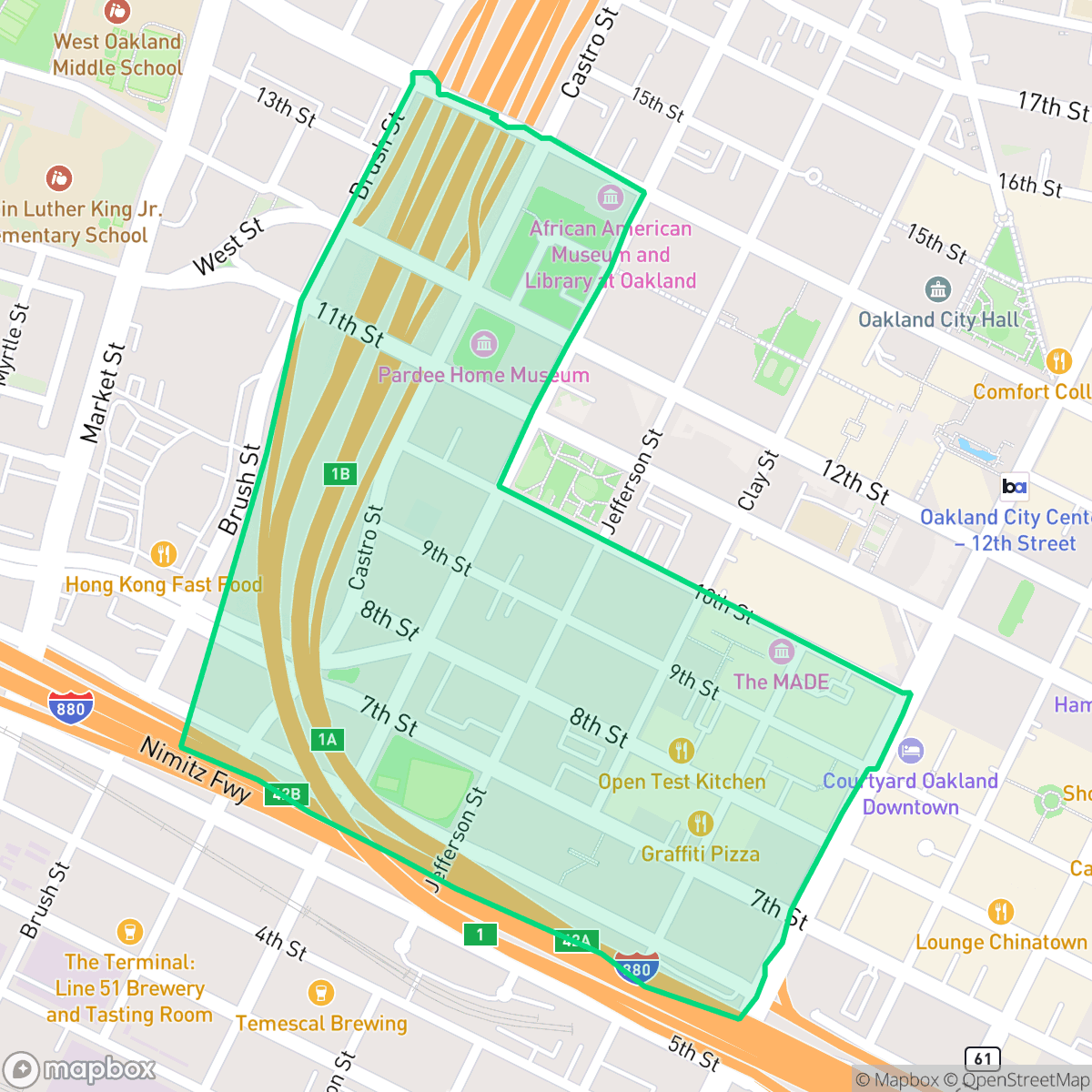
About Old City
Old Oakland (historically the city's original downtown) emerged in the late 1860s as a bustling commercial hub following the completion of the Central Pacific Railroad terminus on 7th Street. The neighborhood is renowned for its exceptionally preserved 1870s and 1880s Victorian brick buildings, which feature distinct cast-iron columns and large plate-glass windows. Following the 1906 San Francisco earthquake, the city's commercial center shifted north, plunging the area into decades of decline. In the 1970s and 1980s, meticulous restoration efforts revived the area, particularly along 9th Street, known as Victorian Row. Today, the historic district is anchored by landmarks like the 1878 Nicholl Block and the historic Swan’s Market, a former 20th-century fresh-food market transformed into a vibrant, award-winning mixed-use community space.
The neighborhood functions as a dense, high-traffic core where the legacy of 19th-century commerce meets modern urban activity. According to iHuus data, the area maintains a high level of liveliness, characterized by a constant flow of pedestrians and proximity to major transit arteries. The grid-based layout ensures that amenities, including local breweries and established eateries, remain accessible within a short walking distance. Living here involves distinct trade-offs, particularly regarding acoustic comfort and privacy. The environment is dominated by concrete and high-density structures, resulting in limited access to parks or quiet residential retreats. Prospective residents should also note that the local school district faces significant administrative and financial challenges. This location is best suited for individuals who prioritize urban accessibility and cultural engagement over suburban quiet or expansive private outdoor space.
Neighborhood Scores Across 15 Qualities
Residential structures in Old City are closely spaced with many shared walls or minimal setbacks. This level of density provides less physical separation between homes than the Oakland average, according to iHuus data.
Continuous sidewalks and dedicated pedestrian zones make navigating the area on foot easy. This street network is exceptionally well-connected, sitting above the Oakland average for accessibility and crossing safety.
Visual character consists of modest multi-unit complexes and standard urban density, which is slightly below the Oakland average. The area features functional architecture such as boxy roofs and tidy but small yards without luxury estate features.
Dense pavement and concrete surfaces dominate the high-density core, resulting in fewer green verges and less accessible park space for dogs than the Oakland average. While some medium-sized public parks and school fields are available, many areas lack immediate access to soft ground or greenery.
High-rise structures and major highway infrastructure create a highly developed environment with very little vegetation. This area is significantly more built-up than the Oakland average, featuring large commercial blocks and minimal green space according to iHuus data.
Dense concentrations of diverse dining, cafes, and cultural landmarks create a level of activity significantly higher than the Oakland average. This high-energy environment is characterized by constant movement near major transit corridors and a variety of local destinations.
Frequent disturbances from nearby freeway and railroad traffic characterize this area. Acoustic comfort is significantly lower than the Oakland average, according to iHuus data.
Air quality in this area is generally good with infrequent periods of elevated readings. Levels remain largely consistent with the Oakland city average according to iHuus data.
A combination of commercial units and light industrial activity, such as local breweries, creates a varied landscape. This level of industrial proximity is notably lower than the Oakland city average, as heavy industrial zones and large-scale freight traffic are not pervasive throughout the neighborhood.
Health insurance coverage among residents is significantly lower than the Oakland average. According to iHuus data, most inhabitants in this area lack employer-sponsored or private health coverage.
Voting patterns and census indicators show a strong liberal leaning that is consistent with the broader Oakland area. According to iHuus data, this political orientation is slightly more pronounced here than the city average.
Residents live alongside a balanced blend of young professionals, families, and seniors. This demographic variety is more evenly distributed across age groups than the typical Oakland profile, according to iHuus data.
Significant flood risk exists here due to being located within a 100-year floodplain. According to iHuus data, this area is subject to higher levels of inundation risk compared to the Oakland average.
Address-Level Insights for Old City


iHuus Neighborhood Intelligence Insights
Get address-level neighborhood insights for Old City
- Street-level scores — see how individual blocks compare, not just neighborhood averages
- Micro-zone boundaries — identify quiet pockets, flood boundaries, and walkable clusters before you visit
- 15 dimensions in full — walkability, noise, air quality, school quality, insurance coverage, population age profile, urban/rural index, and more
- Boundary risk alerts — know if your address sits near a block boundary where scores drop, the kind of detail no listing will ever mention
- School insights — individual school ratings and insights, not just district-level data
- Compare before you commit — side-by-side data across neighborhoods, down to block precision
No credit card required
Compare with Any Neighborhood
| Dimension | Old City | Acorn |
|---|---|---|
| 🚶 Walkabilityavg 8.99 | ||
| 🔊 Acoustic Comfortavg 3.24 | ||
| 🤫 Privacy Indexavg 3.74 | ||
| 🎨 Visual Appealavg 6.28 | ||
| 🐕 Dog Friendlinessavg 5.74 | ||
| 🗺️ Urban-Rural Indexavg 6.02 | ||
| ✨ Neighborhood Vibeavg 5.22 | ||
| 🏥 Health Insurance Coverageavg 7.4 | ||
| 🌿 Air Qualityavg 8.06 | ||
| 🏭 Industrial Proximityavg 8.37 | ||
| 🌊 Flood Safetyavg 2.61 | ||
| 🗳️ Ideological Leanavg 9.95 | ||
| 👥 Population Age Profileavg 4.92 | ||
| 🔥 Fire Safetyavg 0.17 | ||
| 🏫 School Quality |
Old City Rankings
School Districts Serving Old City
School Insights for Old City
Below average outcomes; significant attendance and academic challenges.
School Insights
See what's really behind every school rating near Old City
- Individual school ratings — each school's own score with outcome context, not just a district average
- Enrollment & class size data — student-to-teacher ratio and how it compares to the state average
- Full demographics breakdown — ethnicity and gender composition for every school in the enrollment zone
- Every school in the district — all schools within the enrollment boundary ranked by rating, not just the closest one
- Grade levels & benchmarks — elementary through high school, with below/above state-average flags
No credit card required