Oakmore, Oakland
Updated · 2,642 residents
Oakmore is a scenic hillside community defined by its high visual appeal and tranquil, low-density environment. While the neighborhood offers a quiet setting with excellent access to nature, it features limited walkability and higher ambient noise levels from nearby road traffic.
Key Highlights
About Oakmore
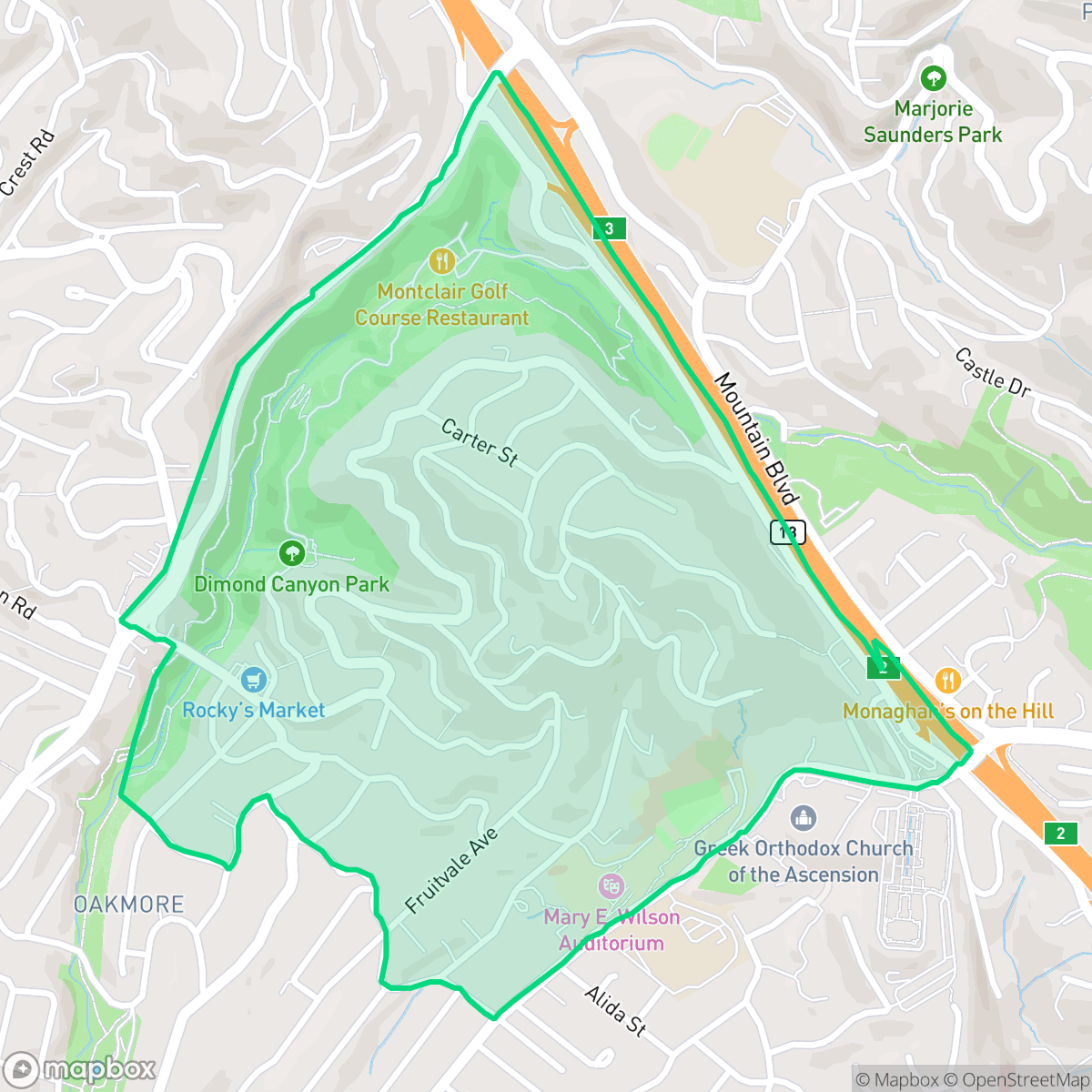
Nestled in the Oakland Hills, Oakmore (originally Oakmore Highlands) was once part of Antonio Peralta’s land before being developed as a master-planned community in 1926 by Walter H. Leimert. The neighborhood’s development was unlocked by the construction of the historic Leimert Bridge, a landmark concrete arch span over Dimond Canyon and Sausal Creek that was the largest of its kind when completed in 1927. Built primarily in the 1920s and 1930s, Oakmore attracted San Francisco commuters who relied on the Key System transit line crossing the bridge. The neighborhood features a mix of Craftsman, Mediterranean, and mid-century homes designed to blend with the hillside terrain. To preserve the area's natural beauty, the Oakmore Homes Association—founded in 1926—initially prohibited cutting down local oak trees. Today, a small commercial district near the bridge features the neighborhood's long-standing Rocky’s Market.
The neighborhood is characterized by its hilly topography and residential nature, maintaining a strong sense of seclusion despite its proximity to major transit routes. Residents benefit from high levels of health insurance coverage and good air quality, contributing to a stable living environment. The area is particularly well-suited for dog owners who value access to open space and a more rural feel within the city limits, as the low-density layout provides ample room for outdoor activity.
Prospective residents should consider the trade-offs of living in this hillside location, which include a lack of local commercial activity and higher levels of ambient noise from nearby traffic. While the area offers significant aesthetic value, it is important to note the heightened risk regarding fire safety in this part of the Oakland Hills. The neighborhood is best suited for those who prioritize a quiet, private lifestyle and are comfortable relying on a vehicle for daily errands, as the hilly terrain and layout limit pedestrian convenience.
Neighborhood Scores Across 15 Qualities
Homes in Oakmore offer more distance between neighbors than the Oakland average, featuring mixed spacing and significant backyard foliage. This provides a greater sense of separation between properties compared to more densely packed areas of the city.
Low traffic residential streets and an established sidewalk network allow for safe pedestrian movement, though walkability is lower than the Oakland average. According to iHuus data, sidewalks are primarily present on one side of the street in certain areas.
Manicured grounds, large homes, and private pools contribute to a visual landscape that is significantly more polished than the Oakland average. According to iHuus data, the area features frequent upscale amenities and spacious residential lots.
Abundant residential greenery, wooded slopes, and large sports fields provide significant space for walking pets. This level of access to open space and trails is considerably higher than the Oakland average, according to iHuus data.
Frequent open land and a significant tree canopy provide a more semi-rural feel than most of Oakland. Residents can expect a landscape of scattered homes and woodland areas according to iHuus data.
Low-density blocks and suburban streets provide a calm atmosphere, though the area has fewer commercial services and less activity than the Oakland average. Most residents will find a quiet environment with scattered dining options, but many daily errands may require driving due to the limited number of walkable businesses.
Persistent noise from nearby railroad tracks and heavy freeway traffic is common in this area. According to iHuus data, acoustic comfort levels are lower than the Oakland city average.
Air quality remains consistently high with rare instances of elevated readings. According to iHuus data, the air in this area is cleaner than the Oakland average.
Industrial presence is non-existent in Oakmore, as the area consists entirely of residential and institutional spaces. According to iHuus data, this lack of warehouses or manufacturing facilities is notably lower than the Oakland average.
Health insurance access is exceptionally high in this area, significantly surpassing the Oakland average. According to iHuus data, the vast majority of residents are covered.
Voting patterns and census indicators in Oakmore reflect a deeply liberal political landscape that is slightly more pronounced than the Oakland average.
A diverse age range of young professionals, families, and seniors provides a more balanced demographic spread than the Oakland average, according to iHuus data.
Flood risk in this area is significantly lower than the Oakland average, though some residual risk remains within the 500-year floodplain according to iHuus data.
Address-Level Insights for Oakmore


iHuus Neighborhood Intelligence Insights
Get address-level neighborhood insights for Oakmore
- Street-level scores — see how individual blocks compare, not just neighborhood averages
- Micro-zone boundaries — identify quiet pockets, flood boundaries, and walkable clusters before you visit
- 15 dimensions in full — walkability, noise, air quality, school quality, insurance coverage, population age profile, urban/rural index, and more
- Boundary risk alerts — know if your address sits near a block boundary where scores drop, the kind of detail no listing will ever mention
- School insights — individual school ratings and insights, not just district-level data
- Compare before you commit — side-by-side data across neighborhoods, down to block precision
No credit card required
Compare with Any Neighborhood
| Dimension | Oakmore | Acorn |
|---|---|---|
| 🚶 Walkabilityavg 8.99 | ||
| 🔊 Acoustic Comfortavg 3.24 | ||
| 🤫 Privacy Indexavg 3.74 | ||
| 🎨 Visual Appealavg 6.28 | ||
| 🐕 Dog Friendlinessavg 5.74 | ||
| 🗺️ Urban-Rural Indexavg 6.02 | ||
| ✨ Neighborhood Vibeavg 5.22 | ||
| 🏥 Health Insurance Coverageavg 7.4 | ||
| 🌿 Air Qualityavg 8.06 | ||
| 🏭 Industrial Proximityavg 8.37 | ||
| 🌊 Flood Safetyavg 2.61 | ||
| 🗳️ Ideological Leanavg 9.95 | ||
| 👥 Population Age Profileavg 4.92 | ||
| 🔥 Fire Safetyavg 0.17 | ||
| 🏫 School Quality |
Oakmore Rankings
School Districts Serving Oakmore
School Insights for Oakmore
Below average outcomes; significant attendance and academic challenges.
School Insights
See what's really behind every school rating near Oakmore
- Individual school ratings — each school's own score with outcome context, not just a district average
- Enrollment & class size data — student-to-teacher ratio and how it compares to the state average
- Full demographics breakdown — ethnicity and gender composition for every school in the enrollment zone
- Every school in the district — all schools within the enrollment boundary ranked by rating, not just the closest one
- Grade levels & benchmarks — elementary through high school, with below/above state-average flags
No credit card required