Oakland Ave-Harrison St, Oakland
Updated · 5,719 residents
Oakland Ave-Harrison St is a high-energy, exceptionally walkable urban enclave characterized by its dense residential blocks and proximity to diverse local dining. While the area offers convenient access to city amenities, residents experience significant noise levels from nearby highway traffic and limited private green space.
Key Highlights
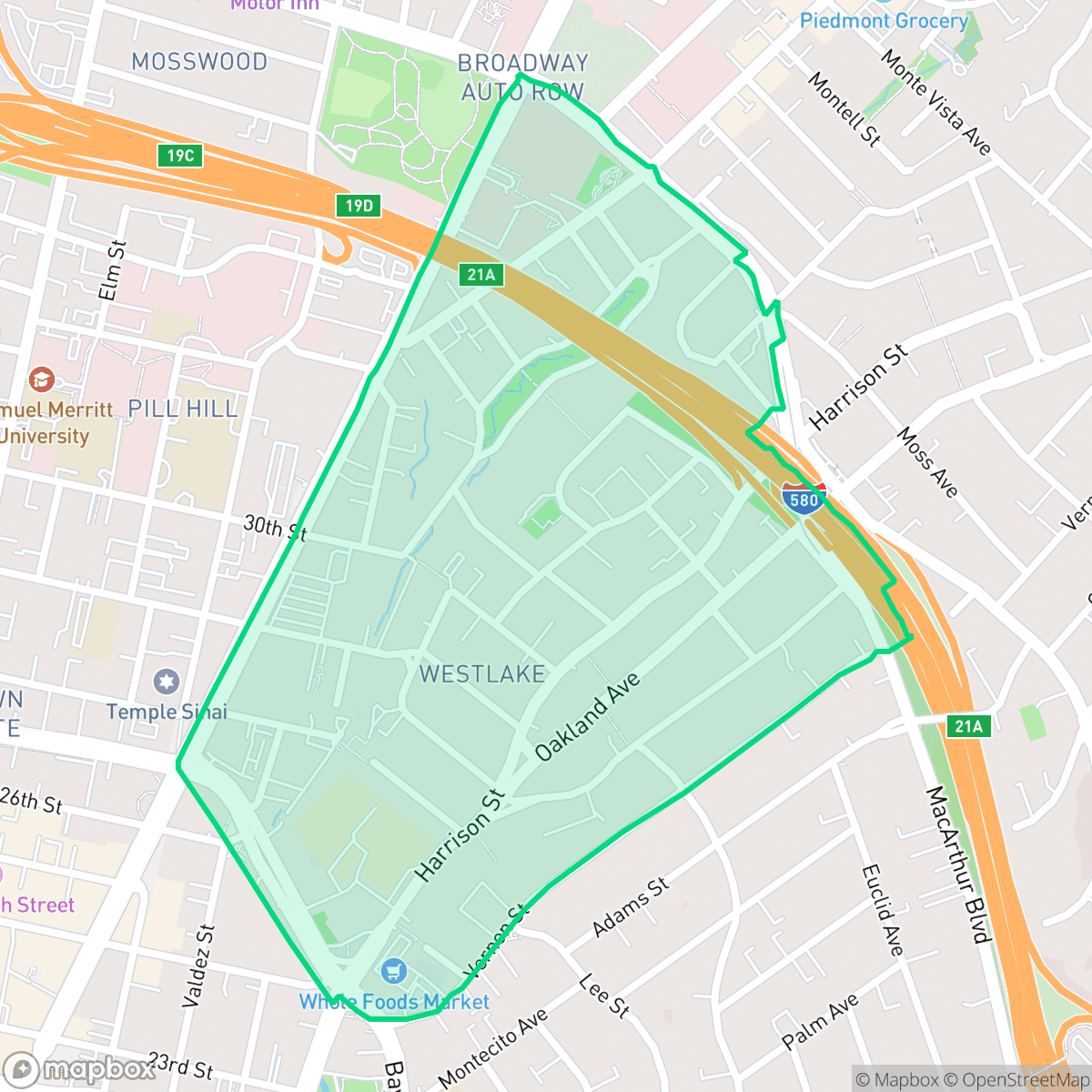
About Oakland Ave-Harrison St
Tucked into the low hills of North Oakland, the Oakland Ave-Harrison St neighborhood—often locally called "HarriOak" or "Westlake"—is a historic enclave shaped by early 20th-century development. The area overlaps with the historic Glen Echo neighborhood, where real estate developer Wickham Havens subdivided the Oak Park Tract in 1905. A centerpiece of the neighborhood is Oak Glen Park, created in 1912 to preserve a rare open segment of Glen Echo Creek. In 1928, the neighborhood's civic identity was further solidified with the opening of Westlake Middle School (originally Lakeview Junior High), a Spanish-style architectural landmark designed to serve the growing population. Today, the neighborhood maintains its distinct residential character, defined by its historic tree-lined streets, early 20th-century homes, and proximity to the Morcom Rose Garden.
The neighborhood functions as a dense, urban hub that prioritizes accessibility and a fast-paced lifestyle. Residents benefit from a highly connected street grid that makes daily errands and dining at local establishments like Judoku Sushi or La Catrina Taqueria easy to accomplish on foot. The landscape is defined by its mix of multi-family housing and commercial blocks, creating a vibrant, high-energy environment that remains free from heavy industrial activity. It is a central location that places inhabitants within reach of major city corridors and essential services.
Prospective residents should consider several trade-offs, including high ambient noise levels averaging 66 decibels due to proximity to major road traffic. The area offers limited private green space, and the local school system, including Westlake Middle, currently faces significant budgetary and performance challenges. This neighborhood is best suited for individuals or households who prioritize high walkability and proximity to urban amenities over quiet surroundings or expansive outdoor space.
Neighborhood Scores Across 15 Qualities
Buildings are closely packed with narrow separations or shared walls, resulting in less privacy than the Oakland average. According to iHuus data, many structures in this area are situated in a high-density urban environment with minimal distance between neighbors.
Extremely accessible pedestrian infrastructure, including wide sidewalks and frequent crosswalks, makes navigating this area on foot exceptionally easy. According to iHuus data, the level of walkability here is superior to the Oakland city average.
Standard urban density defines this area, featuring a mix of multi-unit housing and commercial buildings. The visual landscape is primarily functional with modest yards and boxy architecture, falling slightly below the city average for visual variety.
Access to pet-friendly space is consistent with the city average, featuring tree-lined streets with sidewalk verges and nearby public park access. While some areas offer substantial green space and trails, other pockets are more densely urban with limited public greenery.
High-density buildings and major highways dominate the landscape, creating a much more urban environment than the typical Oakland neighborhood. This area features a mix of multi-story apartments and commercial blocks with very little open green space.
Diverse dining options and dense, high-rise landscapes create a high-energy atmosphere that is significantly more active than the Oakland average. Frequent movement and a variety of local destinations characterize this area according to iHuus data.
Constant noise from nearby freeway and railroad traffic is a prominent feature of this area. According to iHuus data, acoustic comfort is notably lower than the Oakland average.
Air quality is consistently good with infrequent instances of elevated readings. According to iHuus data, the atmosphere in this area is slightly cleaner than the Oakland city average.
Residential and light commercial uses dominate the area with no heavy industrial plants or large warehouses visible. While the neighborhood is slightly cleaner of industrial activity than the Oakland average, residents should be aware of a nearby EPA Superfund site.
Health insurance accessibility is lower here than in the rest of Oakland, according to iHuus data. Residents may find fewer options for coverage compared to the city average.
Voting patterns and census indicators reflect a deeply liberal political leaning that is slightly more pronounced than the Oakland average.
Residents live alongside a balanced mix of young professionals, families, and seniors. This demographic spread is slightly more diverse than the Oakland average, according to iHuus data.
Frequent flooding is a concern in this area as it sits within a designated floodplain. According to iHuus data, the risk level here is notably higher than the Oakland average.
Address-Level Insights for Oakland Ave-Harrison St


iHuus Neighborhood Intelligence Insights
Get address-level neighborhood insights for Oakland Ave-Harrison St
- Street-level scores — see how individual blocks compare, not just neighborhood averages
- Micro-zone boundaries — identify quiet pockets, flood boundaries, and walkable clusters before you visit
- 15 dimensions in full — walkability, noise, air quality, school quality, insurance coverage, population age profile, urban/rural index, and more
- Boundary risk alerts — know if your address sits near a block boundary where scores drop, the kind of detail no listing will ever mention
- School insights — individual school ratings and insights, not just district-level data
- Compare before you commit — side-by-side data across neighborhoods, down to block precision
No credit card required
Compare with Any Neighborhood
| Dimension | Oakland Ave-Harrison St | Acorn |
|---|---|---|
| 🚶 Walkabilityavg 8.99 | ||
| 🔊 Acoustic Comfortavg 3.24 | ||
| 🤫 Privacy Indexavg 3.74 | ||
| 🎨 Visual Appealavg 6.28 | ||
| 🐕 Dog Friendlinessavg 5.74 | ||
| 🗺️ Urban-Rural Indexavg 6.02 | ||
| ✨ Neighborhood Vibeavg 5.22 | ||
| 🏥 Health Insurance Coverageavg 7.4 | ||
| 🌿 Air Qualityavg 8.06 | ||
| 🏭 Industrial Proximityavg 8.37 | ||
| 🌊 Flood Safetyavg 2.61 | ||
| 🗳️ Ideological Leanavg 9.95 | ||
| 👥 Population Age Profileavg 4.92 | ||
| 🔥 Fire Safetyavg 0.17 | ||
| 🏫 School Quality |
Oakland Ave-Harrison St Rankings
School Districts Serving Oakland Ave-Harrison St
School Insights for Oakland Ave-Harrison St
Below average outcomes; significant attendance and academic challenges.
School Insights
See what's really behind every school rating near Oakland Ave-Harrison St
- Individual school ratings — each school's own score with outcome context, not just a district average
- Enrollment & class size data — student-to-teacher ratio and how it compares to the state average
- Full demographics breakdown — ethnicity and gender composition for every school in the enrollment zone
- Every school in the district — all schools within the enrollment boundary ranked by rating, not just the closest one
- Grade levels & benchmarks — elementary through high school, with below/above state-average flags
No credit card required