Oakland Army Base, Oakland
Updated · 1,467 residents
The Oakland Army Base is a primary maritime logistics and industrial hub located at the foot of the San Francisco-Oakland Bay Bridge. While the area offers significant employment opportunities within the Gateway Industrial District, residents face challenges including high noise levels from nearby highway traffic and limited walkability.
Key Highlights
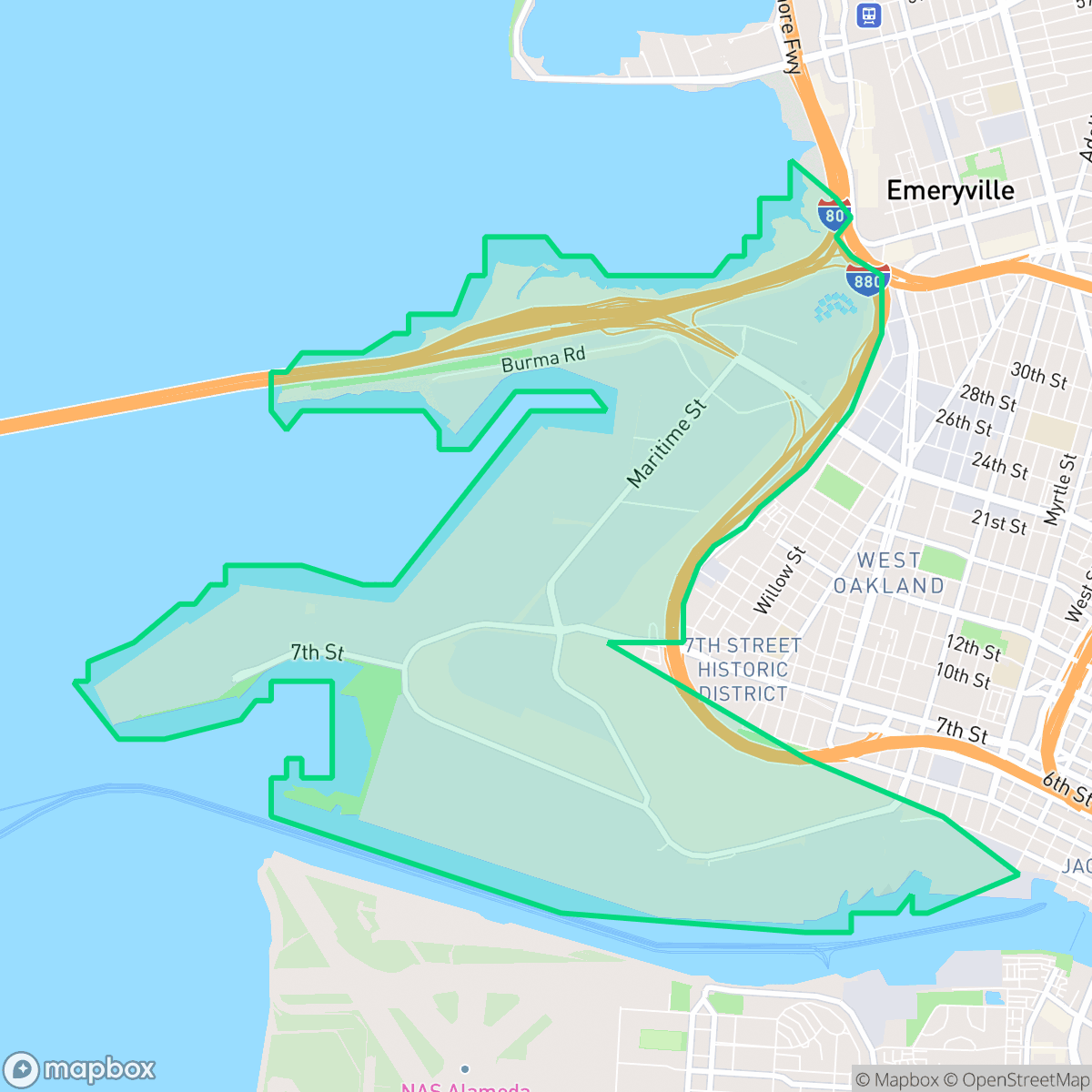
About Oakland Army Base
Established in 1941 on 425 waterfront acres near the San Francisco–Oakland Bay Bridge, the Oakland Army Base was a crucial military port of embarkation during World War II, the Korean War, and the Vietnam War. Constructed in part by Black troops of the 394th Quartermaster Battalion, the base grew into the nation's largest single cargo terminal facility of its kind, featuring extensive rail yards, warehouses, and deep-water piers. Throughout the mid-to-late 20th century, the base operated as a "city-within-a-city" and served as a vital source of working-class employment, particularly for West Oakland’s Black community. Following its decommissioning in 1999, the site underwent a massive $1 billion redevelopment. Today, it has been transformed into the Gateway Industrial District, a modern maritime logistics and warehousing hub supporting the Port of Oakland.
This area functions as a dense industrial and logistics landscape characterized by large-scale warehouses, rail infrastructure, and significant paved surfaces. According to iHuus data, the environment is dominated by heavy freight traffic and concrete-heavy infrastructure, resulting in limited pedestrian-friendly amenities or recreational spaces. While the setting is highly functional for maritime operations, the lack of traditional neighborhood amenities and the presence of industrial sites, including a nearby EPA Superfund location, define the daily experience for those in the vicinity. Prospective residents should be aware that the area is not designed for traditional residential living. The combination of high noise levels from road traffic, low walkability, and significant industrial proximity makes it a challenging environment for those seeking a quiet or pedestrian-oriented lifestyle. It is best suited for individuals who prioritize proximity to regional logistics hubs or major transportation corridors over conventional suburban or urban residential comforts.
Neighborhood Scores Across 15 Qualities
Residential structures are situated in close proximity with minimal separation between property lines. This density results in less privacy than is typical for the Oakland area, according to iHuus data.
Pedestrian movement is constrained by a lack of sidewalks and barriers from nearby highways and heavy rail. While some streets are quiet enough for walking, the area is significantly less walkable than the Oakland average according to iHuus data.
Residential views are dominated by tightly packed housing and proximity to heavy industry. This area offers less greenery and visual variety than the Oakland average according to iHuus data.
Public green space is scarce and sidewalk verges are narrow. According to iHuus data, greenery is primarily confined to private fenced yards, making this area significantly less dog friendly than the Oakland average.
Large-scale warehouses, rail yards, and massive paved surfaces dominate the landscape, making this area significantly more industrial than the Oakland average. According to iHuus data, the terrain is characterized by heavy logistics infrastructure and maritime facilities with very little green space.
Dominated by heavy industrial landscapes, warehouses, and railways, this area offers very little social activity compared to the Oakland average. Most residents will find the environment to be a calm, car-dependent space with few local businesses or walkable amenities near the highway and coastline.
Constant noise from nearby airport runways and heavy rail activity makes this area significantly louder than the Oakland average. Residents should expect high levels of ambient sound throughout the day and night.
Air quality is consistently good with rare instances of elevated readings. This level of air cleanliness is slightly above the Oakland city average, according to iHuus data.
Heavy industrial activity and large-scale freight corridors dominate the area. This neighborhood contains significantly more warehouses and an EPA Superfund site than the Oakland average, according to iHuus data.
Health insurance accessibility is notably lower than the Oakland average. According to iHuus data, fewer residents in this area have access to employer-sponsored or private health coverage.
Voting patterns and census indicators reflect a very liberal political landscape that is largely consistent with the broader Oakland area. According to iHuus data, the ideological leaning of this neighborhood closely matches the city average.
Residents encounter a balanced distribution of young adults, families, and older individuals; this demographic variety is slightly lower than the Oakland average according to iHuus data.
Located within a designated floodplain, this area faces a significantly higher risk of flooding compared to the Oakland average. According to iHuus data, residents should expect a high likelihood of requiring flood insurance.
Address-Level Insights for Oakland Army Base


iHuus Neighborhood Intelligence Insights
Get address-level neighborhood insights for Oakland Army Base
- Street-level scores — see how individual blocks compare, not just neighborhood averages
- Micro-zone boundaries — identify quiet pockets, flood boundaries, and walkable clusters before you visit
- 15 dimensions in full — walkability, noise, air quality, school quality, insurance coverage, population age profile, urban/rural index, and more
- Boundary risk alerts — know if your address sits near a block boundary where scores drop, the kind of detail no listing will ever mention
- School insights — individual school ratings and insights, not just district-level data
- Compare before you commit — side-by-side data across neighborhoods, down to block precision
No credit card required
Compare with Any Neighborhood
| Dimension | Oakland Army Base | Acorn |
|---|---|---|
| 🚶 Walkabilityavg 8.99 | ||
| 🔊 Acoustic Comfortavg 3.24 | ||
| 🤫 Privacy Indexavg 3.74 | ||
| 🎨 Visual Appealavg 6.28 | ||
| 🐕 Dog Friendlinessavg 5.74 | ||
| 🗺️ Urban-Rural Indexavg 6.02 | ||
| ✨ Neighborhood Vibeavg 5.22 | ||
| 🏥 Health Insurance Coverageavg 7.4 | ||
| 🌿 Air Qualityavg 8.06 | ||
| 🏭 Industrial Proximityavg 8.37 | ||
| 🌊 Flood Safetyavg 2.61 | ||
| 🗳️ Ideological Leanavg 9.95 | ||
| 👥 Population Age Profileavg 4.92 | ||
| 🔥 Fire Safetyavg 0.17 | ||
| 🏫 School Quality |
Oakland Army Base Rankings
School Districts Serving Oakland Army Base
School Insights for Oakland Army Base
Below average outcomes; significant attendance and academic challenges.
School Insights
See what's really behind every school rating near Oakland Army Base
- Individual school ratings — each school's own score with outcome context, not just a district average
- Enrollment & class size data — student-to-teacher ratio and how it compares to the state average
- Full demographics breakdown — ethnicity and gender composition for every school in the enrollment zone
- Every school in the district — all schools within the enrollment boundary ranked by rating, not just the closest one
- Grade levels & benchmarks — elementary through high school, with below/above state-average flags
No credit card required