Oak Tree, Oakland
Updated · 3,578 residents
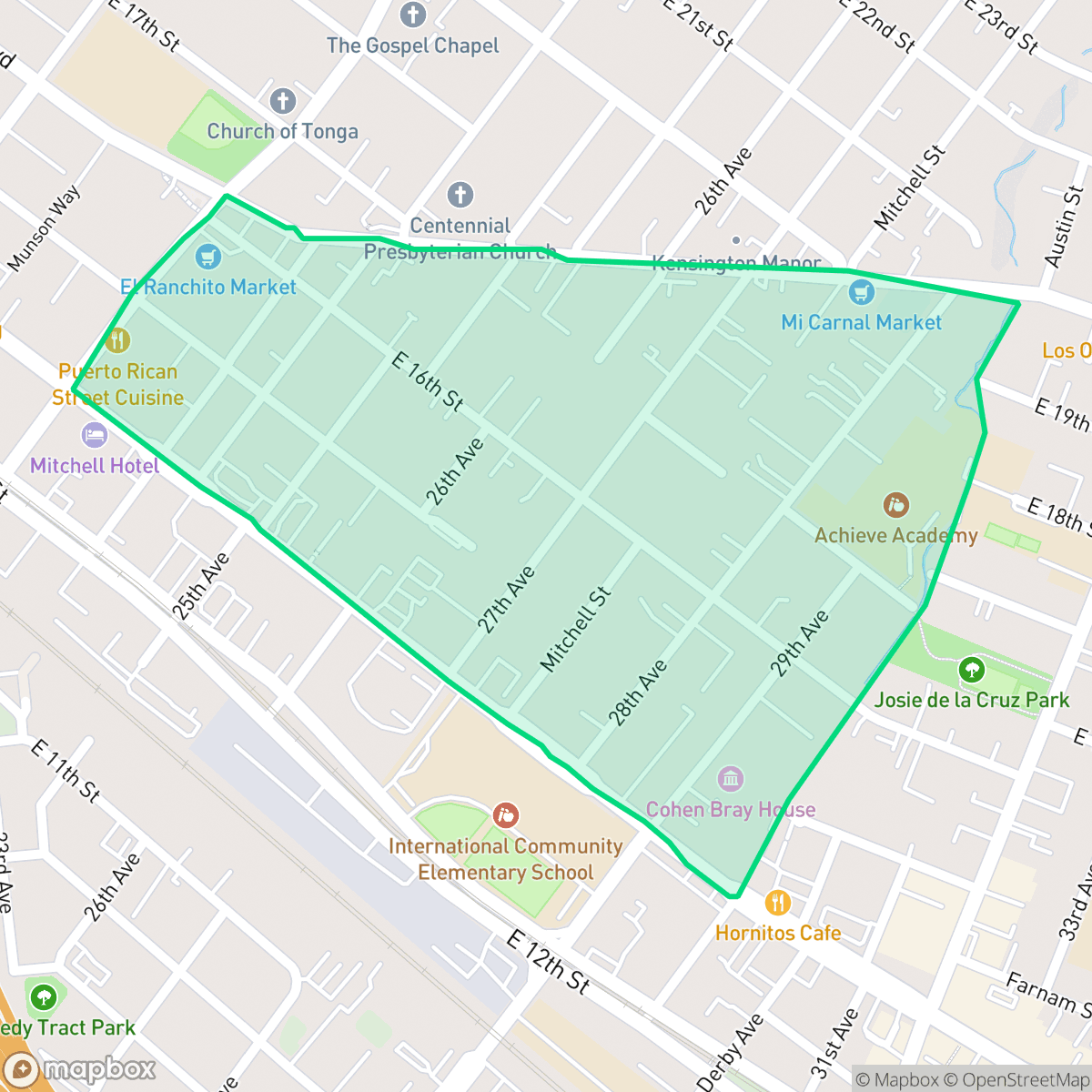
The Oak Tree neighborhood in Oakland is a dense, low-rise residential area defined by its grid-like street layout and active social culture. While the community benefits from high air quality and consistent sidewalk access, residents experience limited privacy due to tightly packed housing and moderate noise from nearby transit corridors.
Key Highlights
About Oak Tree
Named after Watson Bray’s 19th-century Oak Tree Farm estate, the Oak Tree neighborhood in Oakland, California, is historically rooted in diverse communities and grassroots activism. During the 1960s and 1970s, urban renewal displaced Black and Latino families from West Oakland to Oak Tree, followed by Asian families in the 1980s. The neighborhood became a hub for radical educational politics. Chicano activists successfully lobbied for the creation of the Centro Infantil de La Raza pre-school, and in the late 1960s, activist Bert Corona founded the nation's first Latin American library inside the neighborhood’s 1918 Carnegie-built Miller Branch Library. By the mid-1970s, this site also housed the Emiliano Zapata Street Academy, an alternative high school for local youth.
The neighborhood functions as a dense urban enclave where low-rise residential structures sit on small lots with minimal separation. According to iHuus data, the area maintains a consistent sidewalk grid that facilitates local movement, though the lack of dedicated public park space and narrow sidewalk verges can present challenges for pet owners. The local atmosphere is characterized by a mix of residential life and small-scale commercial activity, including various neighborhood eateries and community-focused institutions.
Prospective residents should note that while the area offers a strong sense of community and social engagement, it faces structural trade-offs. The housing stock consists primarily of boxy, high-density units with limited private outdoor space. Additionally, the proximity to major transit corridors contributes to consistent road noise, and local school performance remains a significant concern for families given the broader challenges within the Oakland Unified School District.
Neighborhood Scores Across 15 Qualities
Residential structures are often positioned closely together with shared property lines, providing slightly less seclusion than the Oakland average. Some areas feature high-density apartment blocks and houses spaced very near one another.
Pedestrians benefit from a consistent sidewalk grid and frequent crosswalks throughout the residential blocks. While the area is very easy to navigate on foot, it is slightly less walkable than the Oakland city average.
Standard multi-unit buildings and bungalows define the area, offering a modest visual environment that is slightly below the Oakland average. Most lots feature small yards and functional, boxy architecture according to iHuus data.
Minimal public park access and narrow sidewalks with little greenery make frequent walks difficult. According to iHuus data, the availability of pet-friendly outdoor space is below the Oakland average.
Streetscapes feature a balance of green space and residential infrastructure. While some pockets consist of dense, low-rise urban grids, the area overall maintains a level of openness similar to the Oakland average.
Diverse social hubs and dining options provide a level of activity that is higher than the Oakland average. Residents will find a mix of energetic industrial corridors and quieter, greener suburban blocks featuring various local eateries.
Frequent noise from nearby freeways and railroad tracks makes for a louder environment than most parts of Oakland. According to iHuus data, residents can expect more consistent acoustic disturbances than the city average.
Air quality is consistently good with rare instances of elevated readings. According to iHuus data, levels in this area remain nearly identical to the Oakland average.
Light industrial activity and warehouse zones are present along the southern edges, resulting in lower industrial density than much of Oakland. Residents may encounter intermittent operational noise and loading activity from nearby commercial services and the adjacent railway corridor.
Health insurance coverage levels in Oak Tree are notably lower than the Oakland city average, according to iHuus data. Residents may find fewer local options for employer-sponsored coverage within this specific area.
Voting patterns and census indicators show a heavily liberal political landscape that aligns with the broader Oakland average, according to iHuus data.
Residents live alongside a varied mix of young adults, families, and seniors. According to iHuus data, this age distribution is slightly more concentrated toward younger and middle-aged demographics than the Oakland average.
Flood vulnerability is significantly higher here than the Oakland average, according to iHuus data. Properties in this area are at a greater risk of water damage during heavy rain events.
Address-Level Insights for Oak Tree


iHuus Neighborhood Intelligence Insights
Get address-level neighborhood insights for Oak Tree
- Street-level scores — see how individual blocks compare, not just neighborhood averages
- Micro-zone boundaries — identify quiet pockets, flood boundaries, and walkable clusters before you visit
- 15 dimensions in full — walkability, noise, air quality, school quality, insurance coverage, population age profile, urban/rural index, and more
- Boundary risk alerts — know if your address sits near a block boundary where scores drop, the kind of detail no listing will ever mention
- School insights — individual school ratings and insights, not just district-level data
- Compare before you commit — side-by-side data across neighborhoods, down to block precision
No credit card required
Compare with Any Neighborhood
| Dimension | Oak Tree | Acorn |
|---|---|---|
| 🚶 Walkabilityavg 8.99 | ||
| 🔊 Acoustic Comfortavg 3.24 | ||
| 🤫 Privacy Indexavg 3.74 | ||
| 🎨 Visual Appealavg 6.28 | ||
| 🐕 Dog Friendlinessavg 5.74 | ||
| 🗺️ Urban-Rural Indexavg 6.02 | ||
| ✨ Neighborhood Vibeavg 5.22 | ||
| 🏥 Health Insurance Coverageavg 7.4 | ||
| 🌿 Air Qualityavg 8.06 | ||
| 🏭 Industrial Proximityavg 8.37 | ||
| 🌊 Flood Safetyavg 2.61 | ||
| 🗳️ Ideological Leanavg 9.95 | ||
| 👥 Population Age Profileavg 4.92 | ||
| 🔥 Fire Safetyavg 0.17 | ||
| 🏫 School Quality |
Oak Tree Rankings
School Districts Serving Oak Tree
School Insights for Oak Tree
Below average outcomes; significant attendance and academic challenges.
School Insights
See what's really behind every school rating near Oak Tree
- Individual school ratings — each school's own score with outcome context, not just a district average
- Enrollment & class size data — student-to-teacher ratio and how it compares to the state average
- Full demographics breakdown — ethnicity and gender composition for every school in the enrollment zone
- Every school in the district — all schools within the enrollment boundary ranked by rating, not just the closest one
- Grade levels & benchmarks — elementary through high school, with below/above state-average flags
No credit card required