Oak Knoll-Golf Links, Oakland
Updated · 2,082 residents
Oak Knoll-Golf Links is a quiet, suburban neighborhood characterized by its transition from a historic naval facility into a residential community. The area offers significant open green space and is exceptionally dog-friendly, though it maintains a low-liveliness profile with limited local services. Residents experience a suburban environment that balances proximity to major transit routes with a secluded, residential atmosphere.
Key Highlights
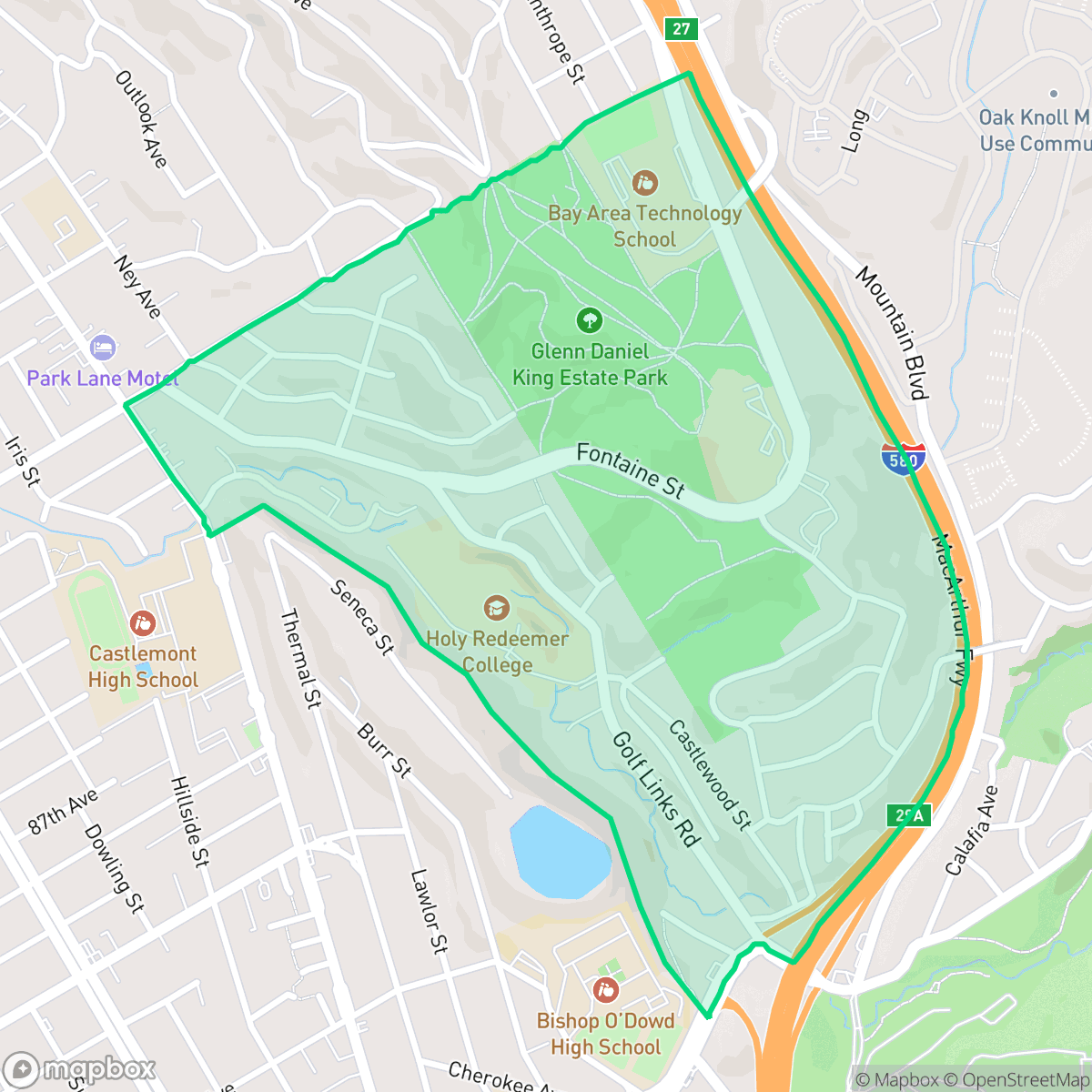
About Oak Knoll-Golf Links
The Oak Knoll-Golf Links neighborhood in the southern foothills of Oakland, California, originated in 1926 with the development of the Oak Knoll Country Club and its Willie Lock-designed golf course. Early residential construction featured Spanish-style bungalows and English-style homes. Following the club's Great Depression-era bankruptcy, the U.S. Navy purchased the 167-acre property in 1942 to establish the Oak Knoll Naval Hospital. The facility became a vital medical hub, treating wounded service members from World War II, the Korean War, and the Vietnam War. After the hospital's decommissioning in 1996 and subsequent demolition, the site began transitioning into a master-planned community. This modern development integrates local history by restoring Rifle Range Creek and preserving the historic 1920s Club Knoll clubhouse as a community center.
The neighborhood functions as a tranquil residential enclave in the southern foothills of Oakland, defined by its spacious layout and integration of natural features like Rifle Range Creek. With a high urban-rural index, the area provides a retreat from the dense city center, prioritizing quiet streets and expansive green space over commercial development. Its residential character is supported by high health insurance coverage and a stable environment, making it a suitable choice for those who prefer a slower pace of life.
Prospective residents should consider the trade-offs associated with the area, particularly regarding the local school district, which currently faces significant financial and operational challenges. While the neighborhood is highly rated for pet owners, those sensitive to environmental factors should note the elevated fire risk and proximity to major road traffic, which contributes to moderate noise levels. The area is best suited for individuals or families who prioritize outdoor access and a suburban aesthetic over immediate walkability to urban amenities.
Neighborhood Scores Across 15 Qualities
Residential spacing is mixed, featuring some buffer between homes but also areas where houses are positioned closely together. According to iHuus data, this level of separation is notably higher than the Oakland average.
Sidewalks are present on both sides of most streets and the consistent grid layout supports easy pedestrian movement. This level of walkability is on par with the rest of Oakland.
Residential streets feature typical tract housing with simple rooflines and modest yards. This level of visual variety is consistent with the rest of Oakland.
Connected green spaces and wide paths provide ample space for pets. According to iHuus data, the area offers significantly better access to safe, low-traffic walking routes than the Oakland average.
Expansive open spaces and scattered greenery provide a more rural character than most of Oakland. According to iHuus data, this area features a low-density mix of single-family homes and woodland pockets.
Low-density residential streets and significant open space define this area, which offers a much more tranquil atmosphere than the Oakland average. Most daily needs require a vehicle, as commercial services and businesses are sparse within walking distance.
Steady traffic sounds from nearby busy streets are noticeable throughout the area. According to iHuus data, this level of acoustic activity is higher than the typical noise profile found across Oakland.
Air quality levels fluctuate between acceptable and unhealthy, particularly for sensitive groups. According to iHuus data, the air quality in this area is lower than the Oakland city average.
Residential, commercial, and educational uses comprise the entire area, with no warehouses or heavy industrial hazards detected. This lack of industrial proximity is notably higher than the Oakland average, according to iHuus data.
Health insurance accessibility is lower than the Oakland average, according to iHuus data. Residents may encounter more difficulty accessing employer-sponsored or subsidized coverage compared to other parts of the city.
Voting patterns and census indicators show a predominantly liberal political leaning, which is consistent with the broader Oakland area according to iHuus data.
Residents live alongside a diverse mix of young professionals, families, and seniors. This age distribution is roughly in line with the broader Oakland area according to iHuus data.
Significant flood hazards exist here due to its location in a coastal high-hazard zone. According to iHuus data, this area carries a much higher risk of wave action and potential insurance costs than the rest of Oakland.
Address-Level Insights for Oak Knoll-Golf Links


iHuus Neighborhood Intelligence Insights
Get address-level neighborhood insights for Oak Knoll-Golf Links
- Street-level scores — see how individual blocks compare, not just neighborhood averages
- Micro-zone boundaries — identify quiet pockets, flood boundaries, and walkable clusters before you visit
- 15 dimensions in full — walkability, noise, air quality, school quality, insurance coverage, population age profile, urban/rural index, and more
- Boundary risk alerts — know if your address sits near a block boundary where scores drop, the kind of detail no listing will ever mention
- School insights — individual school ratings and insights, not just district-level data
- Compare before you commit — side-by-side data across neighborhoods, down to block precision
No credit card required
Compare with Any Neighborhood
| Dimension | Oak Knoll-Golf Links | Acorn |
|---|---|---|
| 🚶 Walkabilityavg 8.99 | ||
| 🔊 Acoustic Comfortavg 3.24 | ||
| 🤫 Privacy Indexavg 3.74 | ||
| 🎨 Visual Appealavg 6.28 | ||
| 🐕 Dog Friendlinessavg 5.74 | ||
| 🗺️ Urban-Rural Indexavg 6.02 | ||
| ✨ Neighborhood Vibeavg 5.22 | ||
| 🏥 Health Insurance Coverageavg 7.4 | ||
| 🌿 Air Qualityavg 8.06 | ||
| 🏭 Industrial Proximityavg 8.37 | ||
| 🌊 Flood Safetyavg 2.61 | ||
| 🗳️ Ideological Leanavg 9.95 | ||
| 👥 Population Age Profileavg 4.92 | ||
| 🔥 Fire Safetyavg 0.17 | ||
| 🏫 School Quality |
Oak Knoll-Golf Links Rankings
School Districts Serving Oak Knoll-Golf Links
School Insights for Oak Knoll-Golf Links
Below average outcomes; significant attendance and academic challenges.
School Insights
See what's really behind every school rating near Oak Knoll-Golf Links
- Individual school ratings — each school's own score with outcome context, not just a district average
- Enrollment & class size data — student-to-teacher ratio and how it compares to the state average
- Full demographics breakdown — ethnicity and gender composition for every school in the enrollment zone
- Every school in the district — all schools within the enrollment boundary ranked by rating, not just the closest one
- Grade levels & benchmarks — elementary through high school, with below/above state-average flags
No credit card required