North Stonehurst, Oakland
Updated · 3,709 residents
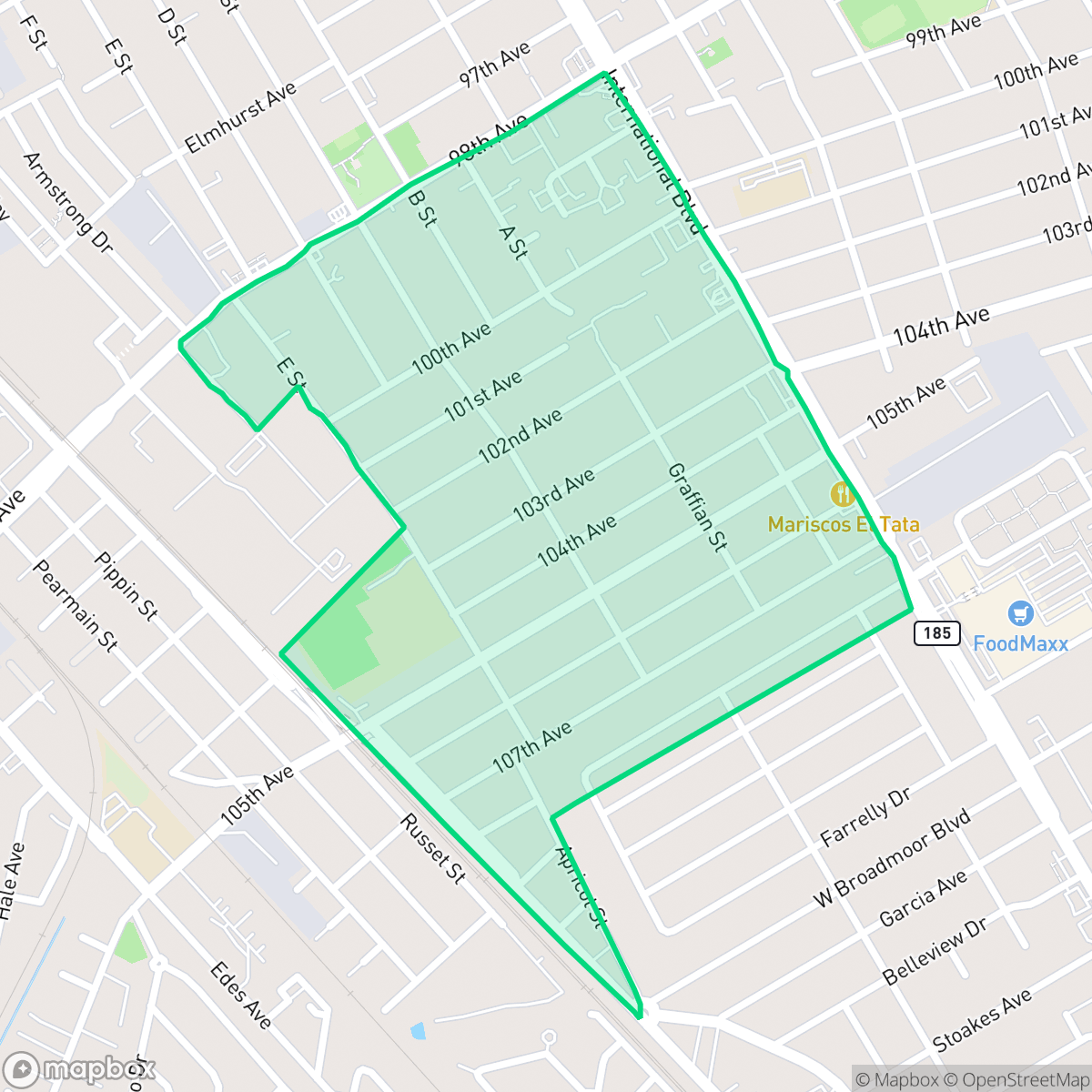
North Stonehurst is a quiet, dense residential neighborhood in East Oakland defined by its grid-like layout and proximity to industrial zones. While the area offers high walkability with consistent sidewalks, residents experience limited privacy due to tightly packed housing and notable noise from road traffic.
Key Highlights
About North Stonehurst
North Stonehurst, located in East Oakland, originated as part of the 19th-century Peralta land grant. In the 1870s, Daniel Webster purchased a tract of land here, planting fruit and vegetable orchards before selling the property to Lysander Stone, a prominent farmer who arrived in 1860 and owned a 250-acre estate. The neighborhood was subsequently named after Stone. The area transitioned from agriculture with the arrival of the Southern Pacific Railroad in 1877. Later, the Southern Pacific Electric Loop system was designed to run through North Stonehurst, transforming the agricultural hub into an early commuter suburb by connecting local residents directly to downtown Oakland and the San Francisco ferry.
The neighborhood functions as a low-rise, dense residential pocket characterized by standard tract housing and a layout that prioritizes connectivity through a consistent street grid. Industrial influence remains a significant feature of the landscape, with warehouses and logistics facilities integrated near the railway corridor. According to iHuus data, the area maintains a serene, low-activity atmosphere, providing a stark contrast to the busier urban centers of the East Bay.
Living here involves specific trade-offs, particularly regarding private space and environmental factors. The high density results in minimal yard space and close proximity to neighbors, while the presence of industrial activity contributes to consistent traffic noise and air quality considerations. Prospective residents should note that while the neighborhood is walkable, public green space is limited to a single small park. It is best suited for those seeking a straightforward, utilitarian residential environment with easy access to major transit corridors.
Neighborhood Scores Across 15 Qualities
Residential structures are closely packed with narrow side-yard setbacks, resulting in less privacy than the Oakland average. Many properties feature shared property lines and minimal separation between neighboring homes.
A continuous grid of sidewalks on both sides of every residential street provides excellent pedestrian connectivity. This network is slightly more comprehensive than the Oakland average, though large rail corridors can occasionally interrupt the path.
Residential lots are characterized by small yards and tight spacing between homes. According to iHuus data, the area features simpler roof geometries and less greenery than the Oakland average.
Limited public green space and narrow sidewalks make long walks difficult for pet owners. According to iHuus data, this area offers fewer park accesses and smaller yards than the Oakland average.
Residential streets and green spaces exist in roughly equal measure, reflecting a suburban character that is very similar to the Oakland average. According to iHuus data, the area features a mix of single-family homes and low-rise buildings interspersed with pockets of urban density.
Low-activity streets and light industrial zones create a tranquil environment that is slightly less active than the Oakland average. While some pockets feature local dining and social hubs, most areas consist of calm residential blocks and green spaces with limited nearby services.
Frequent noise from nearby freeway and railroad corridors is a common feature here. According to iHuus data, acoustic levels in this area are notably higher than the Oakland average.
Air quality fluctuates between acceptable and unhealthy levels, appearing lower than the average for Oakland. Residents sensitive to pollutants may experience occasional concern on certain days according to iHuus data.
Residential zones dominate the area, though some truck traffic and warehouse activity are present along the southern railway corridor. This level of industrial presence is slightly higher than the Oakland average according to iHuus data.
Health insurance coverage among residents is lower than the Oakland average, according to iHuus data. This indicates a higher proportion of uninsured individuals within the community compared to most other parts of the city.
Voting patterns and census indicators reflect a deeply liberal political landscape that is consistent with the broader Oakland area. According to iHuus data, the community shares the same strong liberal leaning found across the rest of the city.
Residents live alongside a balanced spread of young adults, families, and older individuals. This demographic distribution is slightly more concentrated toward certain age groups than the Oakland average, according to iHuus data.
Located in a coastal high-hazard zone with significant wave action, this area faces much greater flooding threats than the Oakland average. Residents should anticipate elevated or potentially prohibitive flood insurance costs according to iHuus data.
Address-Level Insights for North Stonehurst


iHuus Neighborhood Intelligence Insights
Get address-level neighborhood insights for North Stonehurst
- Street-level scores — see how individual blocks compare, not just neighborhood averages
- Micro-zone boundaries — identify quiet pockets, flood boundaries, and walkable clusters before you visit
- 15 dimensions in full — walkability, noise, air quality, school quality, insurance coverage, population age profile, urban/rural index, and more
- Boundary risk alerts — know if your address sits near a block boundary where scores drop, the kind of detail no listing will ever mention
- School insights — individual school ratings and insights, not just district-level data
- Compare before you commit — side-by-side data across neighborhoods, down to block precision
No credit card required
Compare with Any Neighborhood
| Dimension | North Stonehurst | Acorn |
|---|---|---|
| 🚶 Walkabilityavg 8.99 | ||
| 🔊 Acoustic Comfortavg 3.24 | ||
| 🤫 Privacy Indexavg 3.74 | ||
| 🎨 Visual Appealavg 6.28 | ||
| 🐕 Dog Friendlinessavg 5.74 | ||
| 🗺️ Urban-Rural Indexavg 6.02 | ||
| ✨ Neighborhood Vibeavg 5.22 | ||
| 🏥 Health Insurance Coverageavg 7.4 | ||
| 🌿 Air Qualityavg 8.06 | ||
| 🏭 Industrial Proximityavg 8.37 | ||
| 🌊 Flood Safetyavg 2.61 | ||
| 🗳️ Ideological Leanavg 9.95 | ||
| 👥 Population Age Profileavg 4.92 | ||
| 🔥 Fire Safetyavg 0.17 | ||
| 🏫 School Quality |
North Stonehurst Rankings
School Districts Serving North Stonehurst
School Insights for North Stonehurst
Below average outcomes; significant attendance and academic challenges.
School Insights
See what's really behind every school rating near North Stonehurst
- Individual school ratings — each school's own score with outcome context, not just a district average
- Enrollment & class size data — student-to-teacher ratio and how it compares to the state average
- Full demographics breakdown — ethnicity and gender composition for every school in the enrollment zone
- Every school in the district — all schools within the enrollment boundary ranked by rating, not just the closest one
- Grade levels & benchmarks — elementary through high school, with below/above state-average flags
No credit card required