Mosswood, Oakland
Updated · 2,358 residents
Mosswood is a dense, highly walkable urban neighborhood defined by its proximity to major transit corridors and a vibrant local food scene. While the area offers exceptional pedestrian access to daily amenities, residents should expect significant noise from surrounding highway traffic and limited privacy due to the closely spaced residential layout.
Key Highlights
About Mosswood
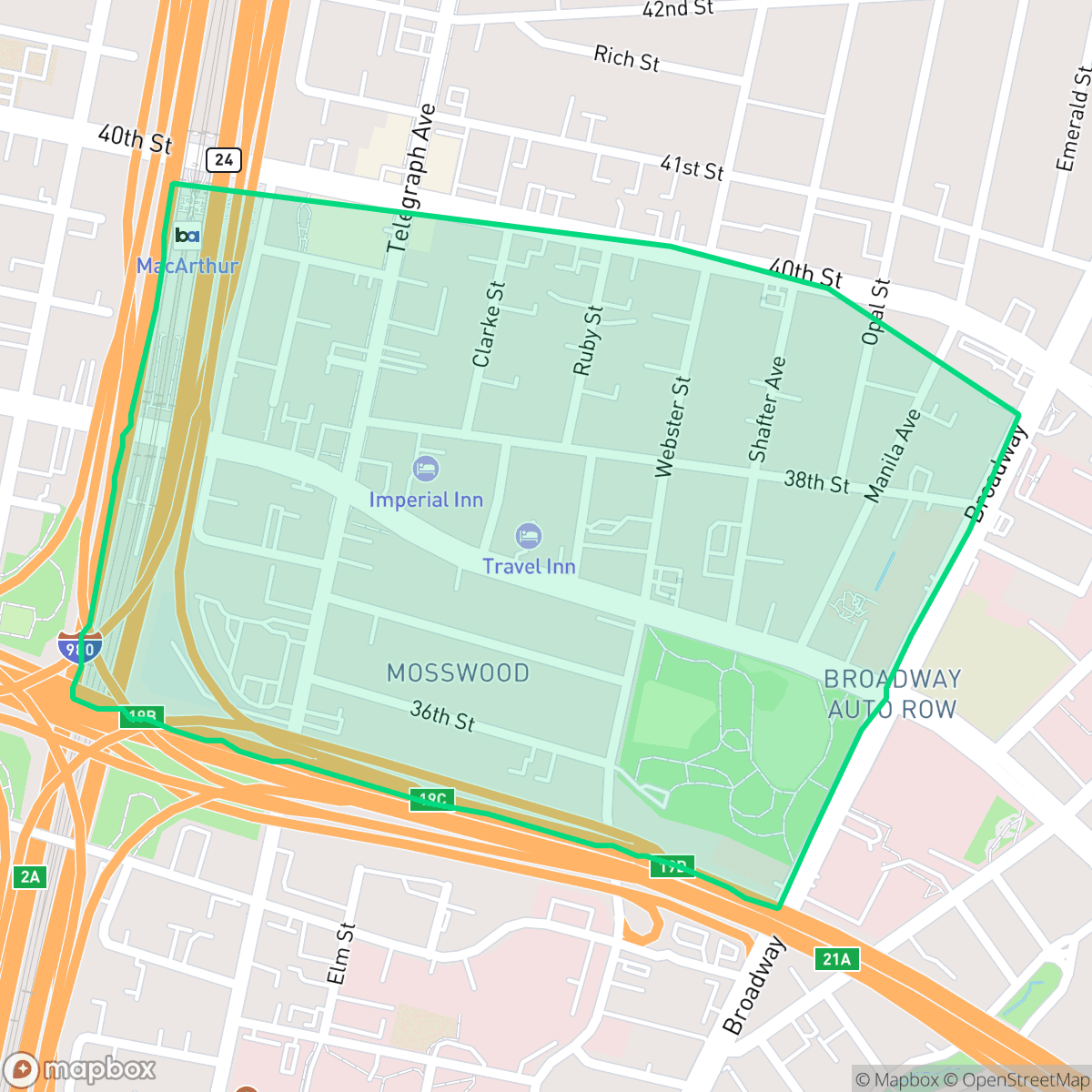
The Mosswood neighborhood in Oakland, California, traces its origins to the 1860s country estate of financier J. Mora Moss and his wife, Julia Wood, whose combined surnames gave the area its name. At the neighborhood's heart lies Mosswood Park, established between 1907 and 1911 after the city acquired the property. The park features the 1864 J. Mora Moss House, a designated Oakland Heritage Landmark celebrated as one of Northern California's finest remaining examples of Carpenter Gothic Victorian architecture. Historically, the neighborhood underwent significant transformation in the 1960s, when the construction of Interstate 580 cut through the area and demolished one of the park's popular outdoor amphitheaters. Today, bounded by Broadway, 40th Street, and major freeways, Mosswood remains a vital community hub defined by its historic park, recreation center, and central location.
The neighborhood serves as a high-energy urban hub characterized by a dense mix of multi-story apartments and traditional residential grids. According to iHuus data, the area excels in walkability, allowing residents to easily access local staples like Seoul Gom Tang and the Oasis Food Market without a vehicle. The atmosphere is notably lively, reflecting a diverse demographic and a central location that connects various parts of Oakland through its immediate highway access. Prospective residents should weigh the benefits of urban convenience against the reality of a high-decibel environment, as constant road traffic contributes to significant noise levels. The housing stock is tightly packed, offering minimal space between neighbors and limited private outdoor areas. Those considering the area should also note the challenges facing the local school district, which is currently managing significant budget and administrative constraints. This location is best suited for those who prioritize transit connectivity and a fast-paced city lifestyle over quietude or expansive private property.
Neighborhood Scores Across 15 Qualities
Residential structures are situated in very close proximity, often with minimal separation between buildings. This density results in a lower level of privacy compared to the Oakland average, according to iHuus data.
A dense grid of streets with wide, consistent sidewalks and frequent crosswalks makes navigating the area on foot very easy. This level of pedestrian infrastructure is even more comprehensive than the Oakland average, according to iHuus data.
Residential streets feature consistent, boxy rooflines and small private yards. This level of visual variety is slightly below the Oakland average due to a lack of large estates or luxury amenities.
Tree-lined streets with consistent sidewalk verges and access to a local public park provide reliable walking options. According to iHuus data, these amenities offer a slightly higher level of dog friendliness than the Oakland average.
Residential streets and green spaces exist in roughly equal measure, offering a suburban character that is very similar to the Oakland average. According to iHuus data, the area features a mix of tightly packed single-family homes and denser apartment blocks.
Diverse dining options and active commercial corridors provide significantly more activity than the Oakland average. Residents have access to a variety of local landmarks, including specialty markets and cafes, situated near major transit routes.
Frequent noise from nearby railroad tracks and heavy freeway traffic is common in this area. According to iHuus data, acoustic comfort is significantly lower than the Oakland average.
Air quality in this area is consistently high and presents very little health concern. According to iHuus data, the air quality remains notably cleaner than the Oakland average.
Residential and light commercial uses dominate the area without any visible heavy warehouses or industrial hazards. According to iHuus data, this absence of industrial proximity is notably higher than the Oakland average.
Health insurance access among residents is notably higher than the Oakland average, according to iHuus data. Most people living in this area have established medical coverage.
Voting patterns and census indicators show a deeply liberal political leaning that is slightly more pronounced than the Oakland average, according to iHuus data.
Residents live alongside a balanced mix of young adults, families, and seniors. This age distribution is consistent with the broader Oakland area according to iHuus data.
Flood risk in this area is notably higher than the Oakland average, though detailed FEMA studies for this specific zone are currently unavailable. Residents should remain aware of potential drainage issues during heavy rain events according to iHuus data.
Address-Level Insights for Mosswood


iHuus Neighborhood Intelligence Insights
Get address-level neighborhood insights for Mosswood
- Street-level scores — see how individual blocks compare, not just neighborhood averages
- Micro-zone boundaries — identify quiet pockets, flood boundaries, and walkable clusters before you visit
- 15 dimensions in full — walkability, noise, air quality, school quality, insurance coverage, population age profile, urban/rural index, and more
- Boundary risk alerts — know if your address sits near a block boundary where scores drop, the kind of detail no listing will ever mention
- School insights — individual school ratings and insights, not just district-level data
- Compare before you commit — side-by-side data across neighborhoods, down to block precision
No credit card required
Compare with Any Neighborhood
| Dimension | Mosswood | Acorn |
|---|---|---|
| 🚶 Walkabilityavg 8.99 | ||
| 🔊 Acoustic Comfortavg 3.24 | ||
| 🤫 Privacy Indexavg 3.74 | ||
| 🎨 Visual Appealavg 6.28 | ||
| 🐕 Dog Friendlinessavg 5.74 | ||
| 🗺️ Urban-Rural Indexavg 6.02 | ||
| ✨ Neighborhood Vibeavg 5.22 | ||
| 🏥 Health Insurance Coverageavg 7.4 | ||
| 🌿 Air Qualityavg 8.06 | ||
| 🏭 Industrial Proximityavg 8.37 | ||
| 🌊 Flood Safetyavg 2.61 | ||
| 🗳️ Ideological Leanavg 9.95 | ||
| 👥 Population Age Profileavg 4.92 | ||
| 🔥 Fire Safetyavg 0.17 | ||
| 🏫 School Quality |
Mosswood Rankings
School Districts Serving Mosswood
School Insights for Mosswood
Below average outcomes; significant attendance and academic challenges.
School Insights
See what's really behind every school rating near Mosswood
- Individual school ratings — each school's own score with outcome context, not just a district average
- Enrollment & class size data — student-to-teacher ratio and how it compares to the state average
- Full demographics breakdown — ethnicity and gender composition for every school in the enrollment zone
- Every school in the district — all schools within the enrollment boundary ranked by rating, not just the closest one
- Grade levels & benchmarks — elementary through high school, with below/above state-average flags
No credit card required