Montclair Business, Oakland
Updated · 229 residents
Montclair Business, known as Montclair Village, is a pedestrian-friendly commercial hub nestled in the Oakland Hills, distinguished by its unique storybook architecture and local boutiques. The area offers high walkability and strong visual appeal, though residents should note that proximity to major thoroughfares results in noticeable road traffic noise.
Key Highlights
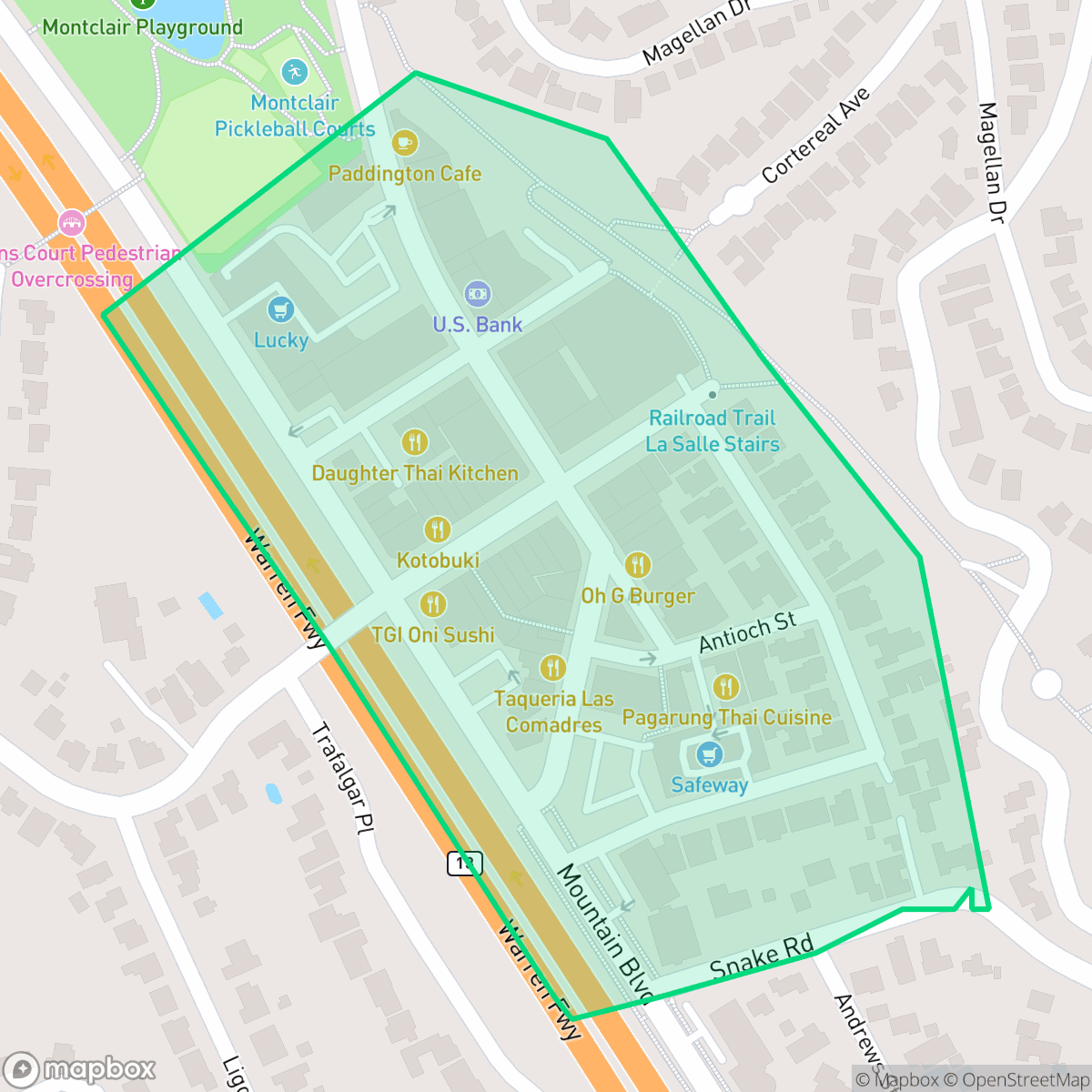
About Montclair Business
Originally the site of the 19th-century Medau Ranch and Dairy, the Montclair Business neighborhood (now known as Montclair Village) was established in 1925 when the Realty Syndicate Company developed the Montclair Business Center. The commercial district grew rapidly around a flagstop on the Sacramento Northern Railway. It is celebrated for its distinctive storybook and Bavarian-style architecture. Notable landmarks include the historic 1927 Montclair Firehouse and the 1930 Montclair Library branch, both designed in a whimsical "Hansel and Gretel" or English cottage style. Today, the pedestrian-friendly neighborhood serves as a vibrant commercial hub nestled in the wooded Oakland Hills, defined by its local shops, cafes, and historic charm.
This commercial district serves as a central gathering point for the surrounding hills, featuring a variety of local dining options such as Daughter Thai Kitchen and Kakui Sushi alongside daily essentials like Peet's Coffee. The neighborhood maintains a distinct aesthetic character with well-preserved historic structures, creating a pleasant environment for residents and visitors alike. Its layout encourages foot traffic, making it a convenient destination for those who prefer to complete errands without constant reliance on a vehicle.
While the area scores highly for health insurance coverage and visual appeal, prospective residents should consider specific environmental and institutional factors. The neighborhood faces significant challenges regarding fire and flood safety, which are common concerns within this part of the Oakland Hills. Additionally, the local school district currently faces substantial budgetary and organizational instability. Those seeking a home here will find a community that prioritizes local commerce and outdoor access, though the ambient noise from nearby highway traffic and the regional school climate are important trade-offs to evaluate.
Neighborhood Scores Across 15 Qualities
Large lots with significant separation between properties provide much more privacy than the Oakland average. According to iHuus data, residents can expect more secluded living spaces compared to the more densely packed citywide norm.
Sidewalks are only present on one side of many streets, and pedestrian accessibility is notably lower than the Oakland average. While safe crossings are available, the area is less walkable than most parts of the city.
Large residences and frequent upscale amenities contribute to a highly aesthetic environment. According to iHuus data, the visual quality of this area is notably higher than the Oakland average.
Accessible green spaces and wide, traffic-safe paths make this area highly suitable for pet owners. According to iHuus data, the level of pet-friendly infrastructure is significantly higher than the Oakland average.
Frequent open land and scattered homes amidst woodland provide a more rural atmosphere than much of Oakland. According to iHuus data, this area features significantly more undeveloped space and greenery compared to the city average.
A balanced mix of dining and essential services exists alongside quieter residential blocks, though the overall activity level is slightly below the Oakland average. According to iHuus data, the area offers a calm atmosphere with notable pockets of amenities near major transit corridors.
Frequent sound from nearby freeways and rail lines contributes to a noisy environment. This level of acoustic disturbance is slightly higher than the Oakland average, according to iHuus data.
Air quality remains consistently high with rare instances of elevated readings. According to iHuus data, this level of air purity is roughly equivalent to the Oakland average.
Industrial activity and hazardous facilities are absent from this area, making it more residential in character than the Oakland average. According to iHuus data, the neighborhood consists only of residential streets and light commercial zones with no detected warehouses or industrial sites.
Health insurance enrollment is exceptionally high among residents here, significantly outpacing the Oakland average according to iHuus data.
Voting patterns and census indicators show a deeply liberal political leaning that is consistent with the rest of Oakland.
Residents live alongside a varied mix of young adults, families, and seniors. According to iHuus data, this demographic spread is more balanced than the average found throughout Oakland.
Flood risk in this area is higher than the Oakland average, though a detailed FEMA study has not yet been completed for this specific location. Residents should remain aware of potential vulnerabilities during heavy rain events according to iHuus data.
Address-Level Insights for Montclair Business


iHuus Neighborhood Intelligence Insights
Get address-level neighborhood insights for Montclair Business
- Street-level scores — see how individual blocks compare, not just neighborhood averages
- Micro-zone boundaries — identify quiet pockets, flood boundaries, and walkable clusters before you visit
- 15 dimensions in full — walkability, noise, air quality, school quality, insurance coverage, population age profile, urban/rural index, and more
- Boundary risk alerts — know if your address sits near a block boundary where scores drop, the kind of detail no listing will ever mention
- School insights — individual school ratings and insights, not just district-level data
- Compare before you commit — side-by-side data across neighborhoods, down to block precision
No credit card required
Compare with Any Neighborhood
| Dimension | Montclair Business | Acorn |
|---|---|---|
| 🚶 Walkabilityavg 8.99 | ||
| 🔊 Acoustic Comfortavg 3.24 | ||
| 🤫 Privacy Indexavg 3.74 | ||
| 🎨 Visual Appealavg 6.28 | ||
| 🐕 Dog Friendlinessavg 5.74 | ||
| 🗺️ Urban-Rural Indexavg 6.02 | ||
| ✨ Neighborhood Vibeavg 5.22 | ||
| 🏥 Health Insurance Coverageavg 7.4 | ||
| 🌿 Air Qualityavg 8.06 | ||
| 🏭 Industrial Proximityavg 8.37 | ||
| 🌊 Flood Safetyavg 2.61 | ||
| 🗳️ Ideological Leanavg 9.95 | ||
| 👥 Population Age Profileavg 4.92 | ||
| 🔥 Fire Safetyavg 0.17 | ||
| 🏫 School Quality |
Montclair Business Rankings
School Districts Serving Montclair Business
School Insights for Montclair Business
Below average outcomes; significant attendance and academic challenges.
School Insights
See what's really behind every school rating near Montclair Business
- Individual school ratings — each school's own score with outcome context, not just a district average
- Enrollment & class size data — student-to-teacher ratio and how it compares to the state average
- Full demographics breakdown — ethnicity and gender composition for every school in the enrollment zone
- Every school in the district — all schools within the enrollment boundary ranked by rating, not just the closest one
- Grade levels & benchmarks — elementary through high school, with below/above state-average flags
No credit card required