Millsmont, Oakland
Updated · 4,032 residents
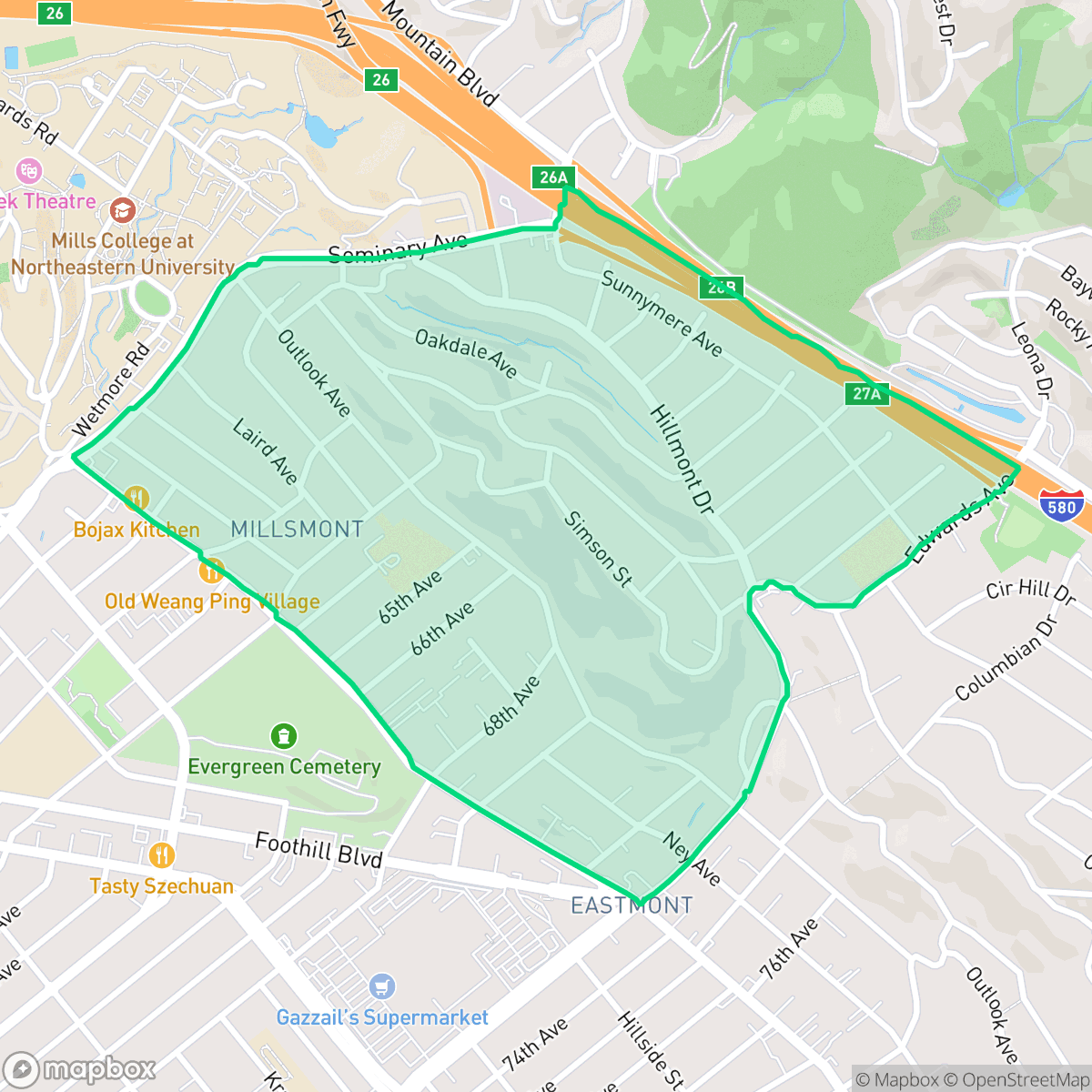
Millsmont is a dense, highly walkable residential enclave in the East Oakland foothills known for its hilly terrain and proximity to Mills College. While the area offers convenient access to local amenities and a vibrant community atmosphere, residents should be prepared for tightly packed housing with limited privacy and consistent ambient noise from nearby road traffic.
Key Highlights
About Millsmont
Located in the foothills of East Oakland adjacent to Mills College, Millsmont originated around the turn of the 20th century as a heavily wooded weekend resort for San Franciscans. Originally part of the Simpson Ranch, 1920s subdivision maps designated the area "Chimes Terrace" because the lots sat within hearing range of the Mills College campanile chimes. For $500, buyers could purchase quarter-acre plots complete with materials for simple one-bedroom cabins. Following the devastating 1906 San Francisco earthquake, many displaced families permanently relocated to these properties, gradually expanding the rustic structures into full-time homes. A rare, unaltered example of these early cabins still stands at the corner of Edgemoor Place and Sunnymere Avenue. Today, Millsmont remains a distinct, eclectic residential enclave defined by its steep topography, historic home stock, and panoramic views of the San Francisco Bay.
The neighborhood functions as a dense suburban environment that balances residential life with institutional and commercial access. It features a robust sidewalk network that makes navigating the local grid efficient for pedestrians. The area maintains a lively local vibe with various neighborhood eateries and community spaces, supported by its strategic location near the Mills College campus. Prospective residents should weigh the benefits of the area against specific livability trade-offs. The housing stock is characterized by close proximity between structures, resulting in lower levels of residential privacy. Additionally, the neighborhood experiences notable road traffic noise, and potential buyers should be aware of regional challenges regarding fire safety and the academic performance of the local school district. It is best suited for those who prioritize neighborhood connectivity and walkability over expansive private outdoor space.
Neighborhood Scores Across 15 Qualities
Residential lots feature closely spaced homes with minimal separation between properties. This level of density is typical for the area and aligns closely with the overall Oakland average according to iHuus data.
A comprehensive sidewalk network and pedestrian-priority areas make much of the neighborhood easy to traverse on foot. This level of accessibility for errands and park access is on par with the rest of Oakland.
Residential streetscapes consist primarily of standard housing with limited private amenities; however, the overall visual quality remains slightly above the Oakland average according to iHuus data.
Access to large parks, cemetery grounds, and campus greens provides ample space for pets, making the area more dog friendly than much of Oakland. While many residential streets feature narrow sidewalks, the proximity to significant green spaces offers plenty of walking opportunities according to iHuus data.
Frequent open land and scattered homes among woodland areas provide a more semi-rural feel than much of Oakland. According to iHuus data, this area features more open space and lower density compared to the city average.
Local social hubs and dining options are present throughout the area, providing a more active atmosphere than the Oakland average. While some residential pockets remain quiet and suburban, there is a notable concentration of community and leisure spots according to iHuus data.
Frequent noise from nearby freeways and railroad tracks characterizes this area. According to iHuus data, acoustic comfort levels are slightly below the Oakland average.
Air quality remains generally clear with only rare instances of elevated readings, though levels are slightly lower than the Oakland average according to iHuus data.
Industrial activity and heavy warehouses are entirely absent from this area. According to iHuus data, the neighborhood maintains a much cleaner residential profile than the Oakland average.
Health insurance enrollment among residents is notably higher than the Oakland average, according to iHuus data.
Voting patterns and census indicators show a predominately liberal political leaning that is slightly more pronounced than the Oakland average, according to iHuus data.
Residents live alongside a diverse mix of young adults, families, and seniors. This age distribution is largely consistent with the broader Oakland area, according to iHuus data.
Flood risk levels remain undetermined because a detailed study has not been completed for this area; however, the risk is notably higher than the Oakland average according to iHuus data.
Address-Level Insights for Millsmont


iHuus Neighborhood Intelligence Insights
Get address-level neighborhood insights for Millsmont
- Street-level scores — see how individual blocks compare, not just neighborhood averages
- Micro-zone boundaries — identify quiet pockets, flood boundaries, and walkable clusters before you visit
- 15 dimensions in full — walkability, noise, air quality, school quality, insurance coverage, population age profile, urban/rural index, and more
- Boundary risk alerts — know if your address sits near a block boundary where scores drop, the kind of detail no listing will ever mention
- School insights — individual school ratings and insights, not just district-level data
- Compare before you commit — side-by-side data across neighborhoods, down to block precision
No credit card required
Compare with Any Neighborhood
| Dimension | Millsmont | Acorn |
|---|---|---|
| 🚶 Walkabilityavg 8.99 | ||
| 🔊 Acoustic Comfortavg 3.24 | ||
| 🤫 Privacy Indexavg 3.74 | ||
| 🎨 Visual Appealavg 6.28 | ||
| 🐕 Dog Friendlinessavg 5.74 | ||
| 🗺️ Urban-Rural Indexavg 6.02 | ||
| ✨ Neighborhood Vibeavg 5.22 | ||
| 🏥 Health Insurance Coverageavg 7.4 | ||
| 🌿 Air Qualityavg 8.06 | ||
| 🏭 Industrial Proximityavg 8.37 | ||
| 🌊 Flood Safetyavg 2.61 | ||
| 🗳️ Ideological Leanavg 9.95 | ||
| 👥 Population Age Profileavg 4.92 | ||
| 🔥 Fire Safetyavg 0.17 | ||
| 🏫 School Quality |
Millsmont Rankings
School Districts Serving Millsmont
School Insights for Millsmont
Below average outcomes; significant attendance and academic challenges.
School Insights
See what's really behind every school rating near Millsmont
- Individual school ratings — each school's own score with outcome context, not just a district average
- Enrollment & class size data — student-to-teacher ratio and how it compares to the state average
- Full demographics breakdown — ethnicity and gender composition for every school in the enrollment zone
- Every school in the district — all schools within the enrollment boundary ranked by rating, not just the closest one
- Grade levels & benchmarks — elementary through high school, with below/above state-average flags
No credit card required