Mills College, Oakland
Updated · 1,310 residents
Centered around its historic campus, this neighborhood offers a scenic, dog-friendly environment with high visual appeal and abundant green space. While the area maintains a quiet residential character, prospective residents should note that it experiences significant noise from nearby road traffic and faces challenges regarding local school district stability and environmental safety risks.
Key Highlights
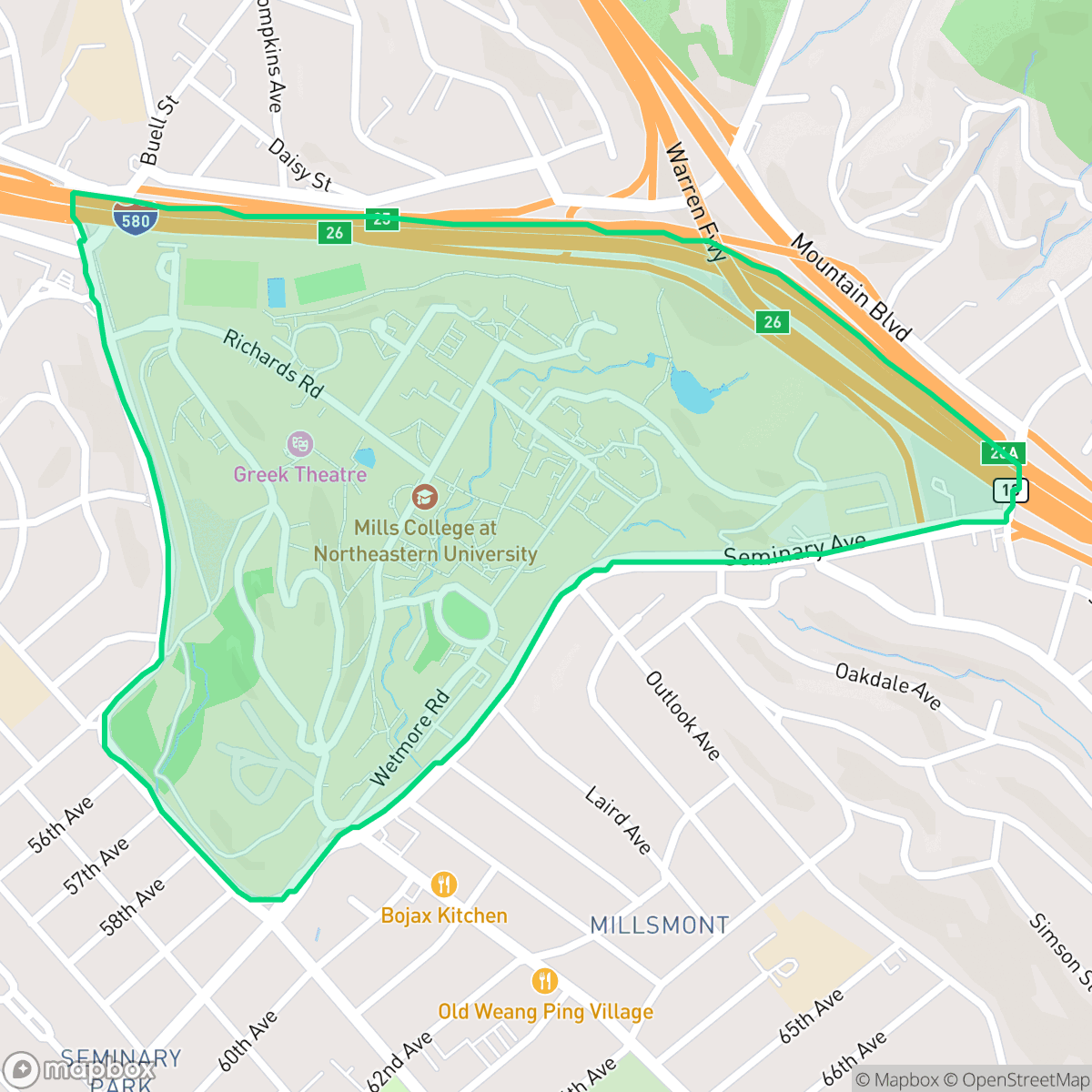
About Mills College
The Mills College neighborhood, historically known as the Seminary district, owes its name and origins to the 1871 relocation of the Young Ladies' Seminary (later Mills College) from Benicia. Seminary Avenue originally served as the primary route connecting the bayshore to the campus. In the early 20th century, the surrounding area developed through subdivisions like Beulah Heights (annexed in 1909) and Mills Gardens (1924), which was built on the college’s former "old meadow". The neighborhood's architectural identity is anchored by the historic 135-acre campus, featuring the French Second Empire-style Mills Hall (1871) and several landmark structures designed by pioneering architect Julia Morgan, including the Spanish Mission-style El Campanil bell tower (1904), believed to be the first freestanding concrete bell tower on a U.S. campus.
The area is defined by its lush, park-like atmosphere and strong residential character, providing a peaceful retreat from the denser parts of Oakland. Residents benefit from high levels of health insurance coverage and a notably progressive local culture. The presence of historic college grounds contributes to the neighborhood's high visual appeal, making it an attractive option for those seeking a suburban feel within city limits, supported by a layout that is both walkable and notably free from industrial encroachment.
Living in this community requires balancing these aesthetic benefits with several practical trade-offs. The neighborhood contends with high levels of road traffic noise, which impacts acoustic comfort, and it is located in a zone with elevated flood and fire safety risks. Additionally, families should be aware that the local school district is currently managing significant budget and administrative instability, which may influence long-term educational planning for those with school-aged children.
Neighborhood Scores Across 15 Qualities
Residential spacing is mixed, offering more separation between neighbors than is typical for Oakland. While some properties feature close proximity with shared property lines, there is generally more buffer between homes than the city average.
Pedestrian-friendly infrastructure is a hallmark of this area, featuring a dense street grid with wide sidewalks on both sides of most roads. According to iHuus data, the availability of marked crosswalks and campus access makes this neighborhood even more walkable than the Oakland average.
Residential views consist primarily of standard single-family homes on small lots with consistent architectural patterns. According to iHuus data, the visual landscape is slightly more varied than the typical Oakland neighborhood.
Abundant green spaces, including campus grounds and nearby parks, offer ample room for pets. Wide paths and a lack of heavy traffic make this area significantly more dog friendly than the Oakland average, according to iHuus data.
Open land and woodland are common throughout this area, providing a more spacious landscape than the denser urban environment typical of the rest of Oakland. According to iHuus data, the mix of institutional campus grounds and scattered homes creates a less built-up atmosphere than the city average.
A blend of quiet residential streets and lively social pockets exists here, offering a moderate selection of dining and amenities that is slightly above the Oakland average. While some areas near the highway are sparse and remote, other blocks feature accessible cafes and green spaces.
Steady traffic sounds from nearby busy streets are present; however, acoustic comfort remains higher than the Oakland average according to iHuus data.
Air quality remains mostly clean with rare instances of elevated readings. This level of air purity is very similar to the average seen across Oakland.
Residential and institutional spaces dominate this area, with no warehouses or heavy industrial hazards detected. This lack of industrial proximity is notably higher than the Oakland average, according to iHuus data.
Health insurance access is exceptionally high among residents, significantly surpassing the Oakland average according to iHuus data.
Voting patterns and census indicators reflect a deeply liberal community, closely mirroring the broader political landscape of Oakland.
A diverse range of age groups lives here, including young adults, families, and seniors. This distribution is roughly in line with the average seen across Oakland, according to iHuus data.
Located within a coastal high-hazard zone, this area is subject to significant wave action and much higher flood risk than the Oakland average. Residents should anticipate elevated or potentially prohibitive flood insurance costs according to iHuus data.
Address-Level Insights for Mills College


iHuus Neighborhood Intelligence Insights
Get address-level neighborhood insights for Mills College
- Street-level scores — see how individual blocks compare, not just neighborhood averages
- Micro-zone boundaries — identify quiet pockets, flood boundaries, and walkable clusters before you visit
- 15 dimensions in full — walkability, noise, air quality, school quality, insurance coverage, population age profile, urban/rural index, and more
- Boundary risk alerts — know if your address sits near a block boundary where scores drop, the kind of detail no listing will ever mention
- School insights — individual school ratings and insights, not just district-level data
- Compare before you commit — side-by-side data across neighborhoods, down to block precision
No credit card required
Compare with Any Neighborhood
| Dimension | Mills College | Acorn |
|---|---|---|
| 🚶 Walkabilityavg 8.99 | ||
| 🔊 Acoustic Comfortavg 3.24 | ||
| 🤫 Privacy Indexavg 3.74 | ||
| 🎨 Visual Appealavg 6.28 | ||
| 🐕 Dog Friendlinessavg 5.74 | ||
| 🗺️ Urban-Rural Indexavg 6.02 | ||
| ✨ Neighborhood Vibeavg 5.22 | ||
| 🏥 Health Insurance Coverageavg 7.4 | ||
| 🌿 Air Qualityavg 8.06 | ||
| 🏭 Industrial Proximityavg 8.37 | ||
| 🌊 Flood Safetyavg 2.61 | ||
| 🗳️ Ideological Leanavg 9.95 | ||
| 👥 Population Age Profileavg 4.92 | ||
| 🔥 Fire Safetyavg 0.17 | ||
| 🏫 School Quality |
Mills College Rankings
School Districts Serving Mills College
School Insights for Mills College
Below average outcomes; significant attendance and academic challenges.
School Insights
See what's really behind every school rating near Mills College
- Individual school ratings — each school's own score with outcome context, not just a district average
- Enrollment & class size data — student-to-teacher ratio and how it compares to the state average
- Full demographics breakdown — ethnicity and gender composition for every school in the enrollment zone
- Every school in the district — all schools within the enrollment boundary ranked by rating, not just the closest one
- Grade levels & benchmarks — elementary through high school, with below/above state-average flags
No credit card required